


The Adverse Outcome Pathway: A Multifaceted Framework Supporting 21st Century Toxicology
- PMID: 29682628
- PMCID: PMC5906804
- DOI: 10.1016/j.cotox.2018.03.004
The Adverse Outcome Pathway: A Multifaceted Framework Supporting 21st Century Toxicology
Abstract
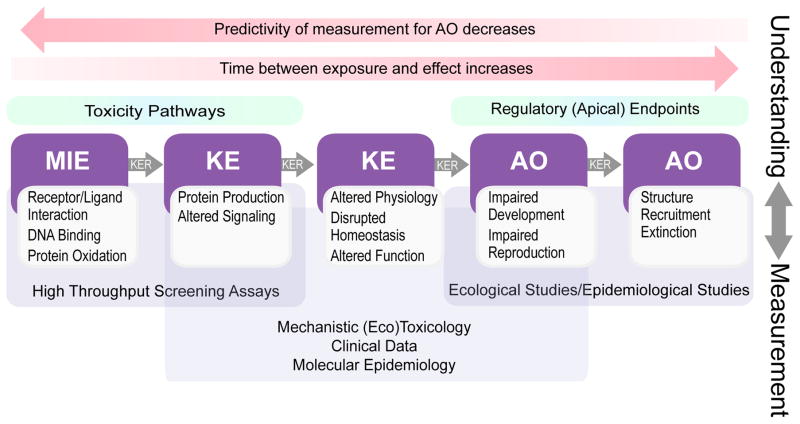
The adverse outcome pathway (AOP) framework serves as a knowledge assembly, interpretation, and communication tool designed to support the translation of pathway-specific mechanistic data into responses relevant to assessing and managing risks of chemicals to human health and the environment. As such, AOPs facilitate the use of data streams often not employed by risk assessors, including information from in silico models, in vitro assays and short-term in vivo tests with molecular/biochemical endpoints. This translational capability can increase the capacity and efficiency of safety assessments both for single chemicals and chemical mixtures. Our mini-review describes the conceptual basis of the AOP framework and aspects of its current status relative to use by toxicologists and risk assessors, including four illustrative applications of the framework to diverse assessment scenarios.
Keywords: Adverse Outcome Pathway; Chemical Assessment; Environment; Human Health.
Conflict of interest statement
AUTHOR DECLARATION TEMPLATE We wish to confirm that there are no known conflicts of interest ass ociated with this publication and there has been no significant financial support for this work that could have influenced its outcome. We confirm that the manuscript has been read and approved by all named authors and that there are no other persons who satisfied the criteria for authorship but are not listed. We further confirm that the order of authors listed in the manuscript has been approved by all of us. We confirm that we have given due consideration to the protection of intellectual property associated with this work and that there are no impediments to publication, including the timing of publication, with respect to intellectual property. In so doing we confirm that we have followed the regulations of our institutions concerning intellectual property.
Figures
References
-
- European Commission. Regulation (EC) 1907/2006 of the European Parliament and of the Council of 18 December 2006 concerning the registration, evaluation, authorisation and restriction of chemicals (REACH), establishing a European Chemicals Agency, amending Directive 1999/45/EC and repealing Council Regulation (EEC) 793/93 and Commission Regulation (EC) No. 1488/94 as well as Council Directive 76/769/EEC and Commission Directives 91/155/EEC, 93/67/EEC, 93/105/EC and 2000/21/EC. Official J Eur Union. 2006;L396:374–375.
-
- US Congress. The Frank R. Lautenberg Chemical Safety for the 21st Century Act. Pub. L. No. 114–182. 2016 Jun 22; Available from: https/ www.epa.gov/assessing-and-managing-chemicals-under-tsca/frank-r-lautenbe....
-
- US Environmental Protection Agency. [accessed 29.09.17];Great Lakes Restoration Initiative. https://www.glri.us/actionplan/pdfs/glri-action-plan-2.pdf.
-
- National Academy of Sciences (NAS) Toxicity testing in the 21st century: A vision and strategy. National Academies Press; 2007.
-
- Ankley GT, Bennett RS, Erickson RJ, Hoff DJ, Hornung MW, Johnson RD, Mount DR, Nichols JW, Russom CL, Schmieder PK, Serrano JA, Tietge JE, Villeneuve DL. Adverse outcome pathways: A conceptual framework to support ecotoxicology research and risk assessment. Environ Technol Chem. 2010;29:730–741. - PubMed
Grants and funding
LinkOut - more resources
Full Text Sources
Other Literature Sources
Research Materials