. 2018 Aug;132(3):253-267.
doi: 10.1037/com0000103. Epub 2018 Apr 23.

Application of a novel social choice paradigm to assess effects of prenatal endocrine-disrupting chemical exposure in rats (Rattus norvegicus)

Affiliations

Application of a novel social choice paradigm to assess effects of prenatal endocrine-disrupting chemical exposure in rats (Rattus norvegicus)

Michael P Reilly et al. J Comp Psychol. 2018 Aug.

Abstract

Endocrine-disrupting chemical (EDC) exposures during critical periods of gestation cause long-lasting behavioral effects, presumably by disturbing hormonal organization of the brain. Among such EDCs are polychlorinated biphenyls (PCBs), a class of industrial chemicals. PCB exposure in utero leads to alterations in mating behaviors and other sexually dimorphic social interactions in rats. Many of the previous studies on social behavior gave the experimental animal a single or binary choice. This study applied a more complex behavioral apparatus, an X-shaped Plexiglas apparatus (FourPlex), that enabled an experimental animal exposed to PCBs or a vehicle to distinguish and choose among 4 stimulus animals of the same or opposite sex, and of different hormonal status. We found that rats were able to differentiate among the stimuli in the FourPlex and showed the expected preference for an opposite sex, hormone-treated rat, particularly for behaviors conducted in proximity. Prenatal treatment caused subtle shifts in behavior toward stimulus rats in the FourPlex; more robust effects were seen for the sexual dimorphisms in behavior. Importantly, the results differ from our previous results of a simple binary choice model, showing that how an animal behaves in a more complex social paradigm does not predict the outcome in a simple choice model, and vice versa. (PsycINFO Database Record


Figures

Figure 1
Figure 1
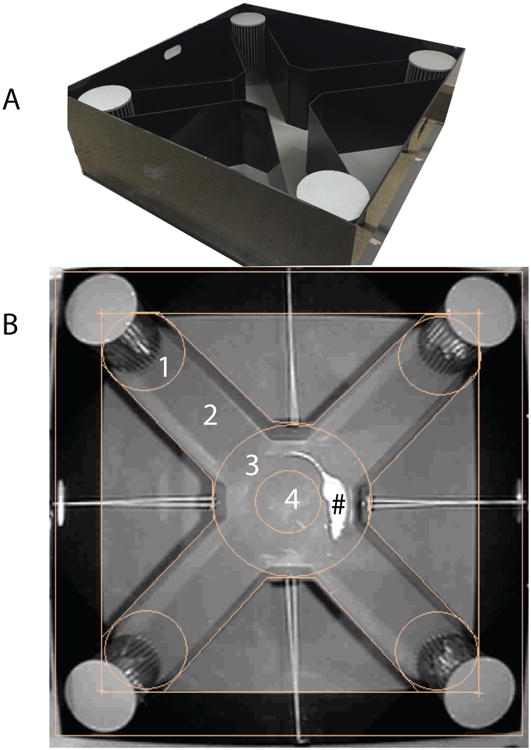
The FourPlex apparatus is shown viewed from one corner (A) and in a bird's eye view (B). Four opaque Plexiglas inserts were fabricated to fit inside of a square apparatus (100 cm × 100cm), resulting in an X-shaped testing arena. As seen in B, each of the four arms emanated from a common central area (outer circle labeled “3”) that projected via four arms to a holding cage in each corner. For the purposes of behavioral analyses, each arm was further divided into two distinct regions: a zone one body length from the walls of the stimulus cage (1; the “near” region), and the remaining length of the arm (2; the “remote” region). At the onset of the test, the experimental rat (indicated by #) was placed into the innermost center circle, labeled “4.”
Figure 2
Figure 2
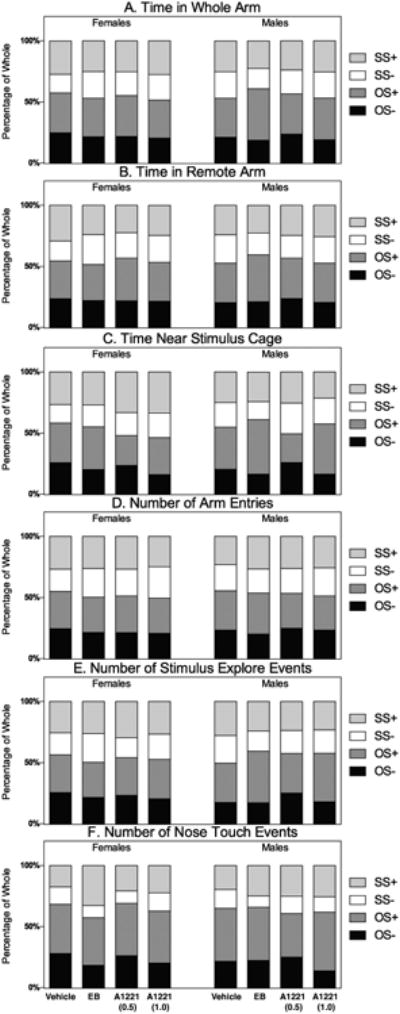
The contribution each stimulus choice had on the behavioral output is shown for the six variables measured. Data are shown separately for each of the four treatment groups in females and males. Bars are always set at 100%, and the percentage of time each behavior is displayed toward each of the stimulus categories is shown. This enables visualization that most behaviors are predominantly exhibited towards the opposite-sex hormone-treated rat, which is the most socially salient, and validates that the FourPlex enables animals to make this distinction. Terminology here and throughout the manuscript is OS-: opposite-sex castrated rat (no hormone); OS+: opposite-sex castrated rat given hormone (estradiol in females, testosterone in males); SS-: same-sex castrated rat, no hormone; and SS+: same-sex castrated rat, given hormone.
Figure 3
Figure 3
Time Spent in the Whole Arm, an appetitive behavior, is shown for females (left), males (middle), and the sex difference (right) as functional landscapes. For each sex, the height of each peak shows the absolute amount of time spent in the arm (seconds). For the sex difference, the y-axis shows the time differential, with an upward peak indicating F > M, and a downward valley indicating M > F.The only landscape profile that differed significantly between the sexes was the EB group. The positions of the four stimulus choices in each landscape are indicated by the inset.
Figure 4
Figure 4
Number of Nose Touch Events (consummatory behavior) is shown for females (left), males (center), and the sex difference (right). Labels and analysis are the same as in Figure 3.A sex difference was found only for the A1221 (0.5) group.

References

    1. Bakker J. Sexual differentiation of the neuroendocrine mechanisms regulating mate recognition in mammals. Journal of Neuroendocrinology. 2003;15(6):615–621. doi: 10.1046/j.1365-2826.2003.01099.x. - DOI - PubMed
    1. Bell MR, Thompson LM, Rodriguez K, Gore AC. Two-hit exposure to polychlorinated biphenyls at gestational and juvenile life stages: 1. Sexually dimorphic effects on social and anxiety-like behaviors. Hormones and Behavior. 2015;78:168–177. doi: 10.1016/j.yhbeh.2015.11.007. - DOI - PMC - PubMed
    1. Belloni V, Dessì-Fulgheri F, Zaccaroni M, Di Consiglio E, De Angelis G, Testai E, Santochirico M, Alleva E, Santucci D. Early exposure to low doses of atrazine affects behavior in juvenile and adult CD1 mice. Toxicology. 2011;279:19–26. doi: 10.1016/j.tox.2010.07.002. - DOI - PubMed
    1. Carson HL. Mate choice theory and the mode of selection in sexual populations. Proceedings of the National Academy of Sciences. 2003;100(11):6584–6587. doi: 10.1073/pnas.0732174100. - DOI - PMC - PubMed
    1. Crews D, Gillette R, Scarpino SV, Manikkam M, Savenkova MI, Skinner MK. Epigenetic transgenerational inheritance of altered stress responses. Proceedings of the National Academy of Sciences. 2012;109(24):9143–9148. doi: 10.1073/pnas.1118514109. - DOI - PMC - PubMed

Publication types

Substances