


Decision Making for Healthcare Resource Allocation: Joint v. Separate Decisions on Interacting Interventions
- PMID: 29683792
- PMCID: PMC5949981
- DOI: 10.1177/0272989X18758018
Decision Making for Healthcare Resource Allocation: Joint v. Separate Decisions on Interacting Interventions
Abstract
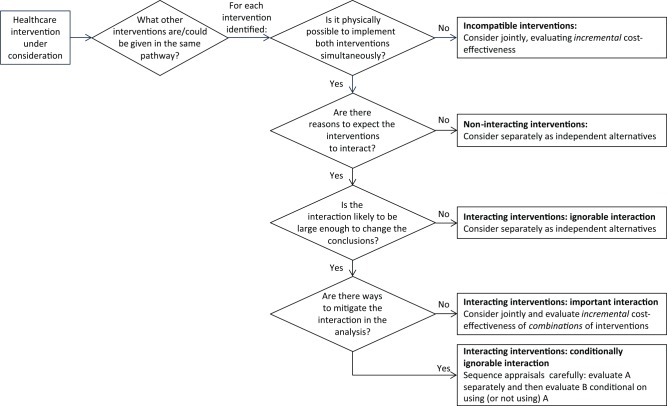
Standard guidance for allocating healthcare resources based on cost-effectiveness recommends using different decision rules for independent and mutually exclusive alternatives, although there is some confusion around the definition of "mutually exclusive." This paper reviews the definitions used in the literature and shows that interactions (i.e., non-additive effects, whereby the effect of giving 2 interventions simultaneously does not equal the sum of their individual effects) are the defining feature of mutually exclusive alternatives: treatments cannot be considered independent if the costs and/or benefits of one treatment are affected by the other treatment. The paper then identifies and categorizes the situations in which interventions are likely to have non-additive effects, including interventions targeting the same goal or clinical event, or life-saving interventions given to overlapping populations. We demonstrate that making separate decisions on interventions that have non-additive effects can prevent us from maximizing health gained from the healthcare budget. In contrast, treating combinations of independent options as though they were "mutually exclusive" makes the analysis more complicated but does not affect the conclusions. Although interactions are considered by the World Health Organization, other decision makers, such as the National Institute for Health and Care Excellence (NICE), currently make independent decisions on treatments likely to have non-additive effects. We propose a framework by which interactions could be considered when selecting, prioritizing, and appraising healthcare technologies to ensure efficient, evidence-based decision making.
Keywords: cost-effectiveness; economic evaluation; health technology assessment; healthcare decision making; interactions.
Conflict of interest statement
The author(s) declared no potential conflicts of interest with respect to the research, authorship, and/or publication of this article.
Figures
References
-
- Drummond MF, Sculpher MJ, Claxton K, Stoddart GL, Torrance GW. Methods for the Economic Evaluation of Health Care Programmes. 4th ed. New York: Oxford University Press; 2015.
-
- Gray A, Clarke P, Wolstenholme J, Wordsworth S. Applied Methods of Cost-Effectiveness Analysis in Health Care. Gray A, Briggs A. eds. Oxford: Oxford University Press; 2011.
-
- Hunink M, Glasziou P, Siegel J, et al. Decision Making in Health and Medicine: Integrating Evidence and Values. Cambridge, UK: Cambridge University Press; 2001.
-
- Johannesson M. On the estimation of cost-effectiveness ratios. Health Policy. 1995;31:225–229. - PubMed
-
- Johannesson M. A note on the depreciation of the societal perspective in economic evaluation of health care. Health Policy. 1995;33:59–66. - PubMed
Publication types
MeSH terms
Grants and funding
LinkOut - more resources
Full Text Sources
Other Literature Sources
