


A week-48 randomized phase-3 trial of darunavir/cobicistat/emtricitabine/tenofovir alafenamide in treatment-naive HIV-1 patients
- PMID: 29683855
- PMCID: PMC6039393
- DOI: 10.1097/QAD.0000000000001817
A week-48 randomized phase-3 trial of darunavir/cobicistat/emtricitabine/tenofovir alafenamide in treatment-naive HIV-1 patients
Abstract
Objectives: To investigate efficacy and safety of a single-tablet regimen of darunavir/cobicistat/emtricitabine/tenofovir alafenamide (D/C/F/TAF) 800/150/200/10 mg vs. darunavir/cobicistat plus emtricitabine/tenofovir disoproxyl fumarate (TDF) (control) in antiretroviral-treatment-naive, HIV-1-infected adults.
Design: Phase-3, randomized, active-controlled, double-blind, international, multicenter, noninferiority study (NCT02431247).
Methods: Seven hundred and twenty-five participants were randomized (1 : 1) to D/C/F/TAF (362) or control (363). The primary objective was to demonstrate noninferiority of D/C/F/TAF vs. control for percentage viral load less than 50 copies/ml (FDA-snapshot analysis) at 48 weeks (10% margin).
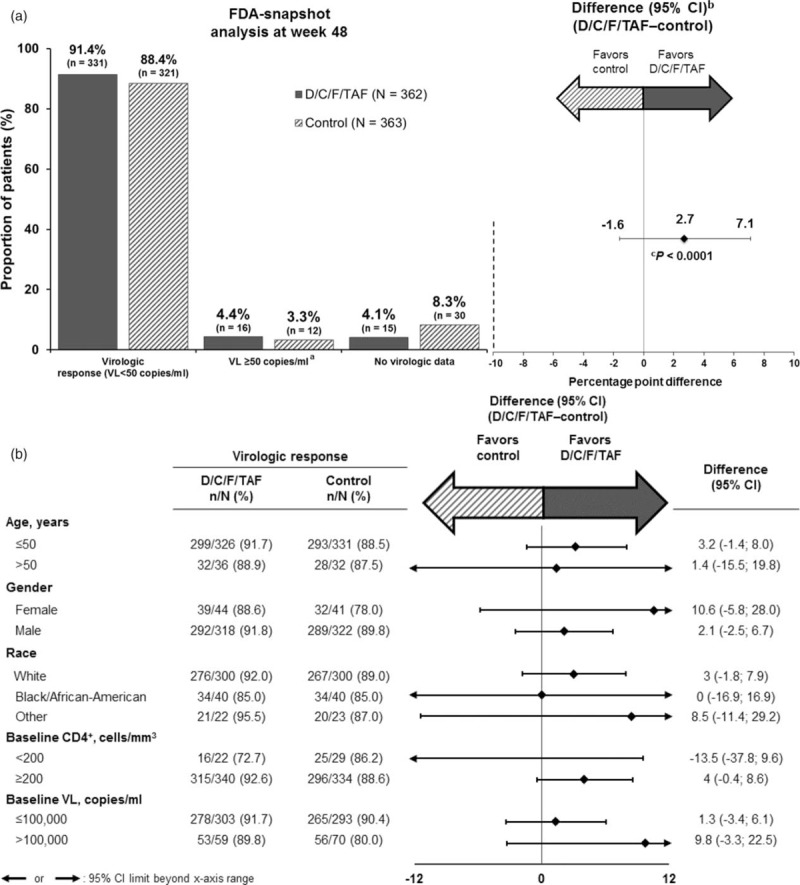
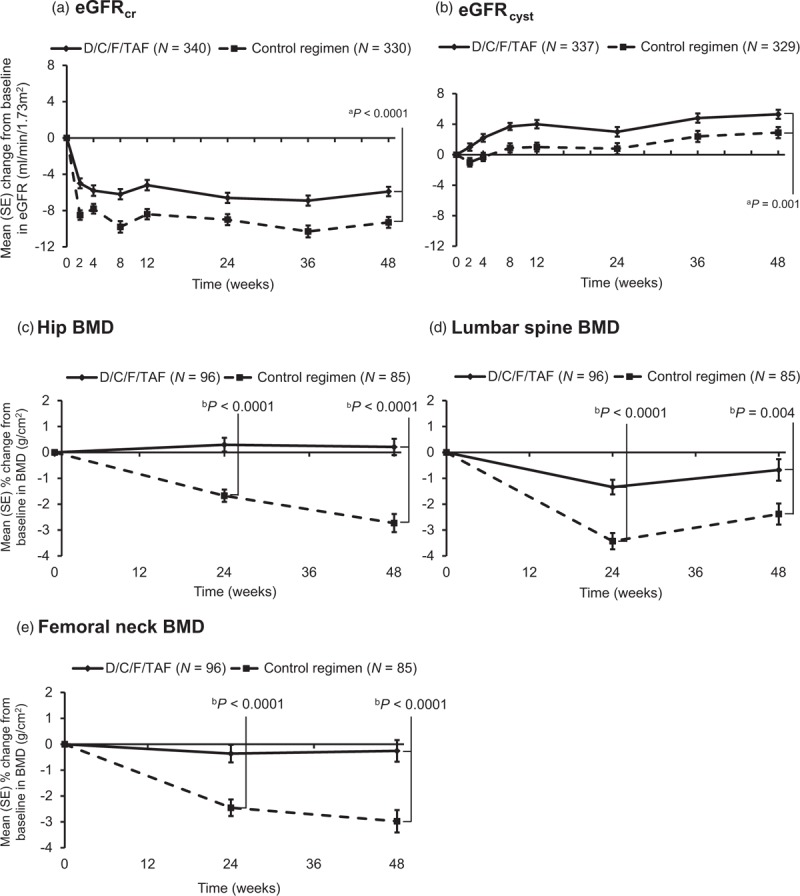
Results: At week 48, D/C/F/TAF was noninferior to control (91.4 vs. 88.4% achieved viral load <50 copies/ml, respectively; difference 2.7%; 95% CI -1.6 to 7.1; P < 0.0001), with 4.4 vs. 3.3% of patients, respectively, having viral load greater or equal to 50 copies/ml. No treatment-emergent mutations associated with darunavir or TAF/TDF resistance were observed in either group. One patient (D/C/F/TAF) was identified with M184I/V conferring resistance to emtricitabine. Incidences of grades 3 and 4 adverse events (5 vs. 6%), serious adverse events (5 vs. 6%) and adverse event-related discontinuations (2 vs. 4%) were low and similar between groups. Mean decrease in urine protein/creatinine ratio was greater with D/C/F/TAF than control (-22.42 vs. -10.34 mg/g, P = 0.033). Mean percentage change in bone mineral density with D/C/F/TAF vs. control was 0.21 vs. -2.73%, P < 0.0001 (hip), -0.68 vs. -2.38%, P = 0.004 (lumbar spine), and -0.26 vs. -2.97%, P < 0.0001 (femoral neck). Median change from baseline in total cholesterol/HDL-cholesterol ratio was 0.20 vs. 0.08, P = 0.036.
Conclusion: D/C/F/TAF achieved a high virologic suppression rate (91.4%) and was noninferior to darunavir/cobicistat with F/TDF. D/C/F/TAF also demonstrated the bone and renal safety advantages of TAF in combination with darunavir/cobicistat.
Figures

References
-
- Cotte L, Ferry T, Pugliese P, Valantin MA, Allavena C, Cabié A, et al. Dat’AIDS Study Group Effectiveness and tolerance of single tablet versus once daily multiple tablet regimens as first-line antiretroviral therapy - results from a large french multicenter cohort study. PLoS One 2017; 12:e0170661. - PMC - PubMed
-
- Orkin C, DeJesus E, Khanlou H, Stoehr A, Supparatpinyo K, Lathouwers E, et al. Final 192-week efficacy and safety of once-daily darunavir/ritonavir compared with lopinavir/ritonavir in HIV-1-infected treatment-naïve patients in the ARTEMIS trial. HIV Med 2013; 14:49–59. - PubMed
-
- Lathouwers E, Wong EY, Luo D, Seyedkazemi S, De Meyer S, Brown K. HIV-1 resistance rarely observed in patients using darunavir once-daily regimens across clinical studies. HIV Clin Trials 2017; 18:196–204. - PubMed
Publication types
MeSH terms
Substances
Associated data
Grants and funding
LinkOut - more resources
Full Text Sources
Other Literature Sources
Medical
