. 2018 May 8;115(19):4987-4991.
doi: 10.1073/pnas.1800650115. Epub 2018 Apr 23.

One prophage WO gene rescues cytoplasmic incompatibility in Drosophila melanogaster

Affiliations

One prophage WO gene rescues cytoplasmic incompatibility in Drosophila melanogaster

J Dylan Shropshire et al. Proc Natl Acad Sci U S A. .

Abstract

Wolbachia are maternally inherited, intracellular bacteria at the forefront of vector control efforts to curb arbovirus transmission. In international field trials, the cytoplasmic incompatibility (CI) drive system of wMel Wolbachia is deployed to replace target vector populations, whereby a Wolbachia-induced modification of the sperm genome kills embryos. However, Wolbachia in the embryo rescue the sperm genome impairment, and therefore CI results in a strong fitness advantage for infected females that transmit the bacteria to offspring. The two genes responsible for the wMel-induced sperm modification of CI, cifA and cifB, were recently identified in the eukaryotic association module of prophage WO, but the genetic basis of rescue is unresolved. Here we use transgenic and cytological approaches to demonstrate that maternal cifA expression independently rescues CI and nullifies embryonic death caused by wMel Wolbachia in Drosophila melanogaster Discovery of cifA as the rescue gene and previously one of two CI induction genes establishes a "Two-by-One" model that underpins the genetic basis of CI. Results highlight the central role of prophage WO in shaping Wolbachia phenotypes that are significant to arthropod evolution and vector control.

Keywords: Drosophila melanogaster; Wolbachia; cytoplasmic incompatibility; prophage WO; rescue.


Conflict of interest statement

Conflict of interest statement: J.D.S. and S.R.B. are listed as inventors on a provisional patent relevant to this work. S.R.B. is a coinventor on two other pending patents related to controlling arthropods.

Figures
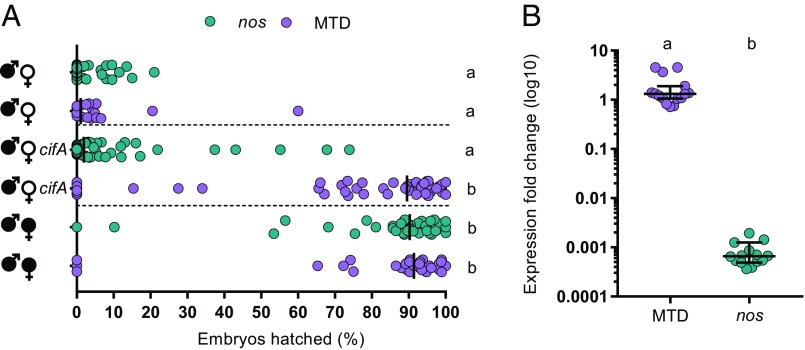
Fig. 1.
Fig. 1.
cifA rescues cytoplasmic incompatibility when it is highly expressed throughout oogenesis. (A) Hatch rate assays were conducted with transgenic expression of cifA under the control of nos-GAL4-tubulin or MTD-GAL4 drivers. Each dot represents a replicate. Rescue occurred only under MTD-GAL4 expression. Horizontal dotted lines from top to bottom separate cross-types with CI, cifA expression, and rescue. Wolbachia infections are represented by filled sex symbols, and expressed genes are noted to the right of the corresponding sex. n = 27–59 for each experimental cross across two experiments (both shown). Vertical bars represent medians, and letters to the right indicate significant differences based on α = 0.05 calculated by Kruskal–Wallis and Dunn’s test for multiple comparisons. (B) Gene expression fold change of cifA relative to the Drosophila housekeeping gene rp49 was determined on a subset of abdomens from females expressing cifA via MTD-GAL4 or nos-GAL4-tubulin with 2−∆∆Ct. Horizontal bars represent medians with 95% confidence intervals, and letters above indicate significance based on a Mann–Whitney U test. In both cases, statistical comparisons are between all groups. Exact P values are provided in Table S2. Hatch rate experiments testing expression of cifA under MTD-GAL4 or nos-GAL4-tubulin have been repeated four and five times, respectively.
Fig. 2.
Fig. 2.
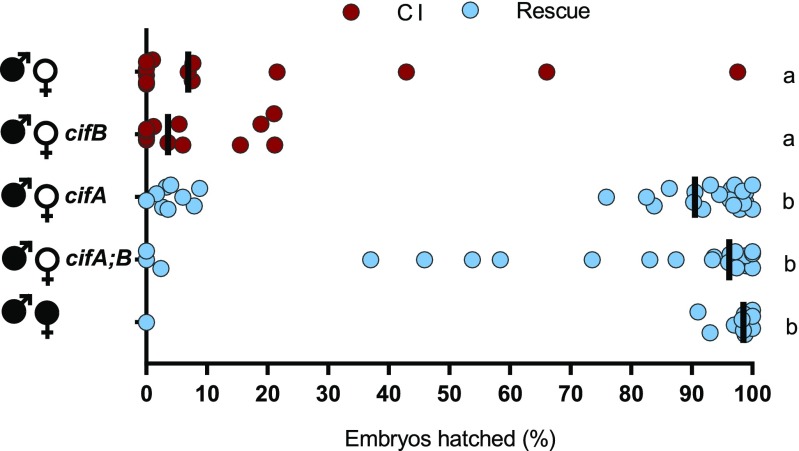
Rescue of cytoplasmic incompatibility is specific to cifA. Hatch rate assays were conducted with transgenic expression of cifA, cifB, and cifA;B using the MTD-GAL4 driver for expression throughout oogenesis. Each dot represents a replicate. Wolbachia infections are represented by filled sex symbols, and expressed genes are noted to the right of the corresponding sex. n = 11–29 for each experimental cross. Vertical bars represent medians, and letters to the right indicate significant differences based on α = 0.05 calculated by Kruskal–Wallis and Dunn’s test for multiple comparisons. Statistical comparisons are between all groups. Exact P values are provided in Table S2. Hatch rate experiments testing expression of cifA under MTD-GAL4 have been repeated four times.
Fig. 3.
Fig. 3.
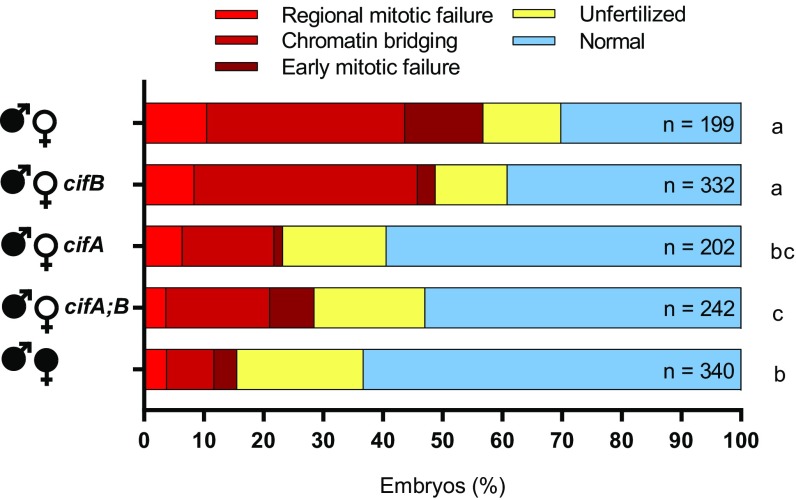
cifA rescues embryonic defects caused by cytoplasmic incompatibility. The percent of embryos with each cytological phenotype resulting from the indicated crosses are shown. All crosses were conducted in parallel and with sisters from the experiment in Fig. 2. cifA, cifB, and cifA;B transgene expression was under the control of MTD-GAL4. Wolbachia infections are represented by filled sex symbols and expressed genes are noted to the right of the corresponding sex. Letters to the right indicate significant differences based on α = 0.05 calculated by pairwise χ2 analyses comparing defects (all shades of red) against normal (blue) with Bonferroni adjusted P values. Exact P values are provided in Table S2. This experiment has been conducted once.
Fig. 4.
Fig. 4.
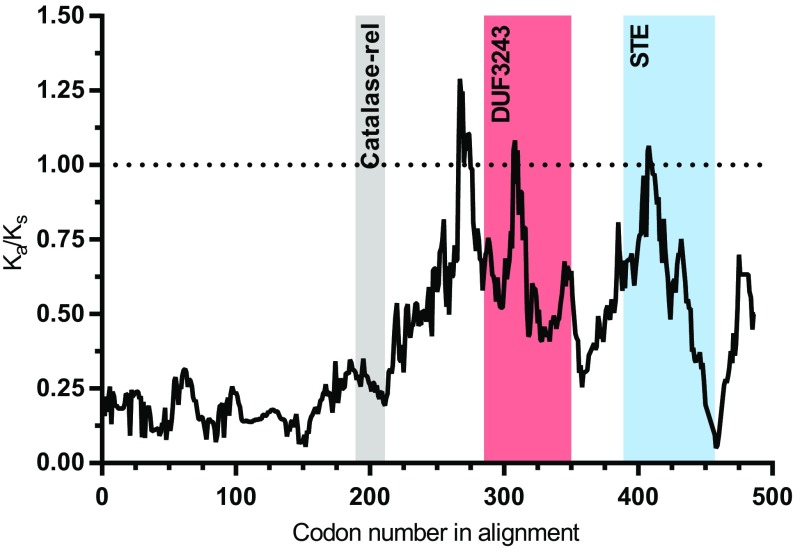
Ka/Ks sliding window analysis identifies cifA regions evolving under negative selection. A comparison between cifA homologs from wMel and wHa rejects the neutral expectation of Ka/Ks = 1 using a 25-amino-acid sliding window across most of cifA. Strong purifying selection is observed in several cifA regions including the sequence preceding the catalase-rel domain. Shaded regions denote previously described protein domain predictions (33).

References

    1. Weinert LA, Araujo-Jnr EV, Ahmed MZ, Welch JJ. The incidence of bacterial endosymbionts in terrestrial arthropods. Proc Biol Sci. 2015;282:20150249. - PMC - PubMed
    1. Zug R, Hammerstein P. Still a host of hosts for Wolbachia: Analysis of recent data suggests that 40% of terrestrial arthropod species are infected. PLoS One. 2012;7:e38544. - PMC - PubMed
    1. Ferri E, et al. New insights into the evolution of Wolbachia infections in filarial nematodes inferred from a large range of screened species. PLoS One. 2011;6:e20843. - PMC - PubMed
    1. Frydman HM, Li JM, Robson DN, Wieschaus E. Somatic stem cell niche tropism in Wolbachia. Nature. 2006;441:509–512. - PubMed
    1. Werren JH, Baldo L, Clark ME. Wolbachia: Master manipulators of invertebrate biology. Nat Rev Microbiol. 2008;6:741–751. - PubMed

Publication types

LinkOut - more resources