. 2018 Jun 26;62(7):e00717-18.
doi: 10.1128/AAC.00717-18. Print 2018 Jul.

Analysis of Clinical Drug-Drug Interaction Data To Predict Magnitudes of Uncharacterized Interactions between Antiretroviral Drugs and Comedications

Affiliations

Analysis of Clinical Drug-Drug Interaction Data To Predict Magnitudes of Uncharacterized Interactions between Antiretroviral Drugs and Comedications

Felix Stader et al. Antimicrob Agents Chemother. .

Abstract

Despite their high potential for drug-drug interactions (DDI), clinical DDI studies of antiretroviral drugs (ARVs) are often lacking, because the full range of potential interactions cannot feasibly or pragmatically be studied, with some high-risk DDI studies also being ethically difficult to undertake. Thus, a robust method to screen and to predict the likelihood of DDIs is required. We developed a method to predict DDIs based on two parameters: the degree of metabolism by specific enzymes, such as CYP3A, and the strength of an inhibitor or inducer. These parameters were derived from existing studies utilizing paradigm substrates, inducers, and inhibitors of CYP3A to assess the predictive performance of this method by verifying predicted magnitudes of changes in drug exposure against clinical DDI studies involving ARVs. The derived parameters were consistent with the FDA classification of sensitive CYP3A substrates and the strength of CYP3A inhibitors and inducers. Characterized DDI magnitudes (n = 68) between ARVs and comedications were successfully quantified, meaning 53%, 85%, and 98% of the predictions were within 1.25-fold (0.80 to 1.25), 1.5-fold (0.66 to 1.48), and 2-fold (0.66 to 1.94) of the observed clinical data. In addition, the method identifies CYP3A substrates likely to be highly or, conversely, minimally impacted by CYP3A inhibitors or inducers, thus categorizing the magnitude of DDIs. The developed effective and robust method has the potential to support a more rational identification of dose adjustment to overcome DDIs, being particularly relevant in an HIV setting, given the treatment's complexity, high DDI risk, and limited guidance on the management of DDIs.

Keywords: CYP3A; HIV infection; antiretroviral drug; comedication; drug-drug interaction.


Figures

FIG 1
FIG 1
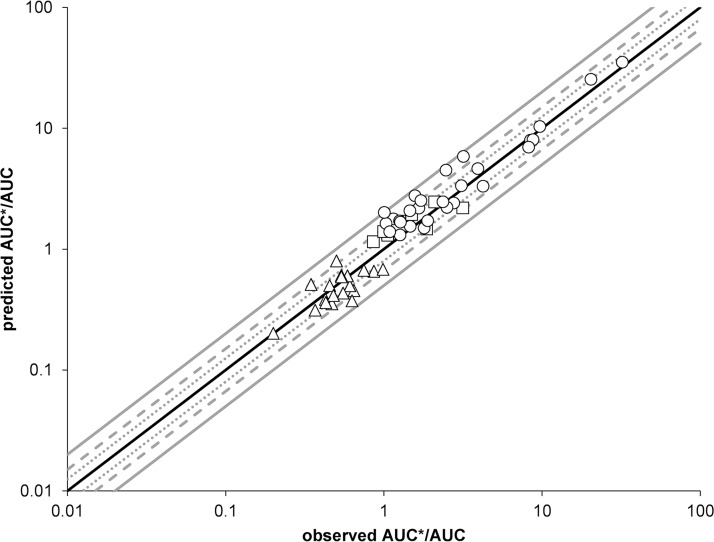
Predicted versus observed AUC ratios for competitive inhibition (open squares), mechanism-based inhibition (open circles), and induction (open triangles). The solid black line is the line of identity, the dotted lines represent the 80% and 125% margins, the dashed lines represent the 66% and 150% margins, and the solid gray lines represent the 50% and 200% margins. The interaction between saquinavir and cimetidine was calculated by using the InR3A of the stronger inhibitor saquinavir rather than that of cimetidine, as explained in Discussion.
FIG 2
FIG 2
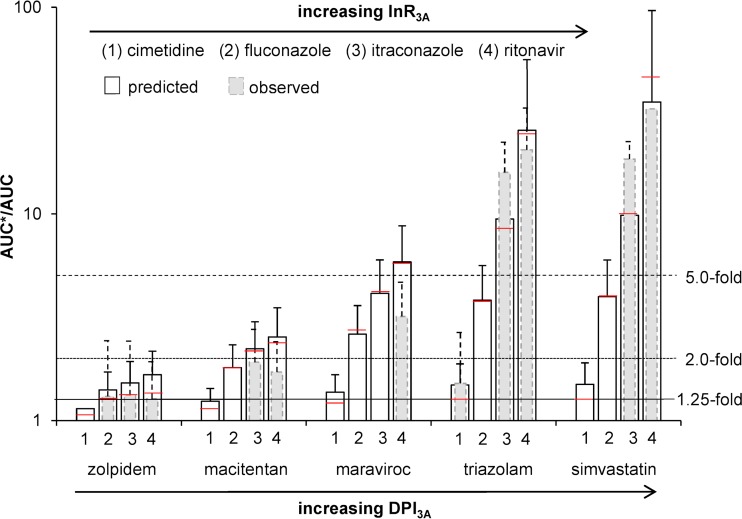
Comparison of predicted (white bars) and observed (gray bars) AUC ratios plus standard deviations for the five victim drugs zolpidem (DPI3A, 0.303 [0.065, 0.661]), macitentan (DPI3A, 0.524 [0.200, 0.810]), maraviroc (DPI3A, 0.792 [0.559, 0.998]), triazolam (DPI3A, 0.966 [0.898, 1.0]), and simvastatin (DPI3A, 0.979 [0.916, 1.0]), administered together with the four CYP3A inhibitors cimetidine (InR3A, 0.256 [0.049, 0.570]), fluconazole (InR3A, 0.700 [0.403, 0.893]), itraconazole (InR3A, 0.877 [0.691, 0.986]), and ritonavir (InR3A, 0.963 [0.873, 1.0]). The red line represents the calculated value without using Monte Carlo predictions. The solid line, the dotted line, and the dashed line represent the 1.25-fold, 2.0-fold, and 5.0-fold increases in the AUC ratio according to the FDA classification of DDI magnitudes (29).
FIG 3
FIG 3
Comparison of the predicted (white bars) and observed (gray bars) AUC ratio plus standard deviations for the two victim drugs with intrinsic inhibitory (ritonavir) and inducing (etravirine) properties administered together with the three CYP3A inhibitors cimetidine (InR3A, 0.256 [0.049, 0.570]), fluconazole (InR3A, 0.700 [0.403, 0.893]), and ketoconazole (InR3A, 0.943 [0.823, 1.0]). The red line represents the calculated value without using Monte Carlo predictions.
FIG 4
FIG 4
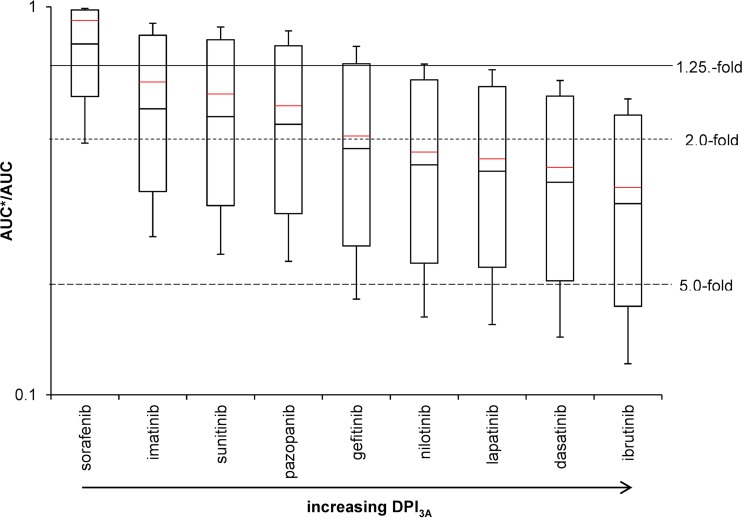
DDI magnitudes between tyrosine kinase inhibitors with increasing DPI3A and the moderate CYP3A inducer etravirine predicted by running 10,000 Monte Carlo simulations. The solid red line shows calculated values without using Monte Carlo predictions. The solid line, the dotted line, and the dashed line represent the 1.25-fold, 2.0-fold, and 5.0-fold increase in the AUC ratio according to the FDA classification of DDI magnitudes (29).
FIG 5
FIG 5
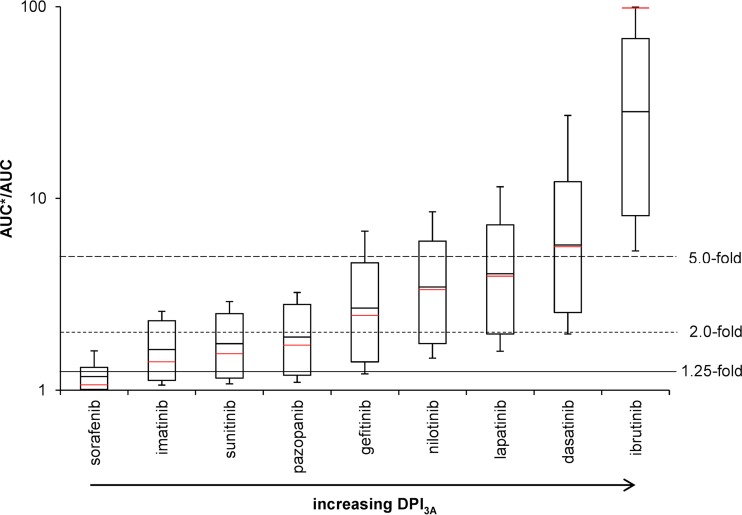
DDI magnitudes between tyrosine kinase inhibitors with increasing DPI3A and the potent CYP3A inhibitor ritonavir predicted by running 10,000 Monte Carlo simulations. The solid red line shows the calculated value without using Monte Carlo predictions. The solid line, the dotted line, and the dashed line represent the 1.25-fold, 2.0-fold, and 5.0-fold increases in the AUC ratio according to the FDA classification of DDI magnitudes (29).
FIG 6
FIG 6
Workflow of the study. DPI3A, fraction of disposition pathway mediated by CYP3A; InR3A, inhibitor ratio; IcR3A, inducer ratio.

References

    1. Warnke D, Barreto J, Temesgen Z. 2007. Antiretroviral drugs. J Clin Pharmacol 47:1570–1579. doi: 10.1177/0091270007308034. - DOI - PubMed
    1. de Wildt SN, Kearns GL, Leeder JS, van den Anker JN. 1999. Cytochrome P450 3A. Clin Pharmacokinet 37:485–505. doi: 10.2165/00003088-199937060-00004. - DOI - PubMed
    1. Barry M, Mulcahy F, Merry C, Gibbons S, Back D. 1999. Pharmacokinetics and potential interactions amongst antiretroviral agents used to treat patients with HIV infection. Clin Pharmacokinet 36:289–304. doi: 10.2165/00003088-199936040-00004. - DOI - PubMed
    1. Marzolini C, Elzi L, Gibbons S, Weber R, Fux C, Furrer H, Chave J-P, Cavassini M, Bernasconi E, Calmy A, Vernazza P, Khoo S, Ledergerber B, Back D, Battegay M. 2010. Prevalence of comedications and effect of potential drug-drug interactions in the Swiss HIV Cohort Study. Antiviral Ther 15:413. doi: 10.3851/IMP1540. - DOI - PubMed
    1. Miller CD, El-Kholi R, Faragon JJ, Lodise TP. 2007. Prevalence and risk factors for clinically significant drug interactions with antiretroviral therapy. Pharmacotherapy 27:1379–1386. doi: 10.1592/phco.27.10.1379. - DOI - PubMed

Publication types

MeSH terms

Substances

LinkOut - more resources