


Influenza-like illness as a trigger for ischemic stroke
- PMID: 29687022
- PMCID: PMC5899905
- DOI: 10.1002/acn3.545
Influenza-like illness as a trigger for ischemic stroke
Abstract
Objective: We hypothesized that ILI is associated with risk of incident stroke, and that the risk would be highest closest in time to the event.
Methods: This case-crossover analysis utilized data obtained from the California State Inpatient Database of the Healthcare Cost and Utilization Project (HCUP). The outcome of interest was ischemic stroke. Exposure was defined as a visit to the emergency department or hospitalization for influenza-like illness (ILI) 365, 180, 90, 30, or 15 days before stroke (risk period) or similar time intervals exactly 1 or 2 years before stroke (control period). Conditional logistic regression was used to calculate the odds ratio and 95% confidence interval (OR, 95% CI).
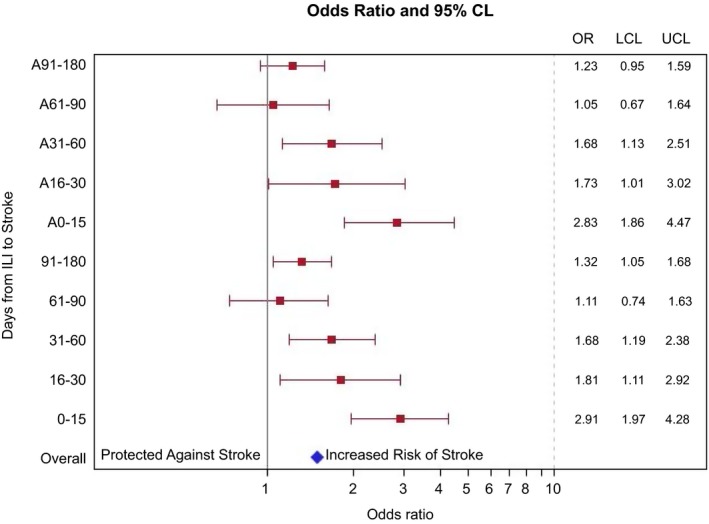
Results: In 2009, 36,975 hospitalized ischemic strokes met inclusion criteria, and of these strokes, 554 (1.5%) had at least 1 episode of ILI in the 365-day risk period prior to their stroke. Using non-overlapping time intervals from ILI to stroke, the odds of ischemic stroke was greatest in the first 15 days post ILI (OR: 2.88, 95% CI: 1.86-4.47). The strength of the relationship decreased as the time from ILI increased, and was no longer significant after 60 days. There was a significant interaction (P = 0.017) with age and ILI; the odds of stroke associated increased 7% with each 10-year decrease in age (OR per 10-year age decrease 1.07, 95% CI: 1.03-1.35).
Interpretation: We found that ILI increases short-term risk of stroke, particularly in people under the age of 45, and therefore may be considered to act as a trigger for stroke.
Figures
References
-
- National Stroke Association . Stroke 101 Fact Sheet. Available at: http://www.stroke.org/site/DocServer/STROKE_101_Fact_Sheet.pdf?docID=4541.(accessed: June 1, 2017)
-
- Ji R, Schwamm LH, Pervez MA, Singhal AB. Ischemic stroke and transient ischemic attack in young adults: risk factors, diagnostic yield, neuroimaging, and thrombolysis. JAMA Neurol 2013;70:51–57. - PubMed
Grants and funding
LinkOut - more resources
Full Text Sources
Other Literature Sources
Miscellaneous
