Probiotics and the development of very low birthweight infants: follow-up study of a randomised trial
- PMID: 29687082
- PMCID: PMC5911150
- DOI: 10.1136/bmjpo-2018-000256
Probiotics and the development of very low birthweight infants: follow-up study of a randomised trial
Abstract
Objective: To investigate the effect of Bifidobacterium bifidum OLB6378 on the development of very low birthweight (VLBW) infants at 18 months of corrected age.
Design: Long-term follow-up study of a cluster-randomised, placebo-controlled trial.
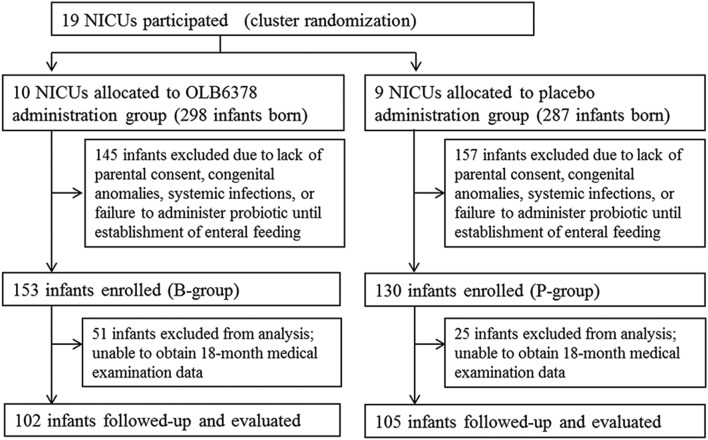
Patients: VLBW infants (birth weight <1500 g) born between January 2010 and March 2011 and managed at 19 neonatal intensive care unit facilities assigned to two groups to account for the effect of probiotic cross-contamination within facilities.
Interventions: For VLBW infants, administration of OLB6378 as a probiotic was started within 48 hours of birth and continued until the body weight reached 2000 g.
Main outcome measures: At 18 months of corrected age, physical status and developmental quotient (DQ18) were assessed. The distribution of DQ18 scores was categorised into four levels of development: <70, significant developmental delay; 70-84, moderate developmental delay; 85-99, without developmental delay; ≥100, average development or better.
Results: Among 153 infants assigned to the OLB6378 administration group and 130 assigned to the placebo administration group, 102 and 105 infants, respectively, underwent the 18-month medical examination. The distribution of developmental levels (DQ18 scores <70, 70-84, 85-99 and ≥100) was significantly more favourable for OLB6378 administration (12, 12, 25 and 40 infants, respectively) than for placebo administration (15, 17, 23 and 24 infants, respectively) (ordered logistic regression analysis: partial correlation coefficient, 0.589; P value, 0.038).
Conclusions: Although limited by assessment rates, result suggests that OLB6378 may have a beneficial effect on the psychological development in VLBW infants.
Clinical trial registration: UMIN000002543.
Keywords: bifidobacterium; developmental quotient at 18 months of age; enteral feeding; sex difference.
Conflict of interest statement
Competing interests: MT is employed by Meiji Co., Ltd.
Figures
References
-
- Kitajima H, Sumida Y, Tanaka R, et al. Early administration of Bifidobacterium breve to preterm infants: randomised controlled trial. Arch Dis Child Fetal Neonatal Ed 1997;76:F101–7. doi:10.1136/fn.76.2.F101 - DOI - PMC - PubMed
-
- AlFaleh K, Anabrees J. Probiotics for prevention of necrotizing enterocolitis in preterm infants. Cochrane Database Syst Rev 2014:CD005496 doi:10.1002/14651858.CD005496.pub4 - DOI - PubMed
-
- Rao SC, Athalye-Jape GK, Deshpande GC, et al. Probiotic supplementation and late-onset sepsis in preterm infants: a meta-analysis. Pediatrics 2016;137:e20153684–16. doi:10.1542/peds.2015-3684 - DOI - PubMed
-
- Costeloe K, Hardy P, Juszczak E, et al. Bifidobacterium breve BBG-001 in very preterm infants: a randomised controlled phase 3 trial. Lancet 2016;387:649–60. doi:10.1016/S0140-6736(15)01027-2 - DOI - PubMed
-
- Yamasaki C, Totsu S, Uchiyama A, et al. Effect of Bifidobacterium administration on very-low-birthweight infants. Pediatr Int 2012;54:651–6. doi:10.1111/j.1442-200X.2012.03649.x - DOI - PubMed
LinkOut - more resources
Full Text Sources
Other Literature Sources