. 2018 May;97(1-2):187-200.
doi: 10.1007/s11103-018-0732-y. Epub 2018 Apr 23.

An improved ternary vector system for Agrobacterium-mediated rapid maize transformation

Affiliations

An improved ternary vector system for Agrobacterium-mediated rapid maize transformation

Ajith Anand et al. Plant Mol Biol. 2018 May.

Abstract

A simple and versatile ternary vector system that utilizes improved accessory plasmids for rapid maize transformation is described. This system facilitates high-throughput vector construction and plant transformation. The super binary plasmid pSB1 is a mainstay of maize transformation. However, the large size of the base vector makes it challenging to clone, the process of co-integration is cumbersome and inefficient, and some Agrobacterium strains are known to give rise to spontaneous mutants resistant to tetracycline. These limitations present substantial barriers to high throughput vector construction. Here we describe a smaller, simpler and versatile ternary vector system for maize transformation that utilizes improved accessory plasmids requiring no co-integration step. In addition, the newly described accessory plasmids have restored virulence genes found to be defective in pSB1, as well as added virulence genes. Testing of different configurations of the accessory plasmids in combination with T-DNA binary vector as ternary vectors nearly doubles both the raw transformation frequency and the number of transformation events of usable quality in difficult-to-transform maize inbreds. The newly described ternary vectors enabled the development of a rapid maize transformation method for elite inbreds. This vector system facilitated screening different origins of replication on the accessory plasmid and T-DNA vector, and four combinations were identified that have high (86-103%) raw transformation frequency in an elite maize inbred.

Keywords: Accessory plasmids; Agrobacterium; Babyboom; Origins of replication; Rapid maize transformation; Ternary vector; Wuschel; pVIR plasmids.


Conflict of interest statement

The authors have no conflict of interest to declare.

Figures
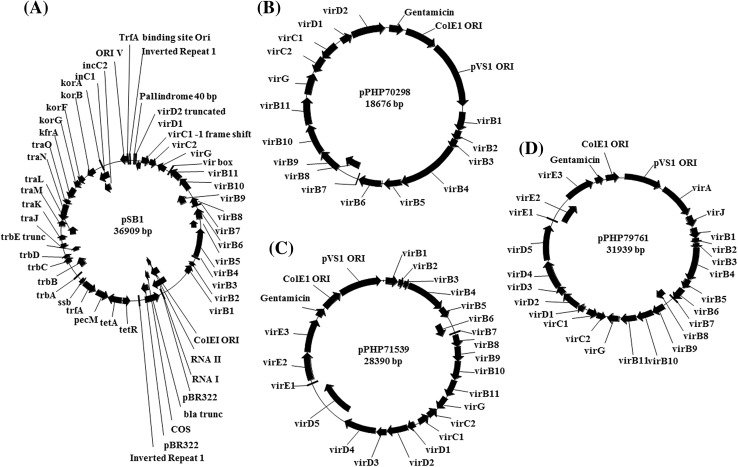
Fig. 1
Fig. 1
The maps of accessory plasmids described in this study, a complete annotation of the pSB1 vectors (Komari et al. 1996) following de novo assembly of the sequenced plasmid, bd newly described pVIR plasmids, pPHP70298, pPHP71539 and pPHP79761 respectively, with complete annotation
Fig. 2
Fig. 2
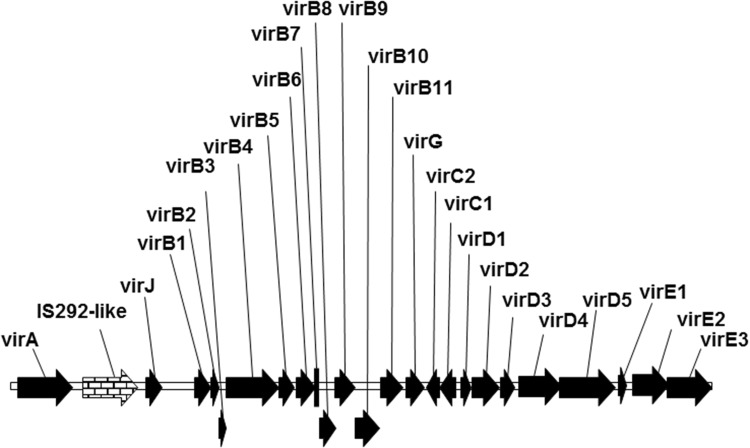
The source of vir genes and their arrangement on the Ti plasmid pTiBo542. A 3.2 kb fragment including the IS292-like insertion element between virA and virJ and an 8.1 kb fragment between virJ and virB1 were deleted from the vir gene cluster in plasmid pPHP79761
Fig. 3
Fig. 3
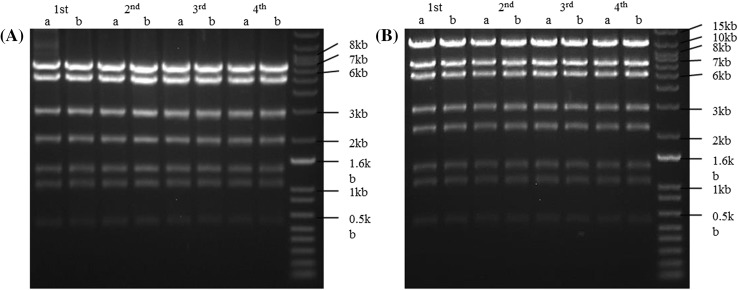
Restriction mapping of the plasmid DNA in Agrobacterium tumefaciens to determine plasmid integrity. Agrobacterium strain LBA4404THY- harboring the plasmid pPHP70298 (a) or pPHP71539 (b) was isolated after four consecutive passage (day 1–4), and retransformed into E. coli. Pooled plasmid DNA from two independent E. coli passages (a and b colonies used for transforming Agrobacterium cells, day 1–4) was subjected to restriction enzyme digestion to determine plasmid integrity. The DNA banding pattern for PstI showed no detectable differences between the two colonies for all the time points. The plasmid DNA was further sequence confirmed by next generation sequencing (Illumina)
Fig. 4
Fig. 4
Schematic representation of the T-DNA elements on the binary plasmid pPHP45981 used in the ternary vector with the different accessory plasmids, pSB1 and pPHP70298 for transforming maize inbred lines HC69 and PH2RT. RB right border, Ubi1 Pro-intron maize ubiquitin 1 promoter-intron, ZS-yellow fluroscent protein (YFP), PMI phosphomannose isomerase, PINII TERM potato proteinase inhibitor II terminator, LB left border
Fig. 5
Fig. 5
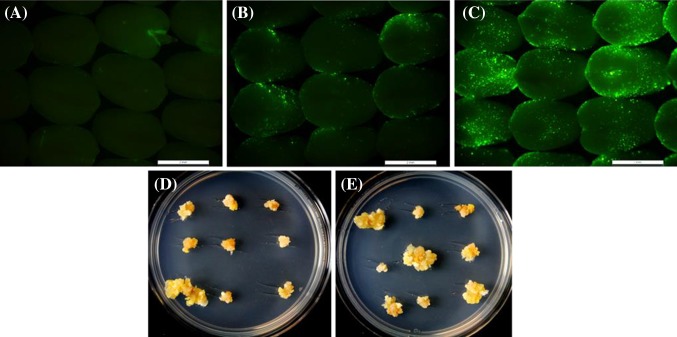
Transient and stable transformation events with the ternary vector containing different accessory plasmids in the maize inbred PH2RT. The top panel displays the transient yellow fluorescent protein expression in immature embryos infected with binary vector pPHP45981 (a), ternary vector pSB1/pPHP45981 (b) and pPHP70298/pPHP45981 (c) 5 days post infection. The bottom panels depict the callus events generated from ternary vectors, pSB1/pPHP45981 plus (d), and pPHP70298/pPHP45981 (e) 5 weeks post embryo infection. Stronger transient gene expression and higher stable transformation events were detected in embryos transformed with ternary vector containing plasmids pPHP70298/pPHP45981
Fig. 6
Fig. 6
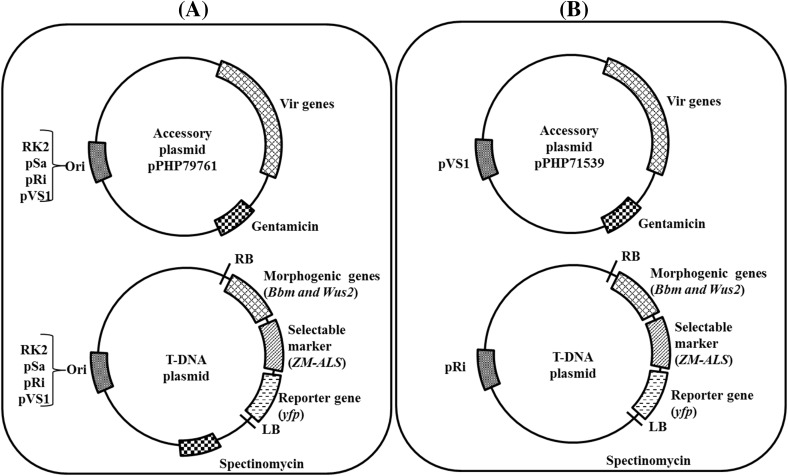
Schematic representation of the different ORI-by-ORI designs tested in the rapid maize transformation system. a The ternary vector design used for evaluating 12 different ORI-by-ORI designs containing the binary plasmid and accessory plasmid based on pPHP79761 differing in their replicons. b The ternary vector design with pRi (binary plasmid)/pVS1 (accessory plasmid pPHP71539) replicon used as the control in the experiments

References

    1. Anand A, Bass SH, Cho HJ, Klein TM, Lassner M, McBride KE (2017) Methods and compositions of improved plant transformation. Patent publication WO2017078836 A1
    1. Bevan M. Binary Agrobacterium vectors for plant transformation. Nucl Acids Res. 1984;12:8711–8721. doi: 10.1093/nar/12.22.8711. - DOI - PMC - PubMed
    1. Che P, Anand A, Wu E, Sander JD, Simon MK, Zhu W, Sigmund AL, Zastrow-Hayes G, Miller M, Liu D, Lawit SJ, Zhao Z-Y, Albertsen MC, Jones TJ. Developing a flexible, high-efficiency Agrobacterium-mediated sorghum transformation system with broad application. Plant Biotechnol. 2018 - PMC - PubMed
    1. Cheng M, Fry JE, Pang S, Zhou H, Hironaka CM, Duncan DR, Conner TW, Wan Y. Genetic transformation of wheat mediated by Agrobacterium tumefaciens. Plant Physiol. 1997;115:971–980. doi: 10.1104/pp.115.3.971. - DOI - PMC - PubMed
    1. Cho M-J, Wu E, Kwan J, Yu M, Banh J, Linn W, Anand A, Li Z, TeRonde S, Register J, III, Jones T, Zhao Z-Y. Agrobacterium-mediated high-frequency transformation of an elite commercial maize (Zea mays L.) inbred line. Plant Cell Rep. 2014;33:1767–1777. doi: 10.1007/s00299-014-1656-x. - DOI - PubMed