


Interhemispheric alpha-band hypoconnectivity in children with autism spectrum disorder
- PMID: 29689375
- PMCID: PMC5993636
- DOI: 10.1016/j.bbr.2018.04.026
Interhemispheric alpha-band hypoconnectivity in children with autism spectrum disorder
Abstract
Diverse genetic and environmental etiologies converge onto circuit level brain dysfunction in autism spectrum disorder (ASD), manifesting at a macroscopic level as aberrant neural connectivity. Previous studies have described atypical patterns of decreased short range and increased long range connectivity in ASD [1]. However, it remains unclear whether group level features of circuit dysfunction are consistently present across the range of cognitive function seen in the autism spectrum.
The dynamics of neural oscillations in the alpha range (6-12 Hz) are exquisitely sensitive to healthy development of functional and structural connectivity. Alpha-band coherence, measured with high temporal-precision electroencephalography (EEG) therefore represents an ideal tool for studying neural connectivity in developmental populations.
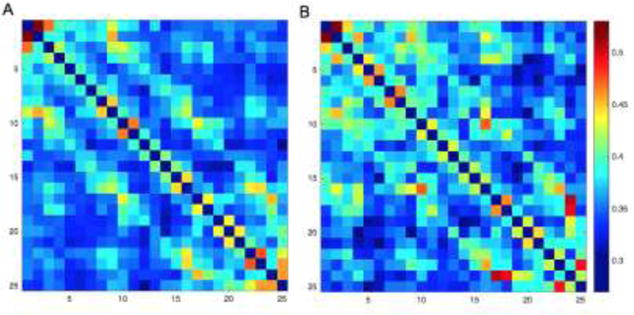
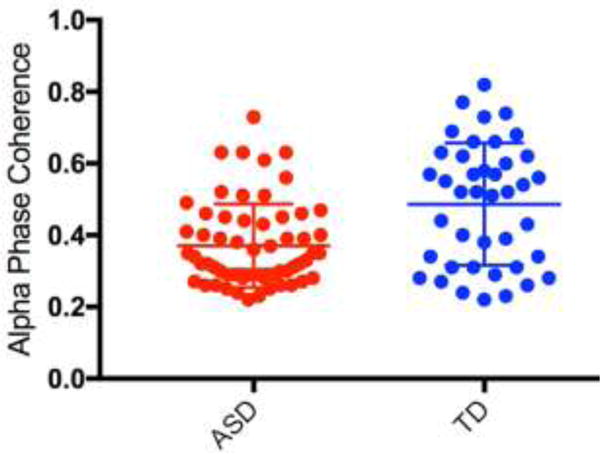
Here we examined spontaneous alpha phase coherence in a heterogeneous sample of 59 children with ASD and 39 age matched typically developing children. Using a data driven approach, we conducted an unbiased examination of all possible atypical connectivity patterns across all cortical regions.
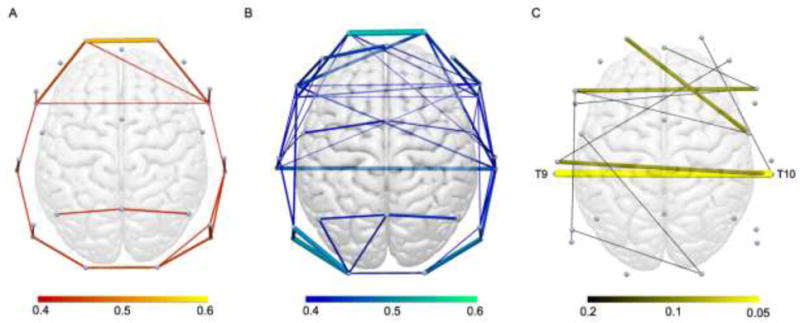
Long-range hypoconnectivity was present in children with ASD compared to typically developing children, with temporal interhemispheric connectivity showing the largest difference between the two groups. Decreased long range alpha coherence distinguishes a heterogeneous group of ASD children from typically developing children. Interhemispheric temporal hypoconnectivity represents a fundamental functional difference in children with ASD across a wide cognitive and age range that may reflect white matter disturbances or increased signal variability at temporal sites in ASD.
Keywords: Alpha; Autism; Circuit dysfunction; Development; Electroencephalography; Neural connectivity.
Conflict of interest statement
Abigail Dickinson has no conflict of interest or financial disclosure to declare. Charlotte DiStefano has no conflict of interest or financial disclosure to declare. Yin-Ying Lin has no conflict of interest or financial disclosure to declare. Aaron Scheffler has no conflict of interest or financial disclosure to declare. Damla Senturk has no conflict of interest or financial disclosure to declare. Shafali Jeste has no conflict of interest or financial disclosure to declare.
Figures
References
-
- Wolff JJ, Gu H, Gerig G, Elison JT, Styner M, Gouttard S, Botteron KN, Dager SR, Dawson G, Estes AM, Evans AC, Hazlett HC, Kostopoulos P, McKinstry RC, Paterson SJ, Schultz RT, Zwaigenbaum L, Piven J, IBIS Network Differences in White Matter Fiber Tract Development Present From 6 to 24 Months in Infants With Autism. Am J Psychiatry. 2012;169:589–600. doi: 10.1176/appi.ajp.2011.11091447. - DOI - PMC - PubMed
-
- Emerson R, Adams C, Nishino T. Functional neuroimaging of high-risk 6-month-old infants predicts a diagnosis of autism at 24 months of age. Science. 2017 http://stm.sciencemag.org/content/9/393/eaag2882.abstract. - PMC - PubMed
Publication types
MeSH terms
Grants and funding
LinkOut - more resources
Full Text Sources
Other Literature Sources
Medical
