Review
. 2018 Apr 22;19(4):1255.
doi: 10.3390/ijms19041255.

Prostate Cancer Genomics: Recent Advances and the Prevailing Underrepresentation from Racial and Ethnic Minorities

Affiliations
Review

Prostate Cancer Genomics: Recent Advances and the Prevailing Underrepresentation from Racial and Ethnic Minorities

Shyh-Han Tan et al. Int J Mol Sci. .

Abstract

Prostate cancer (CaP) is the most commonly diagnosed non-cutaneous cancer and the second leading cause of male cancer deaths in the United States. Among African American (AA) men, CaP is the most prevalent malignancy, with disproportionately higher incidence and mortality rates. Even after discounting the influence of socioeconomic factors, the effect of molecular and genetic factors on racial disparity of CaP is evident. Earlier studies on the molecular basis for CaP disparity have focused on the influence of heritable mutations and single-nucleotide polymorphisms (SNPs). Most CaP susceptibility alleles identified based on genome-wide association studies (GWAS) were common, low-penetrance variants. Germline CaP-associated mutations that are highly penetrant, such as those found in HOXB13 and BRCA2, are usually rare. More recently, genomic studies enabled by Next-Gen Sequencing (NGS) technologies have focused on the identification of somatic mutations that contribute to CaP tumorigenesis. These studies confirmed the high prevalence of ERG gene fusions and PTEN deletions among Caucasian Americans and identified novel somatic alterations in SPOP and FOXA1 genes in early stages of CaP. Individuals with African ancestry and other minorities are often underrepresented in these large-scale genomic studies, which are performed primarily using tumors from men of European ancestry. The insufficient number of specimens from AA men and other minority populations, together with the heterogeneity in the molecular etiology of CaP across populations, challenge the generalizability of findings from these projects. Efforts to close this gap by sequencing larger numbers of tumor specimens from more diverse populations, although still at an early stage, have discovered distinct genomic alterations. These research findings can have a direct impact on the diagnosis of CaP, the stratification of patients for treatment, and can help to address the disparity in incidence and mortality of CaP. This review examines the progress of understanding in CaP genetics and genomics and highlight the need to increase the representation from minority populations.

Keywords: cancer genomics; cancer health disparities; hereditary prostate cancer; prostate cancer.


Conflict of interest statement

The authors declare no conflict of interest.

Figures
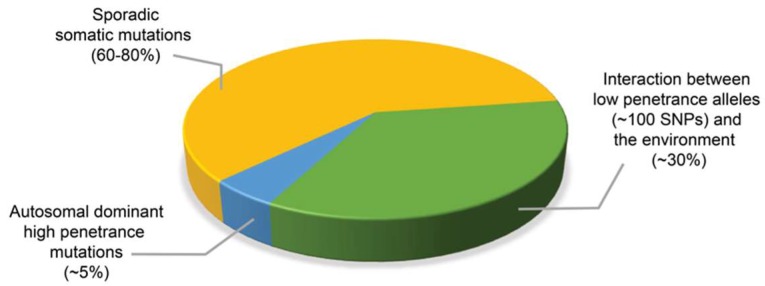
Figure 1
Figure 1
Approximate contribution of germline mutations, low penetrance alleles and sporadic somatic mutations to prostate cancer incidence. While most prostate cancer arise from sporadic somatic mutations, about 5% of prostate cancers develop from autosomal dominant highly penetrant germline mutations, and approximately 30% of cases of prostate cancer occur as a result of interaction between genes with low penetrance alleles and the environment.
Figure 2
Figure 2
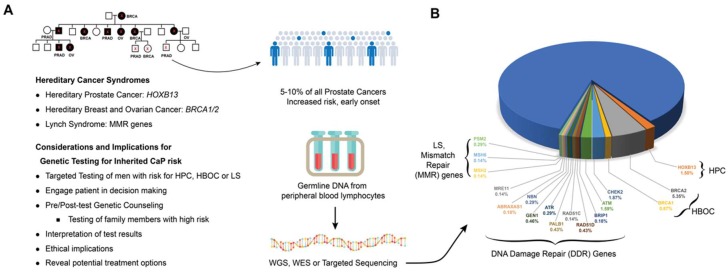
Hereditary cancer syndromes and prostate cancer. Men from families with hereditary cancer syndromes, including Hereditary Prostate Cancer (HPC), Hereditary Breast and Ovarian Cancer (HBOC) and Lynch Syndrome (LS), which are associated with defects in HOXB13, BRCA1/2 and DNA Mismatch Repair genes, respectively, may benefit from genetic testing (A). Frequency of pathogenic germline alterations in DDR genes [30,100,101] and in genes associated with hereditary cancer syndromes (HPC [29,102], HBOC [103], and LS [104,105,106]) detected in metastatic prostate cancers (B).
Figure 3
Figure 3
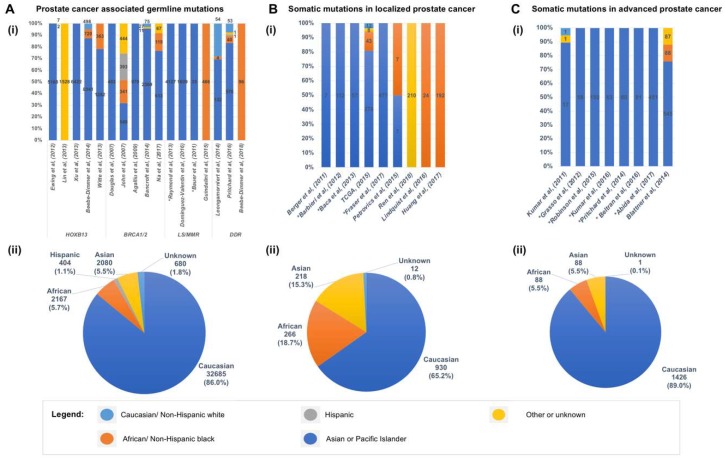
Racial and ethnic disparity in genomic studies of prostate cancer. The distribution of race and ethnicity of cohorts analyzed for germline mutations (A), somatic mutations in localized prostate cancers (B), and somatic mutations in advanced or metastatic castrate resistant prostate cancers (C), in each study reviewed (i), and when grouped together (ii). * In studies which the race or ethnicity of cohort were not specified, the cohort were assumed to be largely Caucasian based on the population of the locale where the study was conducted.
Figure 4
Figure 4
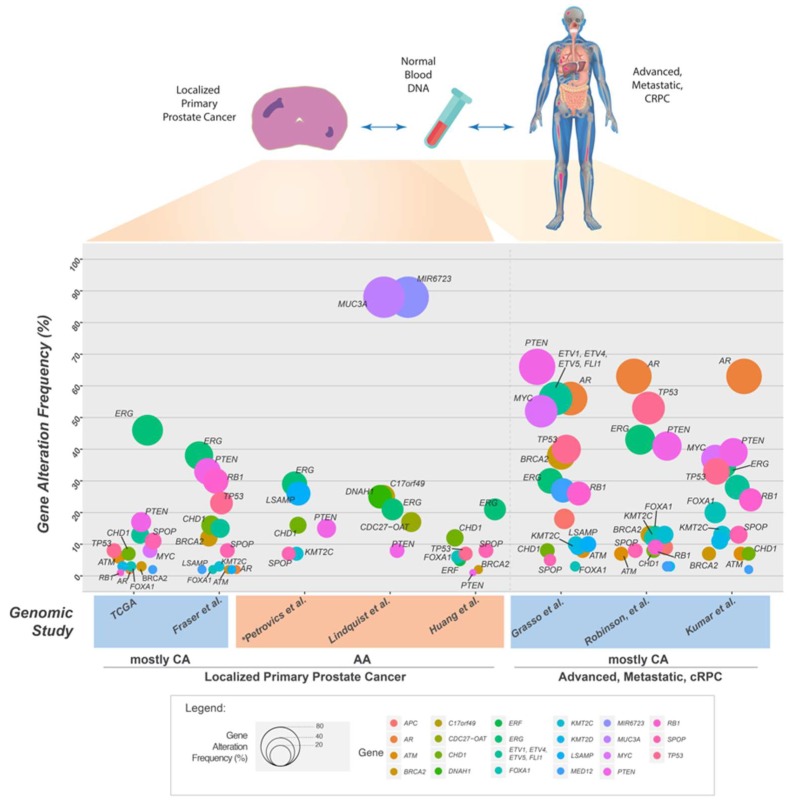
Frequency of somatic gene alteration events reported in selected genomic studies of localized primary prostate cancer and in advanced, metastatic, and/or castrate resistant prostate cancer. Size of circle is proportional to the frequency of gene alteration events (point mutations, deletions, amplifications or gene fusions). * Only gene alteration events in African American cases are shown.

References

    1. Torre L.A., Bray F., Siegel R.L., Ferlay J., Lortet-Tieulent J., Jemal A. Global Cancer Statistics, 2012. CA Cancer J. Clin. 2015;65:87–108. doi: 10.3322/caac.21262. - DOI - PubMed
    1. Siegel R.L., Miller K.D., Jemal A. Cancer Statistics, 2018. CA Cancer J. Clin. 2018;68:7–30. doi: 10.3322/caac.21442. - DOI - PubMed
    1. DeSantis C.E., Siegel R.L., Sauer A.G., Miller K.D., Fedewa S.A., Alcaraz K.I., Jemal A. Cancer Statistics for African Americans, 2016: Progress and Opportunities in Reducing Racial Disparities. CA Cancer J. Clin. 2016;66:290–308. doi: 10.3322/caac.21340. - DOI - PubMed
    1. Chornokur G., Dalton K., Borysova M.E., Kumar N.B. Disparities at Presentation, Diagnosis, Treatment, and Survival in African American Men, Affected by Prostate Cancer. Prostate. 2011;71:985–997. doi: 10.1002/pros.21314. - DOI - PMC - PubMed
    1. Schwartz K., Powell I.J., Underwood W., 3rd, George J., Yee C., Banerjee M. Interplay of Race, Socioeconomic Status, and Treatment on Survival of Patients with Prostate Cancer. Urology. 2009;74:1296–1302. doi: 10.1016/j.urology.2009.02.058. - DOI - PMC - PubMed