. 2018 Apr 24;16(1):108.
doi: 10.1186/s12967-018-1490-y.

CCL20 is up-regulated in non-alcoholic fatty liver disease fibrosis and is produced by hepatic stellate cells in response to fatty acid loading

Affiliations

CCL20 is up-regulated in non-alcoholic fatty liver disease fibrosis and is produced by hepatic stellate cells in response to fatty acid loading

Xin Chu et al. J Transl Med. .

Abstract

Background: Nonalcoholic fatty liver disease (NAFLD) is a prevalent complication of extreme obesity. Loading of the liver with fat can progress to inflammation and fibrosis including cirrhosis. The molecular factors involved in the progression from simple steatosis to fibrosis remain poorly understood.

Methods: Gene expression profiling using microarray, PCR array, and RNA sequencing was performed on RNA from liver biopsy tissue from patients with extreme obesity. Patients were grouped based on histological findings including normal liver histology with no steatosis, lobular inflammation, or fibrosis, and grades 1, 2, 3, and 4 fibrosis with coexistent steatosis and lobular inflammation. Validation of expression was conducted using quantitative PCR. Serum analysis was performed using ELISA. Expression analysis of hepatocytes and hepatic stellate cells in response to lipid loading were conducted in vitro using quantitative PCR and ELISA.

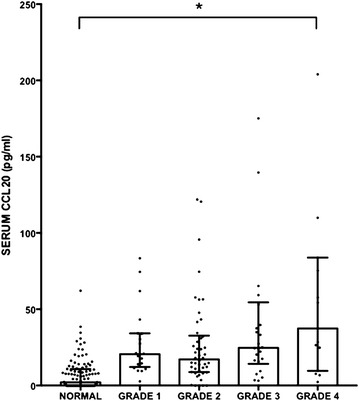
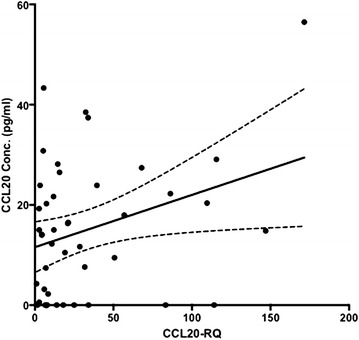
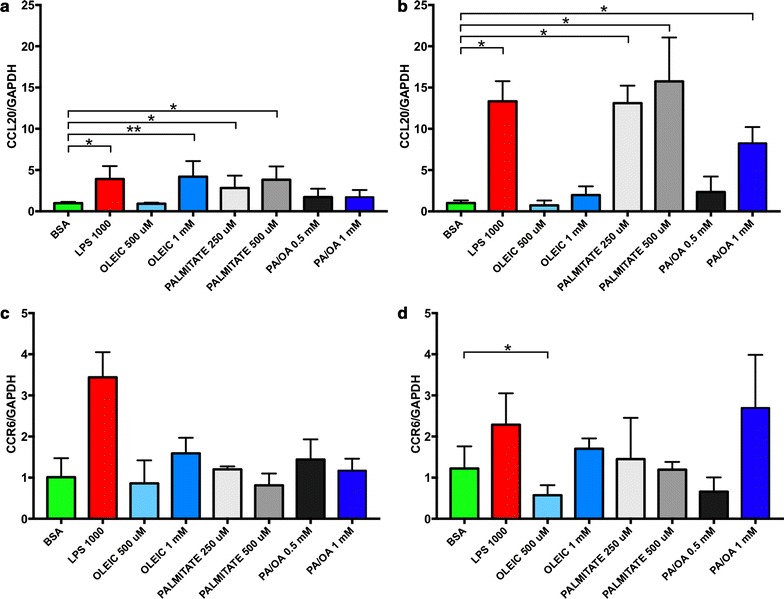
Results: Three orthogonal methods to profile human liver biopsy RNA each identified the chemokine CCL20 (CC chemokine ligand 20 or MIP-3 alpha) gene as one of the most up-regulated transcripts in NAFLD fibrosis relative to normal histology, validated in a replication group. CCL20 protein levels in serum measured in 224 NAFLD patients were increased in severe fibrosis (p < 0.001), with moderate correlation of hepatic transcript levels and serum levels. Expression of CCL20, but not its cognate receptor CC chemokine receptor 6, was significantly (p < 0.001) increased in response to fatty acid loading in LX-2 hepatic stellate cells, with relative increases greater than those in HepG2 hepatocyte cells.

Conclusions: These results suggest that expression of CCL20, an important inflammatory mediator, is increased in NAFLD fibrosis. CCL20 serves as a chemoattractant molecule for immature dendritic cells, which have been shown to produce many of the inflammatory molecules that mediate liver fibrosis. These data also point to hepatic stellate cells as a key cell type that may respond to lipid loading of the liver.

Keywords: CCL20; Fibrosis; NAFLD.


Figures
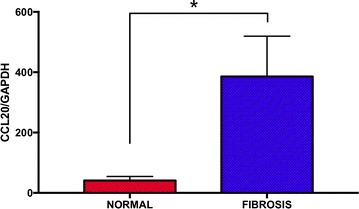
Fig. 1
Fig. 1
QPCR of CCL20 mRNA from 35 liver samples with normal histology (red bar) and 32 samples with fibrosis (blue bar) comprised of 11 with grade 1, 16 with grade 3 bridging fibrosis, and 5 with grade 4 cirrhosis. CCL20 mRNA levels were significantly increased (Mann–Whitney two-tailed p < 0.0001) in fibrosis
Fig. 2
Fig. 2
Box and whisker plot of serum CCL20 levels in 106 patients with normal liver histology (normal), 18 with grade 1 fibrosis (grade 1), 18 with grade 2 fibrosis (grade 2), 28 with grade 3 (bridging) fibrosis (grade 3), and 13 with grade 4 fibrosis/cirrhosis (grade 4). Three high CCL20 values, two grade 3 samples (270 and 538 pg/ml) and one grade 4 sample (580 pg/ml), are not shown in the plot for clarity of presentation. Median serum levels were increased in patient with histological grades of fibrosis (Kruskal–Wallis test Kruskal–Wallis one-way analysis-of-variance-by-ranks test p < 0.0001)
Fig. 3
Fig. 3
Plot of liver RNA expression of CCL20 versus CCL20 serum values. CCL20 liver RNA and serum levels were positively correlated. The 44 paired samples analyzed had an r2 of 0.1043 (r = 0.323) with a p (two-tailed) = 0.0325 and a regression line of y = 0.1043*x + 11.56
Fig. 4
Fig. 4
Transcript levels of CCL20 and CCR6 in HepG2 (a, b) and LX-2 (c, d) cells in response to fatty acid loading. a CCL20 transcript levels were increased by nearly fivefold (**Mann–Whitney p = 0.0029) in HepG2 cells treated with 1 mM oleic acid compared with BSA treated control cells, and by just over two- and threefold (*Mann–Whitney p < 0.0001), respectively, by 250 and 500 mM palmitic acid. b In contrast, in LX-2 cells, CCL20 levels increased ~ 13-fold with 250 μM (p < 0.0001) and the positive control LPS (p < 0.0001), ~ 15-fold with 500 μM of palmitic acid (p < 0.0001), and ~twofold (p < 0.0001) and ~eightfold (p < 0.0001) in response to oleic acid or 1 mM palmitic acid/oleic acid (50/50) mixture, respectively. c No statistically significant differences were observed in CCR6 transcript levels across the different treatments in HepG2 cells after adjusting for multiple comparisons. d In LX-2 cells, the only pairwise comparison to achieve statistical significance was ~ 50% decrease in CCR6 transcript levels in response to 500 μM oleic acid

References

    1. Wynn TA. Cellular and molecular mechanisms of fibrosis. J Pathol. 2008;214(2):199–210. doi: 10.1002/path.2277. - DOI - PMC - PubMed
    1. Gluchowski NL, Becuwe M, Walther TC, Farese RV., Jr Lipid droplets and liver disease: from basic biology to clinical implications. Nat Rev Gastroenterol Hepatol. 2017;14(6):343–355. doi: 10.1038/nrgastro.2017.32. - DOI - PMC - PubMed
    1. Basaranoglu M, Basaranoglu G, Senturk H. From fatty liver to fibrosis: a tale of “second hit”. World J Gastroenterol. 2013;19(8):1158–1165. doi: 10.3748/wjg.v19.i8.1158. - DOI - PMC - PubMed
    1. Tariq Z, Green CJ, Hodson L. Are oxidative stress mechanisms the common denominator in the progression from hepatic steatosis towards non-alcoholic steatohepatitis (NASH)? Liver Int. 2014;34(7):e180–e190. doi: 10.1111/liv.12523. - DOI - PubMed
    1. Marra F, Tacke F. Roles for chemokines in liver disease. Gastroenterology. 2014;147(3):577–594. doi: 10.1053/j.gastro.2014.06.043. - DOI - PubMed

Publication types