. 2018 Oct;19(10):896-901.
doi: 10.1016/j.jamda.2018.03.006.

Readmission Patterns Over 90-Day Episodes of Care Among Medicare Fee-for-Service Beneficiaries Discharged to Post-acute Care

Affiliations

Readmission Patterns Over 90-Day Episodes of Care Among Medicare Fee-for-Service Beneficiaries Discharged to Post-acute Care

Addie Middleton et al. J Am Med Dir Assoc. 2018 Oct.

Abstract

Objective: Examine readmission patterns over 90-day episodes of care in persons discharged from hospitals to post-acute settings.

Design: Retrospective cohort study.

Setting: Acute care hospitals.

Participants: Medicare fee-for-service enrollees (N = 686,877) discharged from hospitals to post-acute care in 2013-2014. The cohort included beneficiaries >65 years of age hospitalized for stroke, joint replacement, or hip fracture and who survived for 90 days following discharge.

Measurements: 90-day unplanned readmissions.

Results: The cohort included 127,680 individuals with stroke, 442,195 undergoing joint replacement, and 117,002 with hip fracture. Thirty-day readmission rates ranged from 3.1% for knee replacement patients discharged to home health agencies (HHAs) to 14.4% for hemorrhagic stroke patients discharged to skilled nursing facilities (SNFs). Ninety-day readmission rates ranged from 5.0% for knee replacement patients discharged to HHAs to 26.1% for hemorrhagic stroke patients discharged to SNFs. Differences in readmission rates decreased between stroke subconditions (hemorrhagic and ischemic) and increased between joint replacement subconditions (knee, elective hip, and nonelective hip) from 30 to 90 days across all initial post-acute discharge settings.

Conclusions: We observed clear patterns in readmissions over 90-day episodes of care across post-acute discharge settings and subconditions. Our findings suggest that patients with hemorrhagic stroke may be more vulnerable than those with ischemic over the first 30 days after hospital discharge. For patients receiving nonelective joint replacements, readmission prevention efforts should start immediately after discharge and continue, or even increase, over the 90-day episode of care.

Keywords: Quality of care; health care reform; health services research; outcomes research.


Conflict of interest statement

The authors have no conflicts of interest to report.

Figures
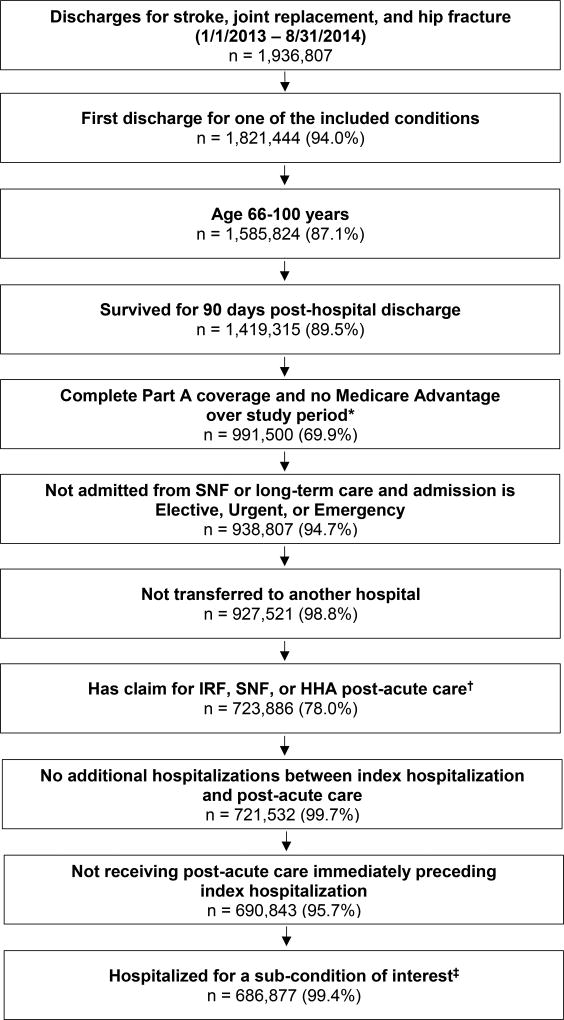
Figure 1
Figure 1
Flow chart presenting number of eligible cases remaining at each step during cohort selection. Values in parentheses are the percentage of the previous step remaining. Abbreviations: SNF, skilled nursing facility; IRF, inpatient rehabilitation facility; HHA, home health agency. * ‘Study period’ refers to the one-year prior to the index hospitalization through the 90 days post-discharge for each index hospitalization. † Has a claim for IRF services starting within 3 days of index hospitalization discharge, a SNF claim starting within 8 days, or a HHA claim starting within 10 days. ‡ Sub-conditions of interest for stroke were hemorrhagic and ischemic strokes; for joint replacements were elective hip, non-elective hip, and knee replacements; and for hip fractures were femur neck fractures, femur fractures, and hip/femur procedures with complication.
Figure 2
Figure 2
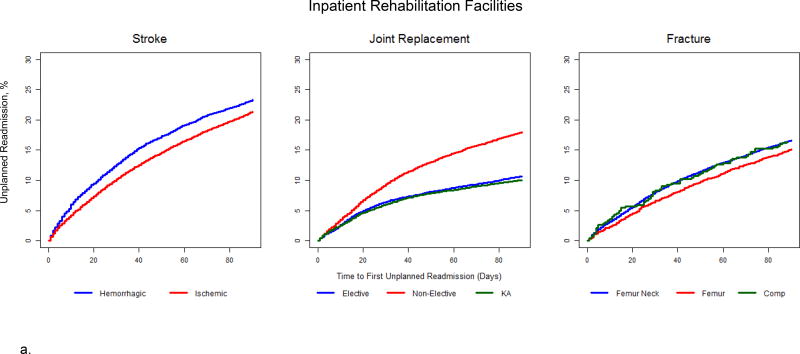
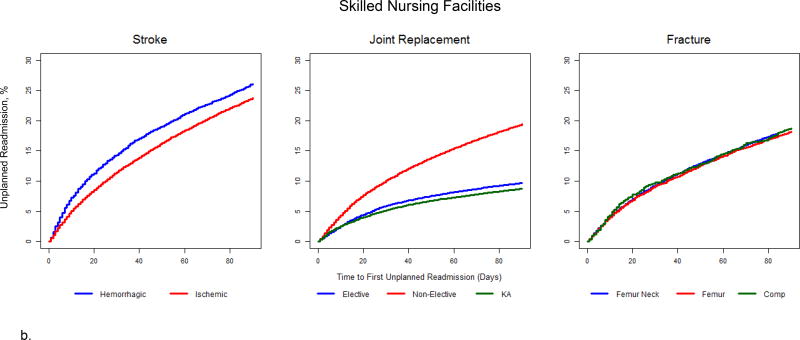
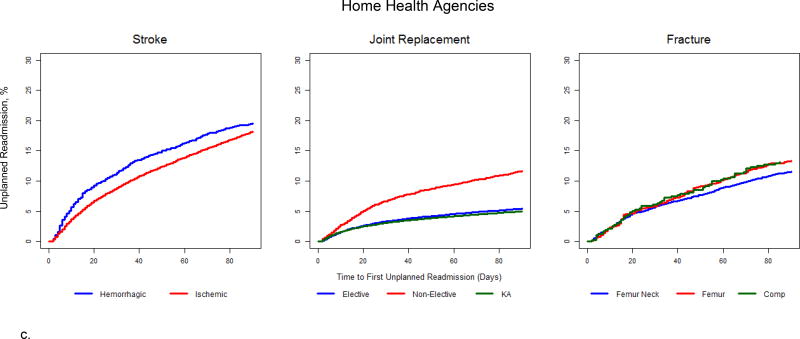
Unadjusted unplanned readmission rates over 90-day episodes of care for patients discharged to post-acute care (a. Inpatient Rehabilitation Facilities, b. Skilled Nursing Facilities, c. Home Health Agencies) following hospitalization for stroke, lower extremity joint replacement, or hip or femur fracture. Labels: Elective, elective hip replacement; Non-elective, non-elective hip replacement; KA, knee arthroplasty; Comp, hip fracture with complications. a. Patients discharged to Inpatient Rehabilitation Facilities. *Log rank tests for 30- and 90-day unplanned readmissions were 33.16 (p<0.0001) and 15.58 (p<0.0001) for stroke, 153.19 (p<0.0001) and 543.87 (p<0.0001) for joint replacement, and 6.51 (p=0.0387) and 3.94 (p=0.1396) for fracture. b. Patients discharged to Skilled Nursing Facilities. *Log rank tests for 30- and 90-day unplanned readmissions were 40.01 (p<0.0001) and 18.06 (p<0.0001) for stroke, 1367.07 (p<0.0001) and 3959.17 (p<0.0001) for joint replacement, and 0.62 (p=0.7331) and 1.38 (p=0.5017) for fracture, respectively. c. Patients discharged with Home Health Agency services. *Log rank tests for 30- and 90-day unplanned readmissions were 19.91 (p<0.0001) and 4.44 (p=0.0350) for stroke, 217.50 (p<0.0001) and 476.52 (p<0.0001) for joint replacement, and 0.14 (p=0.9335) and 3.12 (p=0.2102) for fracture, respectively.
Figure 2
Figure 2
Unadjusted unplanned readmission rates over 90-day episodes of care for patients discharged to post-acute care (a. Inpatient Rehabilitation Facilities, b. Skilled Nursing Facilities, c. Home Health Agencies) following hospitalization for stroke, lower extremity joint replacement, or hip or femur fracture. Labels: Elective, elective hip replacement; Non-elective, non-elective hip replacement; KA, knee arthroplasty; Comp, hip fracture with complications. a. Patients discharged to Inpatient Rehabilitation Facilities. *Log rank tests for 30- and 90-day unplanned readmissions were 33.16 (p<0.0001) and 15.58 (p<0.0001) for stroke, 153.19 (p<0.0001) and 543.87 (p<0.0001) for joint replacement, and 6.51 (p=0.0387) and 3.94 (p=0.1396) for fracture. b. Patients discharged to Skilled Nursing Facilities. *Log rank tests for 30- and 90-day unplanned readmissions were 40.01 (p<0.0001) and 18.06 (p<0.0001) for stroke, 1367.07 (p<0.0001) and 3959.17 (p<0.0001) for joint replacement, and 0.62 (p=0.7331) and 1.38 (p=0.5017) for fracture, respectively. c. Patients discharged with Home Health Agency services. *Log rank tests for 30- and 90-day unplanned readmissions were 19.91 (p<0.0001) and 4.44 (p=0.0350) for stroke, 217.50 (p<0.0001) and 476.52 (p<0.0001) for joint replacement, and 0.14 (p=0.9335) and 3.12 (p=0.2102) for fracture, respectively.
Figure 2
Figure 2
Unadjusted unplanned readmission rates over 90-day episodes of care for patients discharged to post-acute care (a. Inpatient Rehabilitation Facilities, b. Skilled Nursing Facilities, c. Home Health Agencies) following hospitalization for stroke, lower extremity joint replacement, or hip or femur fracture. Labels: Elective, elective hip replacement; Non-elective, non-elective hip replacement; KA, knee arthroplasty; Comp, hip fracture with complications. a. Patients discharged to Inpatient Rehabilitation Facilities. *Log rank tests for 30- and 90-day unplanned readmissions were 33.16 (p<0.0001) and 15.58 (p<0.0001) for stroke, 153.19 (p<0.0001) and 543.87 (p<0.0001) for joint replacement, and 6.51 (p=0.0387) and 3.94 (p=0.1396) for fracture. b. Patients discharged to Skilled Nursing Facilities. *Log rank tests for 30- and 90-day unplanned readmissions were 40.01 (p<0.0001) and 18.06 (p<0.0001) for stroke, 1367.07 (p<0.0001) and 3959.17 (p<0.0001) for joint replacement, and 0.62 (p=0.7331) and 1.38 (p=0.5017) for fracture, respectively. c. Patients discharged with Home Health Agency services. *Log rank tests for 30- and 90-day unplanned readmissions were 19.91 (p<0.0001) and 4.44 (p=0.0350) for stroke, 217.50 (p<0.0001) and 476.52 (p<0.0001) for joint replacement, and 0.14 (p=0.9335) and 3.12 (p=0.2102) for fracture, respectively.

References

    1. Burwell SM. Setting value-based payment goals--HHS efforts to improve U.S. health care. N Engl J Med. 2015;372(10):897–899. - PubMed
    1. The Lewin Group. [Accessed July 5, 2017];CMS Bundled Payments for Care Improvement (BPCI) Initiative Models 2–4: Year 1 Evaluation & Monitoring Annual Report. https://innovation.cms.gov/Files/reports/BPCI-EvalRpt1.pdf.
    1. Department of Health and Human Services. [Accessed July 5, 2017];Centers for Medicare & Medicaid Services. Federal Register. Medicare Program; Comprehensive Care for Joint Replacement Payment Model for Acute Care Hospitals Furnishing Lower Extremity Joint Replacement Services; Final Rule. https://www.gpo.gov/fdsys/pkg/FR-2015-11-24/pdf/2015-29438.pdf. - PubMed
    1. Department of Health and Human Services. [Accessed December 16, 2017];Federal Register. Medicare Program; Advancing Care Coordination Through Episode Payment Models (EPMs); Cardiac Rehabilitation Incentive Payment Model; and Changes to the Comprehensive Care for Joint Replacement Model (CJR); Proposed Rule. https://www.gpo.gov/fdsys/pkg/FR-2016-08-02/pdf/2016-17733.pdf. - PubMed
    1. Medicare Payment Advisory Commission. [Accessed July 20, 2016];A Data Book: Health Care Spending and the Medicare Program. 2016 Jun; http://medpac.gov/documents/data-book/june-2016-data-book-health-care-sp....

Publication types

LinkOut - more resources