


Topological Arrangement of Cardiac Fibroblasts Regulates Cellular Plasticity
- PMID: 29691232
- PMCID: PMC6014922
- DOI: 10.1161/CIRCRESAHA.118.312589
Topological Arrangement of Cardiac Fibroblasts Regulates Cellular Plasticity
Abstract
Rationale: Cardiac fibroblasts do not form a syncytium but reside in the interstitium between myocytes. This topological relationship between fibroblasts and myocytes is maintained throughout postnatal life until an acute myocardial injury occurs, when fibroblasts are recruited to, proliferate and aggregate in the region of myocyte necrosis. The accumulation or aggregation of fibroblasts in the area of injury thus represents a unique event in the life cycle of the fibroblast, but little is known about how changes in the topological arrangement of fibroblasts after cardiac injury affect fibroblast function.
Objective: The objective of the study was to investigate how changes in topological states of cardiac fibroblasts (such as after cardiac injury) affect cellular phenotype.
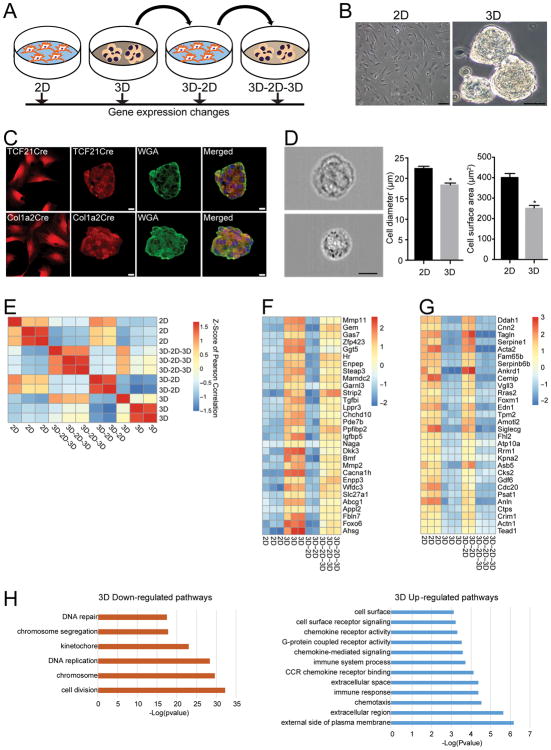
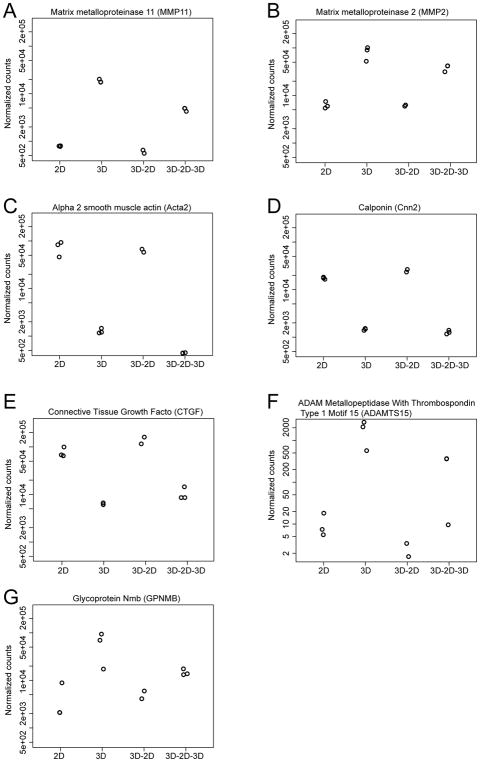
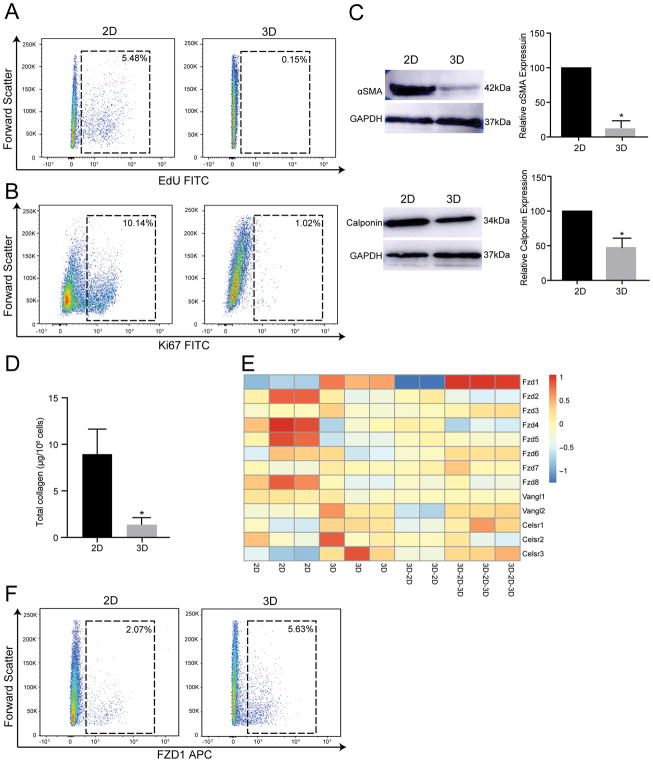
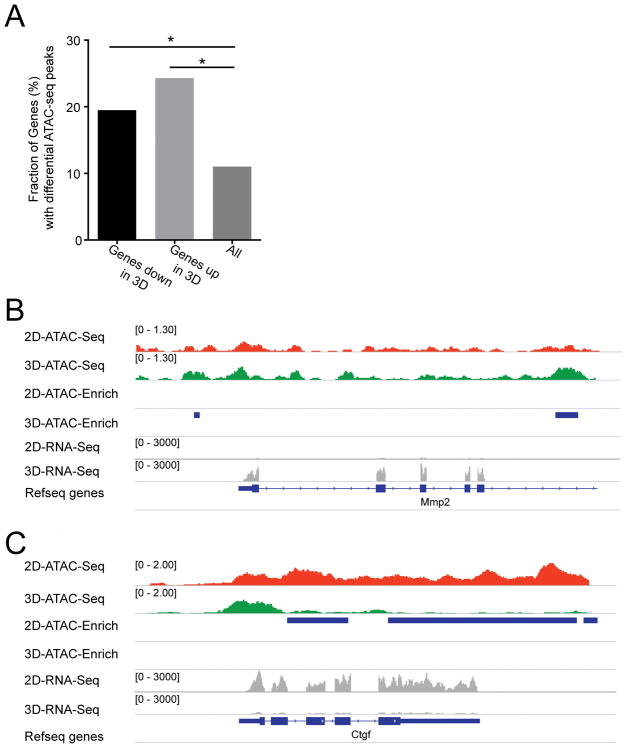
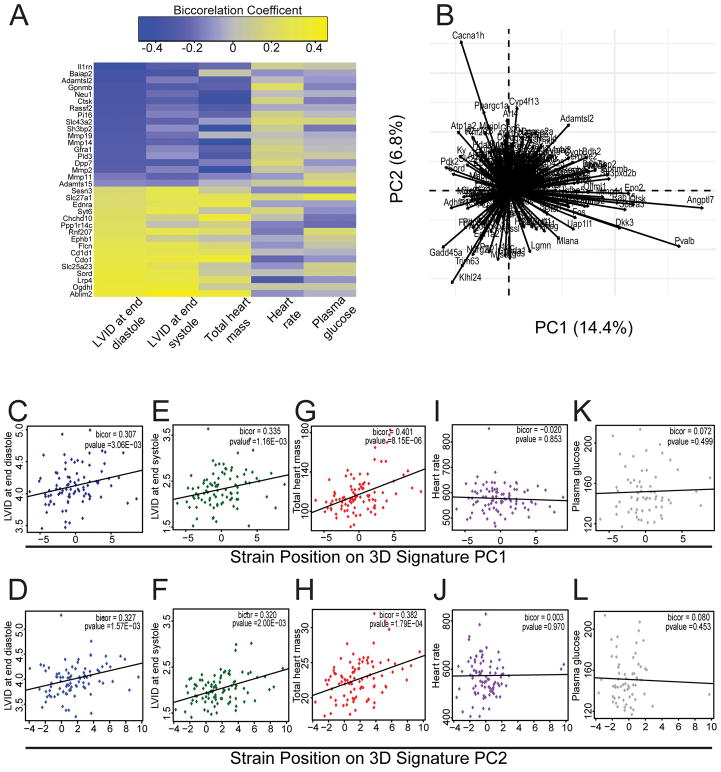
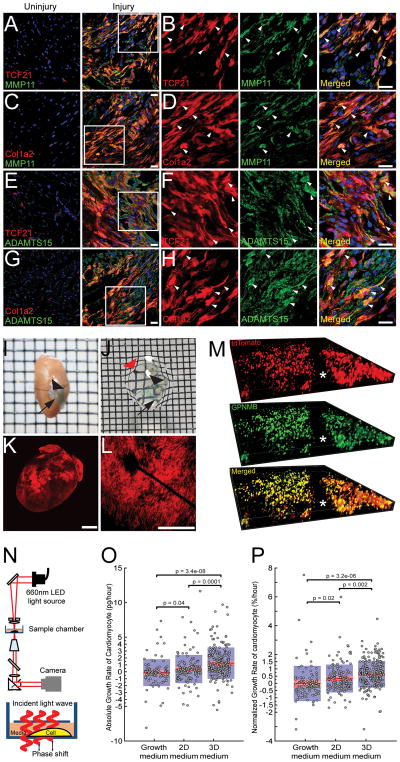
Methods and results: Using 2 and 3-dimensional (2D versus 3D) culture conditions, we show that simple aggregation of cardiac fibroblasts is sufficient by itself to induce genome-wide changes in gene expression and chromatin remodeling. Remarkably, gene expression changes are reversible after the transition from a 3D back to 2D state demonstrating a topological regulation of cellular plasticity. Genes induced by fibroblast aggregation are strongly associated and predictive of adverse cardiac outcomes and remodeling in mouse models of cardiac hypertrophy and failure. Using solvent-based tissue clearing techniques to create optically transparent cardiac scar tissue, we show that fibroblasts in the region of dense scar tissue express markers that are induced by fibroblasts in the 3D conformation. Finally, using live cell interferometry, a quantitative phase microscopy technique to detect absolute changes in single cell biomass, we demonstrate that conditioned medium collected from fibroblasts in 3D conformation compared with that from a 2D state significantly increases cardiomyocyte cell hypertrophy.
Conclusions: Taken together, these findings demonstrate that simple topological changes in cardiac fibroblast organization are sufficient to induce chromatin remodeling and global changes in gene expression with potential functional consequences for the healing heart.
Keywords: cell biology; fibroblasts; fibrosis; hypertrophy; interferometry.
© 2018 American Heart Association, Inc.
Figures
Comment in
-
Strength in Numbers: Cardiac Fibroblast Clustering and Myocardial Remodeling.Circ Res. 2018 Jun 22;123(1):12-14. doi: 10.1161/CIRCRESAHA.118.313280. Circ Res. 2018. PMID: 29929969 No abstract available.
References
-
- Manner J, Perez-Pomares JM, Macias D, Munoz-Chapuli R. The origin, formation and developmental significance of the epicardium: a review. Cells Tissues Organs. 2001;169:89–103. - PubMed
-
- Camelliti P, Borg TK, Kohl P. Structural and functional characterisation of cardiac fibroblasts. Cardiovasc Res. 2005;65:40–51. - PubMed
-
- Pillai IC, Li S, Romay M, Lam L, Lu Y, Huang J, Dillard N, Zemanova M, Rubbi L, Wang Y, Lee J, Xia M, Liang O, Xie YH, Pellegrini M, Lusis AJ, Deb A. Cardiac Fibroblasts Adopt Osteogenic Fates and Can Be Targeted to Attenuate Pathological Heart Calcification. Cell stem cell. 2017;20:218–232e5. - PMC - PubMed
Publication types
MeSH terms
Substances
Grants and funding
LinkOut - more resources
Full Text Sources
Other Literature Sources
Medical
Molecular Biology Databases
