


Comment
doi: 10.1073/pnas.1804081115.
Epub 2018 Apr 24.
Invasive insect hybridizes with local pests
Affiliations
- PMID: 29691323
- PMCID: PMC5949011
- DOI: 10.1073/pnas.1804081115
Item in Clipboard
Comment
Invasive insect hybridizes with local pests
Proc Natl Acad Sci U S A.
.
No abstract available
Conflict of interest statement
The author declares no conflict of interest.
Figures
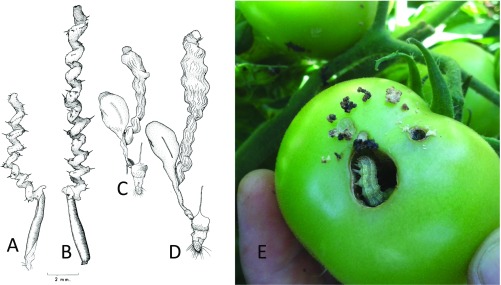
Genitalia and larva of Helicoverpa. (A) Male genitalia of H. armigera, showing the aedeagus below and spiral extension above. (B) Male genitalia of H. zea. (C) Female genitalia of H. armigera, showing the spiral diverticulum off the bursa copulatrix (sac on Left of drawing). (D) Female genitalia of H. zea. (E) Larva of H. armigera or a hybrid with H. zea feeding on developing tomato fruit, in Goiás, Brazil. [(A–D) Reproduced from ref. , with permission from the Minister of Public Works and Government Services of Canada, 2018; (E) Image courtesy of Cecília Czepak (Universidade Federal de Goiás, Goiânia, Brazil).]
Comment on
-
Hybridization and gene flow in the mega-pest lineage of moth, Helicoverpa.Proc Natl Acad Sci U S A. 2018 May 8;115(19):5034-5039. doi: 10.1073/pnas.1718831115. Epub 2018 Apr 2. Proc Natl Acad Sci U S A. 2018. PMID: 29610329 Free PMC article.
References
-
- Cho S, et al. Molecular phylogenetics of heliothine moths (Lepidoptera: Noctuidae: Heliothinae), with comments on the evolution of host range and pest status. Syst Entomol. 2008;33:581–594.
-
- Czepak C, Albernaz KC, Vivan LM, Guimarães HO, Carvalhais T. Primeiro registro de ocorrência de Helicoverpa armigera (Hübner) (Lepidoptera: Noctuidae) no Brasil. Pesqui Agropecu Trop. 2013;43:110–113.
Publication types
MeSH terms
LinkOut - more resources
Full Text Sources
Other Literature Sources
