


Feed-forward alpha particle radiotherapy ablates androgen receptor-addicted prostate cancer
- PMID: 29691406
- PMCID: PMC5915579
- DOI: 10.1038/s41467-018-04107-w
Feed-forward alpha particle radiotherapy ablates androgen receptor-addicted prostate cancer
Abstract
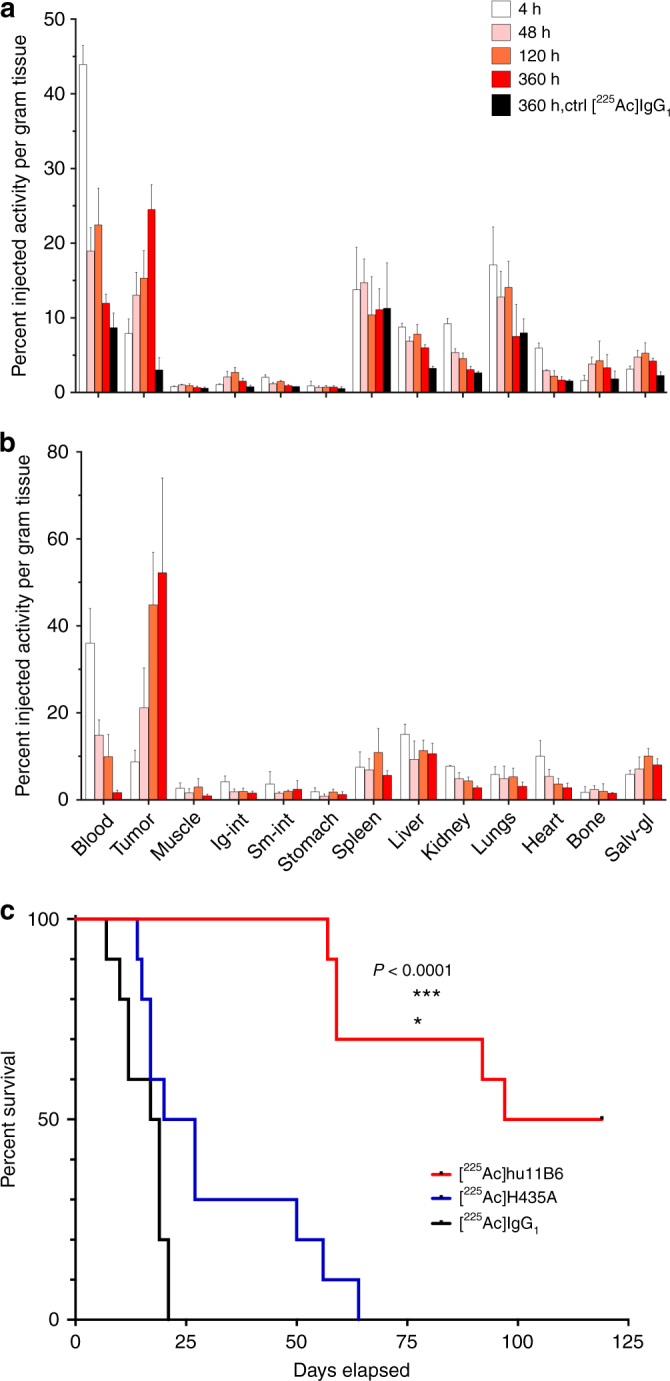
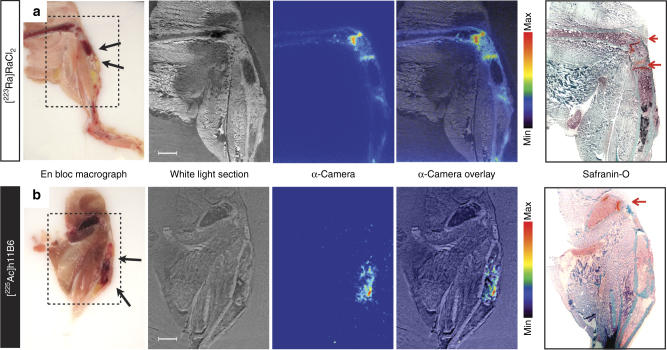
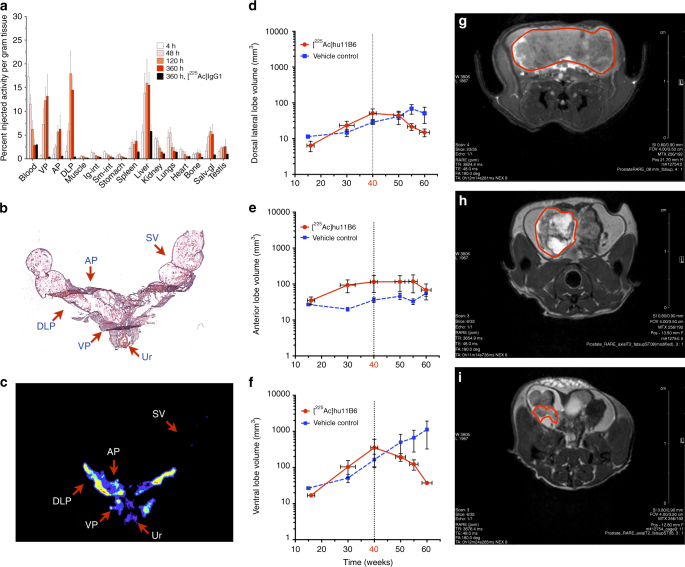
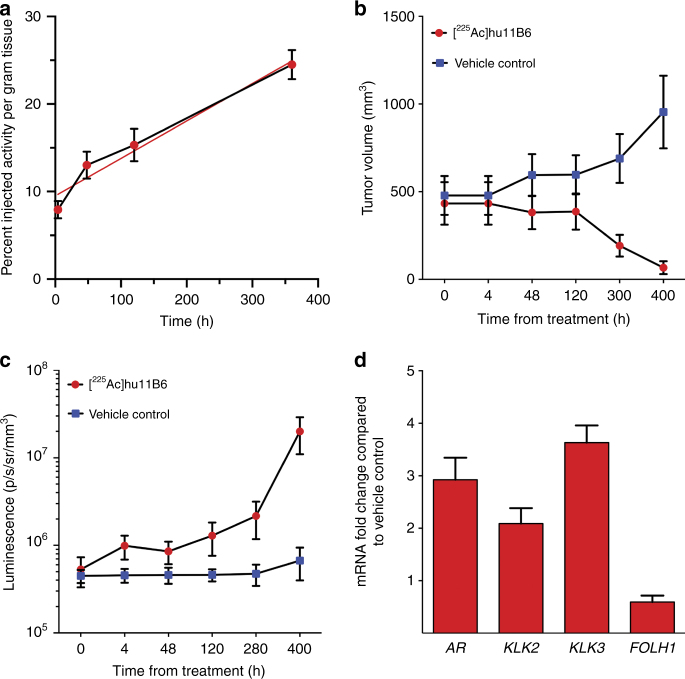
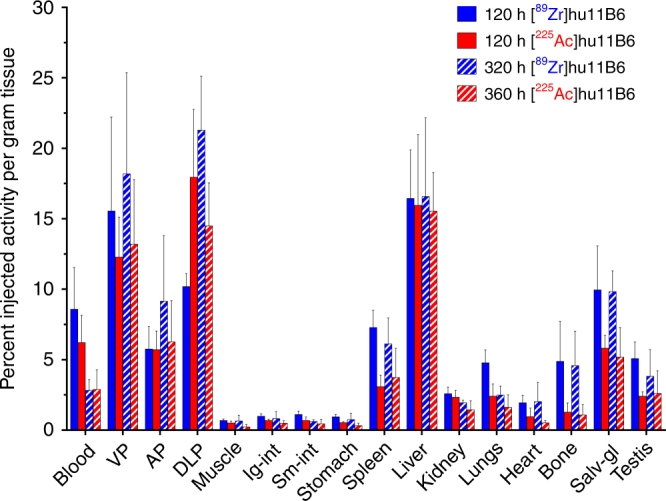
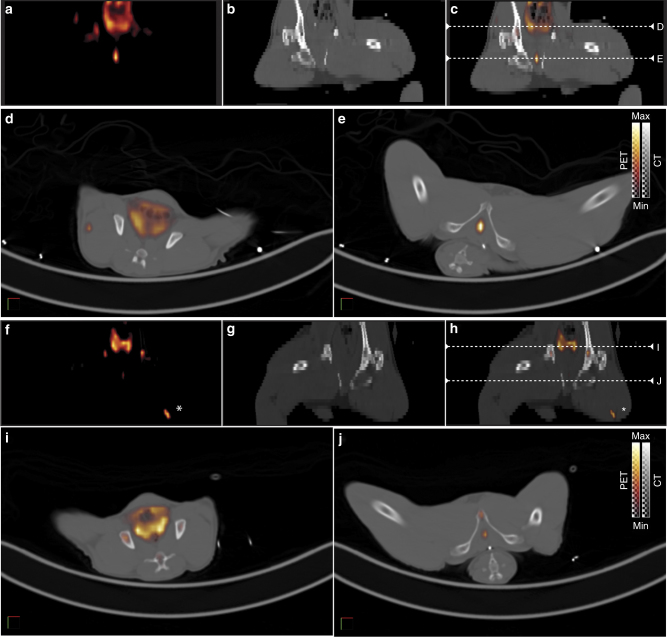
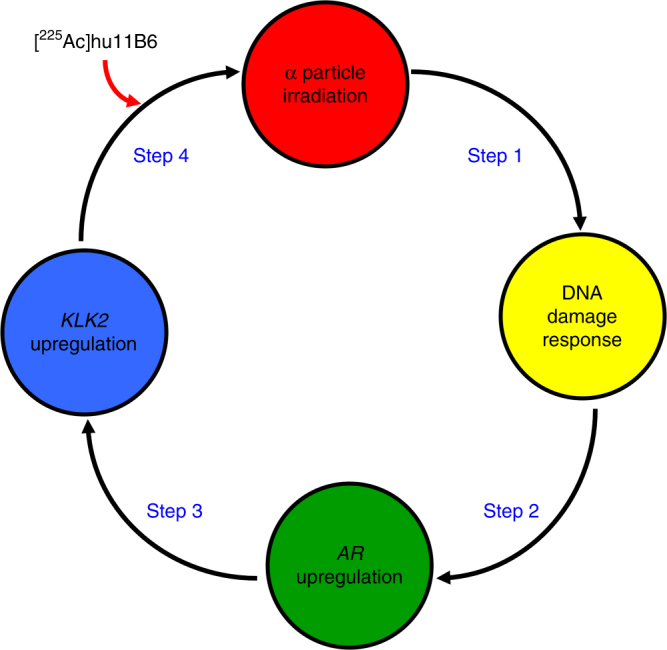
Human kallikrein peptidase 2 (hK2) is a prostate specific enzyme whose expression is governed by the androgen receptor (AR). AR is the central oncogenic driver of prostate cancer (PCa) and is also a key regulator of DNA repair in cancer. We report an innovative therapeutic strategy that exploits the hormone-DNA repair circuit to enable molecularly-specific alpha particle irradiation of PCa. Alpha-particle irradiation of PCa is prompted by molecularly specific-targeting and internalization of the humanized monoclonal antibody hu11B6 targeting hK2 and further accelerated by inherent DNA-repair that up-regulate hK2 (KLK2) expression in vivo. hu11B6 demonstrates exquisite targeting specificity for KLK2. A single administration of actinium-225 labeled hu11B6 eradicates disease and significantly prolongs survival in animal models. DNA damage arising from alpha particle irradiation induces AR and subsequently KLK2, generating a unique feed-forward mechanism, which increases binding of hu11B6. Imaging data in nonhuman primates support the possibility of utilizing hu11B6 in man.
Conflict of interest statement
Authors D.L.J.T., S.E.S., H.L. and D.U. are shareholders of Diaprost Inc., which owns the antibody hu11B6. The remaining authors declare no competing interests.
Figures
References
-
- Jurcic JG, et al. Targeted α-particle immunotherapy for myeloid leukemia. Blood. 2002;100:1233–1239. - PubMed
-
- Jurcic J, et al. Phase I trial of alpha-particle immunotherapy with 225Ac-lintuzumab and low-dose cytarabine in patients age 60 or older with untreated acute myeloid leukemia. J. Nucl. Med. 2017;58:456.
-
- Nikula TN, et al. Alpha-emitting bismuth cyclohexylbenzyl DTPA constructs of recombinant humanized anti-CD33 antibodies: pharmacokinetics, bioactivity, toxicity and chemistry. J. Nucl. Med. 1999;40:166–176. - PubMed
Publication types
MeSH terms
Substances
Grants and funding
- R01 CA201035/CA/NCI NIH HHS/United States
- R01 CA055349/CA/NCI NIH HHS/United States
- P50 CA086438/CA/NCI NIH HHS/United States
- P30 CA006973/CA/NCI NIH HHS/United States
- F31 CA167863/CA/NCI NIH HHS/United States
- P01 CA033049/CA/NCI NIH HHS/United States
- P50 CA092629/CA/NCI NIH HHS/United States
- P30 CA008748/CA/NCI NIH HHS/United States
- R01 CA166078/CA/NCI NIH HHS/United States
- R01 CA160816/CA/NCI NIH HHS/United States
- R01 CA175491/CA/NCI NIH HHS/United States
- S10 RR020892/RR/NCRR NIH HHS/United States
- S10 RR028889/RR/NCRR NIH HHS/United States
LinkOut - more resources
Full Text Sources
Other Literature Sources
Medical
Molecular Biology Databases
Research Materials
