. 2018 Apr 10:9:702.
doi: 10.3389/fimmu.2018.00702. eCollection 2018.

Long Non-Coding RNA GAPLINC Promotes Tumor-Like Biologic Behaviors of Fibroblast-Like Synoviocytes as MicroRNA Sponging in Rheumatoid Arthritis Patients

Affiliations

Long Non-Coding RNA GAPLINC Promotes Tumor-Like Biologic Behaviors of Fibroblast-Like Synoviocytes as MicroRNA Sponging in Rheumatoid Arthritis Patients

Bi Yao Mo et al. Front Immunol. .

Abstract

Rapidly accumulating evidence has now suggested that the long non-coding RNAs (LncRNAs), a large and diverse class of non-coding transcribed RNA molecules with diverse functional roles and mechanisms, play a major role in the pathogenesis of many human inflammatory diseases. Although some LncRNAs are overexpressed in plasma, T cell, and synovial tissues of patients with rheumatoid arthritis (RA), there is a dearth of knowledge in what role these transcripts play in fibroblast-like synoviocytes (FLSs) of these patients. Here, our studies showed that GAPLINC, a newly identified functional LncRNA in oncology, displayed a greater degree of expression in FLSs from RA than in patients with traumatic injury. GAPLINC suppression in RA-FLS cells revealed significant alterations in cell proliferation, invasion, migration, and proinflammatory cytokines production. Additionally, we performed a preliminary bioinformatics analysis of GAPLINC gene sequence in order to find its target molecules, using miRanda, PITA, RNAhybrid algorithms, Kyoto encyclopedia of genes and genomes, and gene ontology analysis. Since the results predicted that some of microRNAs and mRNA may interact with GAPLINC, we simulated a gene co-action network model based on a competitive endogenous RNA theory. Further verification of this model demonstrated that silencing of GAPLINC increased miR-382-5p and miR-575 expression. The results of this study suggest that GAPLINC may function as a novel microRNAs sponging agent affecting the biological characteristics of RA-FLSs. Additionally, GAPLINC may also promote RA-FLS tumor-like behaviors in a miR-382-5p-dependent and miR-575-dependent manner. Based upon these findings, LncRNA GAPLINC may provide a novel valuable therapeutic target for RA patients.

Keywords: LncRNA GAPLINC; cell behaviors regulation; fibroblast-like synoviocytes; long non-coding RNAs; rheumatoid arthritis.


Figures
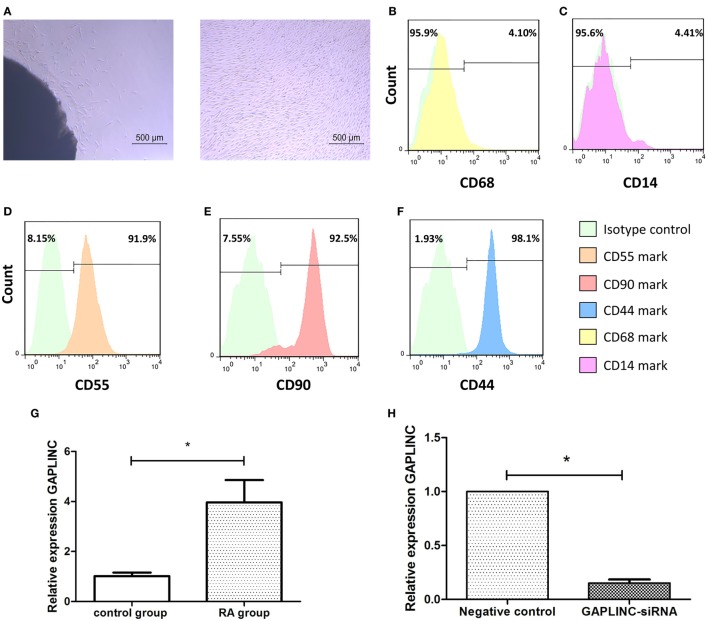
Figure 1
Figure 1
The cell characterization and the relative expression of LncRNA GAPLINC in different groups. (A) The morphology of rheumatoid arthritis (RA)-fibroblast-like synoviocytes (FLSs) were observed under the light microscope. The left graph showed primary fibroblast-like synoviocytes of RA crawled out from synovial tissues: the right graph showed the RA-FLSs at passages 3 have unique morphology. In (B–F), the surface markers (CD55, CD90, CD44, CD14, CD68) of RA-FLS at passages 3 was detected by Flow cytometry. The left was Isotype control map; the right was surface mark map. Cells were identified by CD68 (B) and CD14 (C) negative staining, coupled with positive staining for CD55 (D), CD90 (E), and CD44 (F) staining. The diagrams revealed CD55, CD90 and CD44 expression rate of RA-FLS cell at passage 3 highly up to 90%. (G) LncRNA GAPLINC expression is increased in FLSs from RA patients than trauma groups analyzed by quantitative real-time reverse transcription PCR (qRT-PCR) (*P < 0.05). (H) GAPLINC-small interference RNA efficiently interferes with GAPLINC expression in RA-FLSs detected by (qRT-PCR) (*P < 0.05).
Figure 2
Figure 2
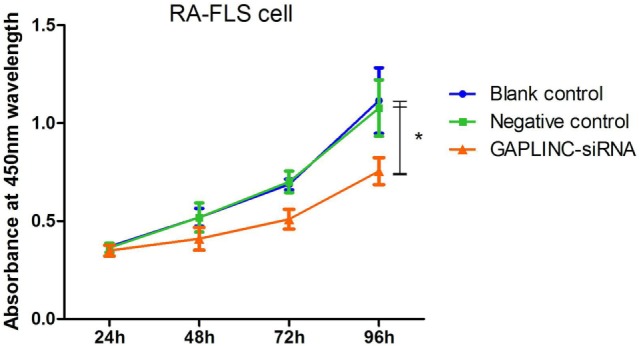
Knocking-down GAPLINC in rheumatoid arthritis-fibroblast-like synoviocytes decreases cell proliferation. Cell growth was measured using a cell counting kit-8 assay. The absorbance at 450 nm wavelength of GAPLINC-small interference RNA group were significantly reduced at 24, 48, and 72 h, largely maintained at 96 h compared to two control groups, *P < 0.05.
Figure 3
Figure 3
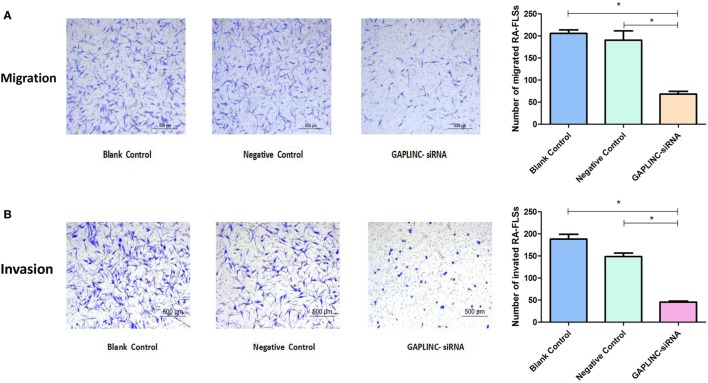
Knocking-down GAPLINC in rheumatoid arthritis (RA)-fibroblast-like synoviocytes impaired cell migration and invasion ability. The migration and invasion in RA-FLS were examined, respectively, by Transwell assay and Matrigel Transwell assay. In both (A,B), left panels show representative images of transmembrane cells; right panels present quantification (means ± SD) of different groups, *P < 0.05.
Figure 4
Figure 4
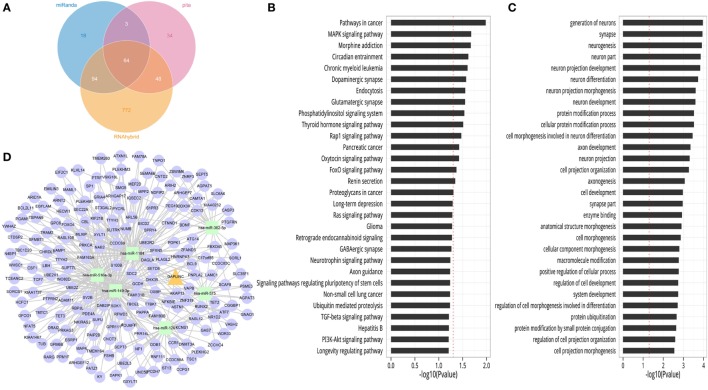
The bioinformatics analysis result of GAPLINC sequence. (A) The Venn graph showed 64 candidate microRNAs of GAPLINC in the intersections of miRanda, PITA, and RNAhybrid algorithms. (B) The classification map of KEGG analysis predicted the possible GAPLINC-related pathways. The x-axis is the −log10 of the p-value, and p < 0.05 was considered statistically significant. (C) The distribution map of gene ontology (GO) analysis revealed the possible function of GAPLINC-related genes. The x-axis is the −log10 of the p-value, and p < 0.05 was considered statistically significant. (D) The view of ceRNA module network of GAPLINC based on front six candidate microRNAs (hsa-miR-575, hsa-miR-149-3p, hsa-miR-382-5p, hsa-miR-516a-3p, hsa-miR-1184, hsa-miR-1261).
Figure 5
Figure 5
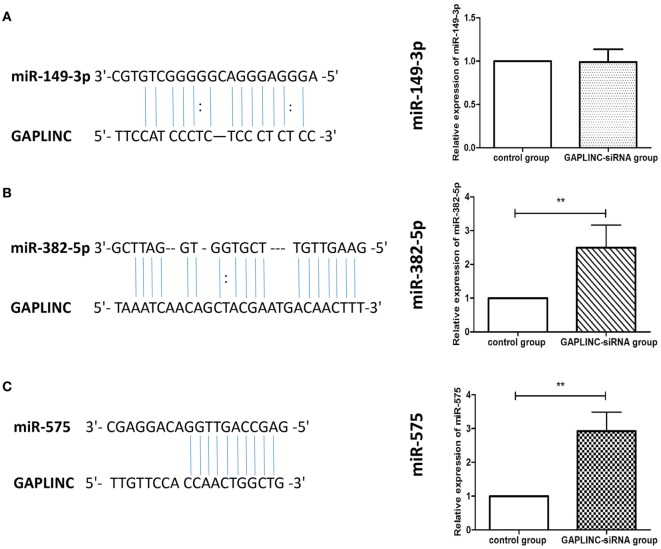
The verification of the target microRNAs of LncRNA GAPLINC (miR-149-3p, miR-382-5p, miR-575). In both (A–C), the left panel shows the potential binding site in the sequences of GAPLINC with relevant microRNA, analyzed through bioinformatics; the right panel identified the relative expression of three microRNAs between negative control and GAPLINC-small interference RNA groups, respectively, measured by quantitative real-time reverse transcription PCR. **P < 0.01 vs control group.
Figure 6
Figure 6
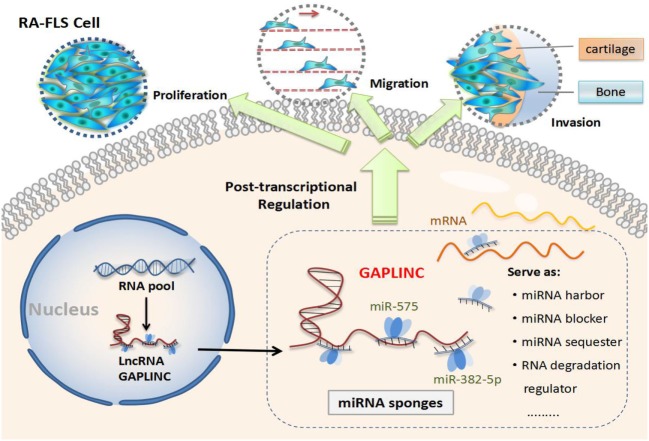
The schematic representation showing possible mechanism of LncRNA GAPLINC. The high expression level of GAPLINC may regular cell behaviors in rheumatoid arthritis (RA)-fibroblast-like synoviocytes (FLSs) though a post-transcriptional way. Bioinformatics analysis speculated that GAPLINC may be molecular attractions for microRNAs and have some regulatory roles. In this investigation, the expression of miR-382-5p and miR-575 had significant increases after GAPLINC suppression, suggesting GAPLINC may promote RA-FLS tumor-like behaviors in an miR-382-5p-dependent and miR-575-dependent manner.

References

    1. Chen M, Su W, Lin X, Guo Z, Wang J, Zhang Q, et al. Adoptive transfer of human gingiva-derived mesenchymal stem cells ameliorates collagen-induced arthritis via suppression of Th1 and Th17 cells and enhancement of regulatory T cell differentiation. Arthritis Rheum (2013) 65(5):1181–93. 10.1002/art.37894 - DOI - PMC - PubMed
    1. Kong N, Lan Q, Su W, Chen M, Wang J, Yang Z, et al. Induced T regulatory cells suppress osteoclastogenesis and bone erosion in collagen-induced arthritis better than natural T regulatory cells. Ann Rheum Dis (2012) 71(9):1567–72. 10.1136/annrheumdis-2011-201052 - DOI - PMC - PubMed
    1. McInnes IB, Schett G. Pathogenetic insights from the treatment of rheumatoid arthritis. Lancet (2017) 389(10086):2328–37. 10.1016/s0140-6736(17)31472-1 - DOI - PubMed
    1. Harre U, Schett G. Cellular and molecular pathways of structural damage in rheumatoid arthritis. Semin Immunopathol (2017) 39(4):355–63. 10.1007/s00281-017-0634-0 - DOI - PubMed
    1. Peng WX, Zhu SL, Zhang BY, Shi YM, Feng XX, Liu F, et al. Smoothened regulates migration of fibroblast-like synoviocytes in rheumatoid arthritis via activation of rho GTPase signaling. Front Immunol (2017) 8:159. 10.3389/fimmu.2017.00159 - DOI - PMC - PubMed

Publication types