. 2018 Jul;40(7):1029-1036.
doi: 10.1007/s10529-018-2556-x. Epub 2018 Apr 24.

A simple method to determine evaporation and compensate for liquid losses in small-scale cell culture systems

Affiliations

A simple method to determine evaporation and compensate for liquid losses in small-scale cell culture systems

Vincent Wiegmann et al. Biotechnol Lett. 2018 Jul.

Abstract

Objectives: Establish a method to indirectly measure evaporation in microwell-based cell culture systems and show that the proposed method allows compensating for liquid losses in fed-batch processes.

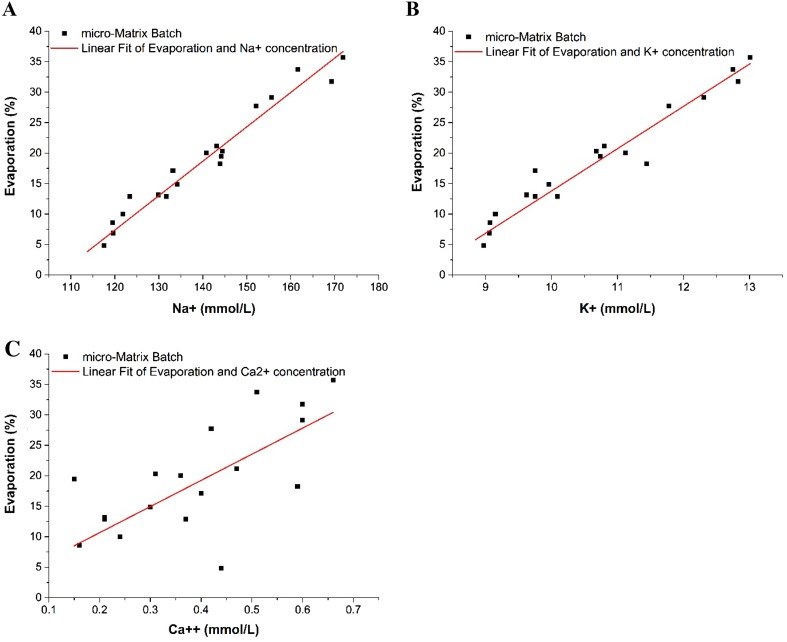
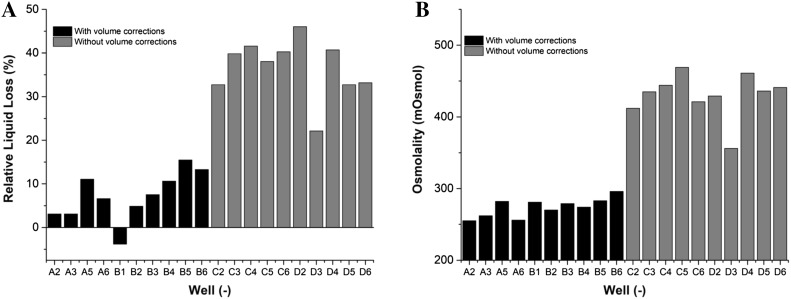
Results: A correlation between evaporation and the concentration of Na+ was found (R2 = 0.95) when using the 24-well-based miniature bioreactor system (micro-Matrix) for a batch culture with GS-CHO. Based on these results, a method was developed to counteract evaporation with periodic water additions based on measurements of the Na+ concentration. Implementation of this method resulted in a reduction of the relative liquid loss after 15 days of a fed-batch cultivation from 36.7 ± 6.7% without volume corrections to 6.9 ± 6.5% with volume corrections.

Conclusion: A procedure was established to indirectly measure evaporation through a correlation with the level of Na+ ions in solution and deriving a simple formula to account for liquid losses.

Keywords: Evaporation; Fed batch; GS-CHO cells; Miniature shaken bioreactor; Reproducibility.


Conflict of interest statement

The authors declare that they have no conflict of interest.

Figures
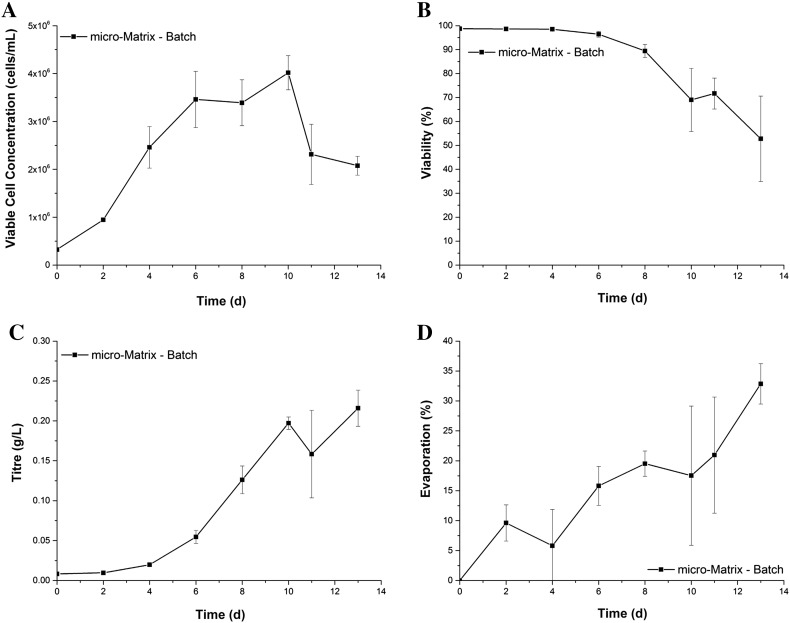
Fig. 1
Fig. 1
Growth profile (a), viability (b), titre (c), and liquid loss through evaporation (d) of GS-CHO cells grown as batch culture in the micro-Matrix at a shaking speed of 220 rpm, a working volume of 3.5 mL, and active control of temperature (37 °C), DO (30%), and pH (7.2). Error bars represent one standard deviation about the mean (n = 3)
Fig. 2
Fig. 2
Concentration of the electrolytes Na+ (a), K+ (b), and Ca2+ (c) depending on the relative evaporation (filled square), respective linear correlations (line) during a batch culture with GS-CHO cells grown in the micro-Matrix. The shaking speed was set to 220 rpm at a working volume of 3.5 mL. The DO was controlled at 30% and the pH at 7.2. Na+: y = 0.56·x − 60.4, R2 = 0.95; K+: y = 6.94·x − 55.6, R2 = 0.92; Ca2+: 42.9·x + 2.1, R2 = 0.45. Error bars represent one standard deviation about the mean (n = 3)
Fig. 3
Fig. 3
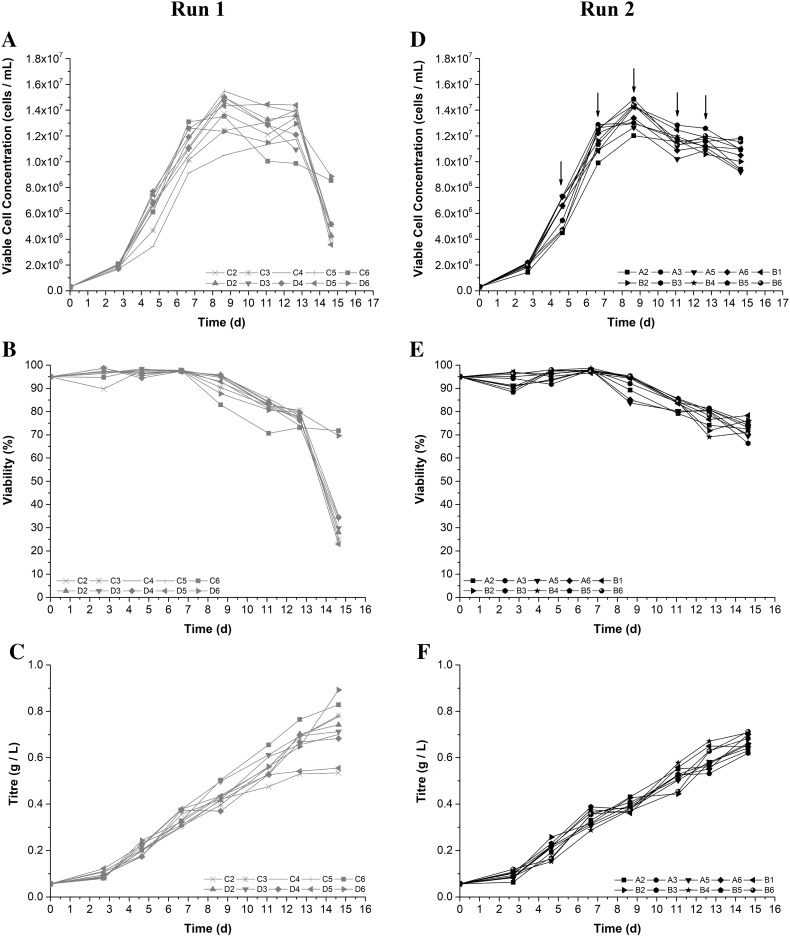
Growth profile (a, d), viability (b, e), and titre (c, f) of GS-CHO cells grown as fed-batch culture in the micro-Matrix at a shaking speed of 280 rpm, a working volume of 3 mL, and active control of temperature (37 °C), DO (30%), and pH (7.2). In run 1 (ac) no compensation for evaporation was performed, whereas run 2 (df) was subjected to this procedure five times. Arrows indicate the time points of dH2O additions to counteract evaporation based on the sodium level measured
Fig. 4
Fig. 4
Endpoint values of the relative liquid loss (a) and osmolality (b) after 15 days of two fed-batch cultivations with GS-CHO cells grown in the micro-Matrix. In run 1 no compensation for evaporation was performed, whereas run 2 was subjected to this procedure five times. The shaking speed for both runs was set to 280 rpm, the working volume was 3 mL, temperature was controlled at 37 °C, DO at 30%, and pH at 7.2

References

    1. Bareither R, Pollard D. A review of advanced small-scale parallel bioreactor technology for accelerated process development: current state and future need. Biotechnol Prog. 2011;27:2–14. doi: 10.1002/btpr.522. - DOI - PubMed
    1. Betts JPJ, Warr SRC, Finka GB, et al. Impact of aeration strategies on fed-batch cell culture kinetics in a single-use 24-well miniature bioreactor. Biochem Eng J. 2014;82:105–116. doi: 10.1016/j.bej.2013.11.010. - DOI
    1. Chaturvedi K, Sun SY, O’brien T, et al. Comparison of the behavior of CHO cells during cultivation in 24-square deep well microplates and conventional shake flask systems. Biotechnol Rep. 2014;1–2:22–26. doi: 10.1016/j.btre.2014.04.001. - DOI - PMC - PubMed
    1. Chen A, Chitta R, Chang D, Amanullah A. Twenty-four well plate miniature bioreactor system as a scale-down model for cell culture process development. Biotechnol Bioeng. 2009;102:148–160. doi: 10.1002/bit.22031. - DOI - PubMed
    1. Deshpande RR, Wittmann C, Heinzle E. Microplates with integrated oxygen sensing for medium optimization in animal cell culture. Cytotechnology. 2004;46(1):1–8. doi: 10.1007/s10616-004-6401-9. - DOI - PMC - PubMed

LinkOut - more resources