


Oral microbiota reveals signs of acculturation in Mexican American women
- PMID: 29694348
- PMCID: PMC5918619
- DOI: 10.1371/journal.pone.0194100
Oral microbiota reveals signs of acculturation in Mexican American women
Abstract
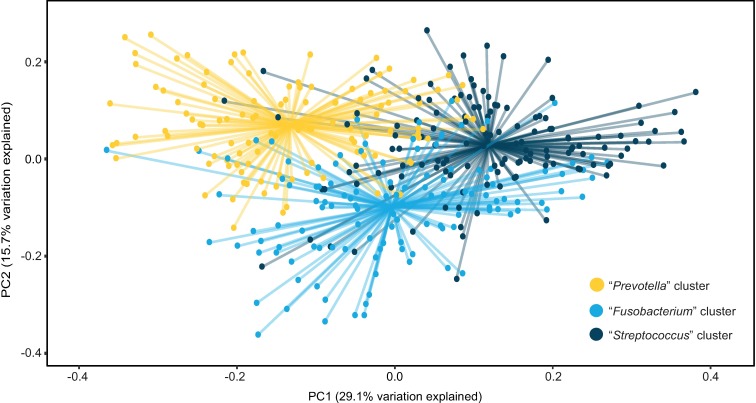
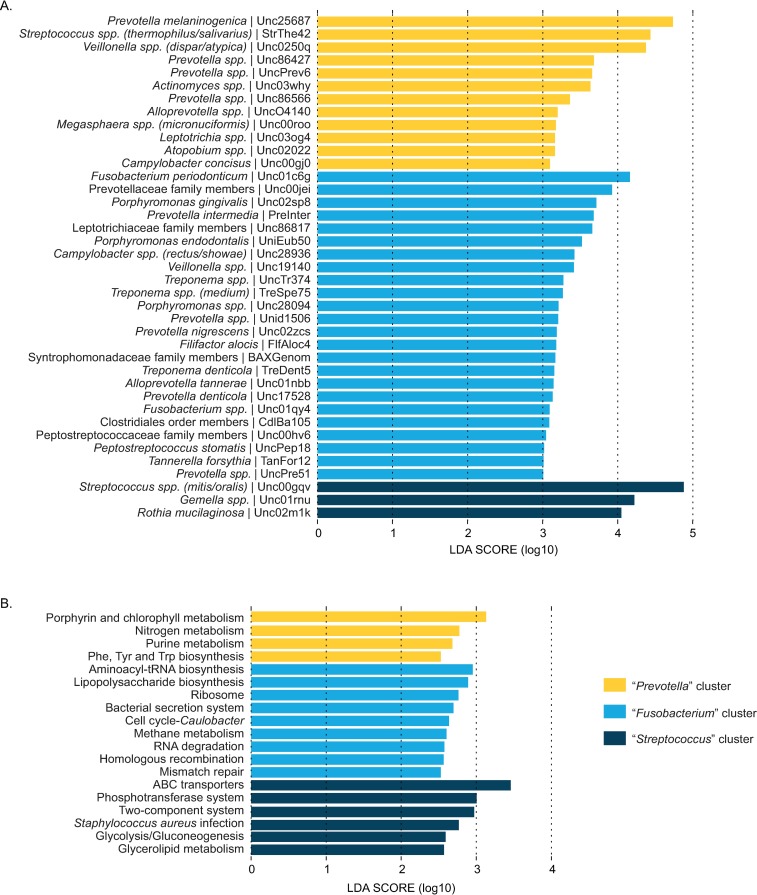
The oral microbiome has been linked to a number of chronic inflammatory conditions, including obesity, diabetes, periodontitis, and cancers of the stomach and liver. These conditions disproportionately affect Mexican American women, yet few studies have examined the oral microbiota in this at-risk group. We characterized the 16S rDNA oral microbiome in 369 non-smoking women enrolled in the MD Anderson Mano a Mano Mexican American Cohort Study. Lower bacterial diversity, a potential indicator of oral health, was associated with increased age and length of US residency among recent immigrants. Grouping women by overarching bacterial community type (e.g., "Streptococcus," "Fusobacterium," and "Prevotella" clusters), we observed differences across a number of acculturation-related variables, including nativity, age at immigration, time in the US, country of longest residence, and a multi-dimensional acculturation scale. Participants in the cluster typified by higher abundance of Streptococcus spp. exhibited the lowest bacterial diversity and appeared the most acculturated as compared to women in the "Prevotella" group. Computationally-predicted functional analysis suggested the Streptococcus-dominated bacterial community had greater potential for carbohydrate metabolism while biosynthesis of essential amino acids and nitrogen metabolism prevailed among the Prevotella-high group. Findings suggest immigration and adaption to life in the US, a well-established mediator of disease risk, is associated with differences in oral microbial profiles in Mexican American women. These results warrant further investigation into the joint and modifying effects of acculturation and oral bacteria on the health of Mexican American women and other immigrant populations. The oral microbiome presents an easily accessible biomarker of disease risk, spanning biological, behavioral, and environmental factors.
Conflict of interest statement
Figures

References
-
- U.S. Census Bureau, Population Division. Annual estimates of the resident population by sex, age, race, and Hispanic origin for the United States and states: April 1, 2010 to July 1, 2015; 2016. [cited 2016 Sep 9]. Database: American FactFinder [Internet]. Available from: http://www.factfinder.census.gov.
-
- Generational differences. Report No. 7054. Pew Hispanic Center. 2004. Available from: http://www.pewhispanic.org/files/2011/10/13.pdf.
-
- U.S. Census Bureau. American Community Survey 1-year estimates; 2016. [cited 2016 Sep 9]. Database: American FactFinder [Internet]. Available from: http://www.factfinder.census.gov.
-
- National Center for Health Statistics. Health, United States, 2015: with special feature on racial and ethnic health disparities. Report No. 2016–1232. Hyattsville, MD: US Department of Health and Human Services; 2016. - PubMed
-
- Siegel RL, Miller KD, Jemal A. Cancer statistics, 2016. CA Cancer J Clin. 2016; 66: 7–30. doi: 10.3322/caac.21332 - DOI - PubMed
Publication types
MeSH terms
Grants and funding
LinkOut - more resources
Full Text Sources
Other Literature Sources
Miscellaneous
