. 2018 Apr 24;8(5):270.
doi: 10.3390/nano8050270.

Cationic Liposomes Carrying siRNA: Impact of Lipid Composition on Physicochemical Properties, Cytotoxicity and Endosomal Escape

Affiliations

Cationic Liposomes Carrying siRNA: Impact of Lipid Composition on Physicochemical Properties, Cytotoxicity and Endosomal Escape

Anna Lechanteur et al. Nanomaterials (Basel). .

Abstract

In recent year, cationic liposomes have gained a lot of attention for siRNA delivery. Despite this, intracellular barriers as endosomal escape and cytosolic delivery of siRNA still represent a challeng, as well as the cytotoxicity due to cationic lipids. To address these issues, we developed four liposomal formulations, composed of two different cationic lipids (DOTAP and DC-Cholesterol) and different ratio of co-lipids (cholesterol and DOPE). The objective is to dissect these impacts on siRNA efficacy and cytotoxicity. Liposomes were complexed to siRNA at six different N/P molar ratios, physico-chemical properties were characterized, and consequently, N/P 2.5, 5 and 10 were selected for in vitro experiments. We have shown that cytotoxicity is influenced by the N/P ratio, the concentration of cationic lipid, as well as the nature of the cationic lipid. For instance, cell viability decreased by 70% with liposomes composed of DOTAP/Cholesterol/DOPE 1/0.75/0.5 at a N/P ratio 10, whereas the same formulation at a N/P ratio of 2.5 was safe. Interestingly, we have observed differences in terms of mRNA knock-down efficiency, whereas the transfection rate was quite similar for each formulation. Liposomes containing 50% of DOPE induced a mRNA silencing of around 80%. This study allowed us to highlight crucial parameters in order to develop lipoplexes which are safe, and which induce an efficient intracytoplasmic release of siRNA.

Keywords: Cellular uptake: lipids; cytoxiciy; liposome; siRNA.


Conflict of interest statement

The authors declare no conflict of interest.

Figures
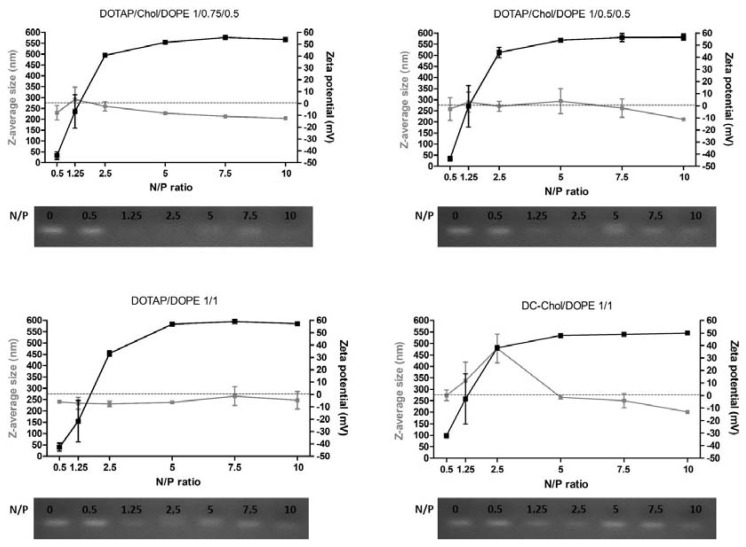
Figure 1
Figure 1
Z-average diameter (nm) and Zeta potential (mV) values of lipoplexes at different N/P molar ratios. Formulations DOTAP/Chol/DOPE 1/0.75/0.5, DOTAP/Chol/DOPE 1/0.5/0.5, DOTAP/DOPE 1/1 and DC-Chol/DOPE 1/1 were complexed to siCR at 100nM at N/P ratios of 0.5, 1.25, 2.5, 5, 7.5 and 10 (n = 4). The siRNA binding ability of lipoplexes was also evaluated by agarose gel retardation assay for all same formulations. The N/P 0 represents free siRNA.
Figure 2
Figure 2
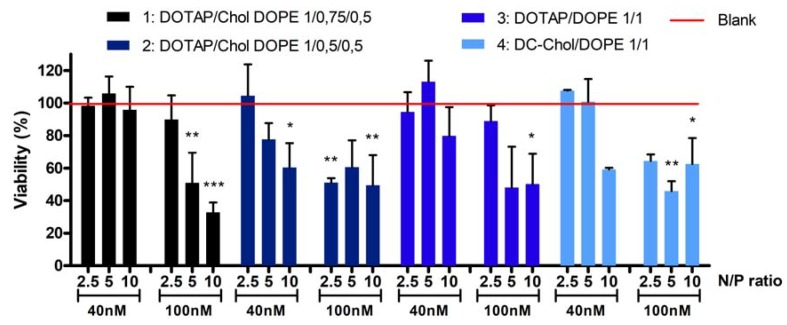
Cell viability of A549 cell lines treated during 24 h with liposomes complexed to inactive siRNA (siCR) at different N/P molar ratios at siRNA concentrations of 40 and 100 nM (n = 3). One-way ANOVA, post test Dunnett’s, p < 0.1 (*), p < 0.01 (**) and p < 0.001 (***) compared to untreated cells (Blank).
Figure 3
Figure 3
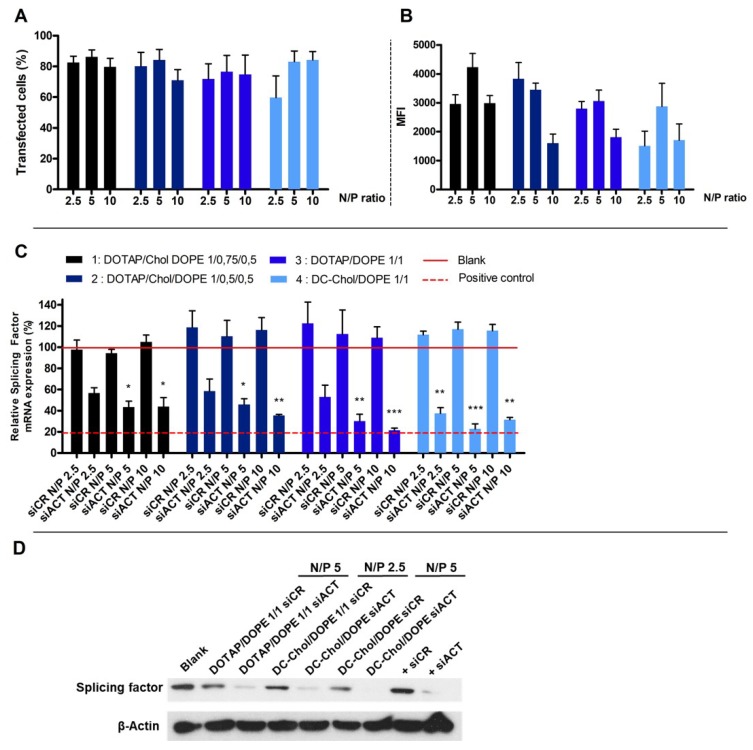
(A) Percentage of transfected A549 cells after the treatment by lipoplexes at different N/P ratios at siRNA concentration of 40 nM (4 h). Cells were post-treated with Trypan Blue solution; (B) Mean Fluorescence Intensity (MFI) was determined by flow cytometry 4 h after the treatment (n = 3). (C) Silencing efficiency of a splicing factor mRNA with lipoplexes carrying the corresponding siRNA targeting this splicing factor (siACT) or a siRNA control (siCR). A549 cells were transfected during 48 h by lipoplexes with 40nM of siRNA (n = 4). The calcium phosphate was used as a transfection positive control following the same procedure. One-way ANOVA, post test Dunnett’s, p < 0.1 (*), p < 0.01 (**) and p < 0.001 (***) compared to untreated cells (Blank); (D) Silencing efficiency of the targeted splicing factor protein with selected lipoplexes carrying the corresponding siRNA directed against this splicing factor (siACT) or a siRNA control (siCR). A549 cells were transfected during 72 h by lipoplexes with 40 nM of siRNA. The calcium phosphate was used as a transfection positive control (+). β-Actin was used as loading control.

References

    1. Kapoor M., Burgess D.J., Patil S.D. Physicochemical characterization techniques for lipid based delivery systems for siRNA. Int. J. Pharm. 2012;427:35–57. doi: 10.1016/j.ijpharm.2011.09.032. - DOI - PubMed
    1. Belmadi N., Midoux P., Loyer P., Passirani C., Pichon C., Le Gall T., Jaffres P.A., Lehn P., Montier T. Synthetic vectors for gene delivery: An overview of their evolution depending on routes of administration. Biotechnol. J. 2015;10:1370–1389. doi: 10.1002/biot.201400841. - DOI - PubMed
    1. Balazs D.A., Godbey W.T. Liposomes for use in gene delivery. J. Drug Deliv. 2011;2011:326497. doi: 10.1155/2011/326497. - DOI - PMC - PubMed
    1. Zhang P., An K., Duan X., Xu H., Li F., Xu F. Recent advances in siRNA delivery for cancer therapy using smart nanocarriers. Drug Discov. Today. 2018;23:900–911. doi: 10.1016/j.drudis.2018.01.042. - DOI - PubMed
    1. Tyagi P., Santos J.L. Macromolecule nanotherapeutics: Approaches and challenges. Drug Discov. Today. 2018 doi: 10.1016/j.drudis.2018.01.017. - DOI - PubMed