Review
. 2018 Apr 24;19(5):1272.
doi: 10.3390/ijms19051272.

Contribution of Tumor Endothelial Cells in Cancer Progression

Affiliations
Review

Contribution of Tumor Endothelial Cells in Cancer Progression

Kyoko Hida et al. Int J Mol Sci. .

Abstract

Tumor progression depends on the process of angiogenesis, which is the formation of new blood vessels. These newly formed blood vessels supply oxygen and nutrients to the tumor, supporting its progression and providing a gateway for tumor metastasis. Tumor angiogenesis is regulated by the balance between angiogenic activators and inhibitors within the tumor microenvironment. Because the newly formed tumor blood vessels originate from preexisting normal vessels, tumor blood vessels, and tumor endothelial cells (TECs) have historically been considered to be the same as normal blood vessels and endothelial cells; however, evidence of TECs’ distinctive abnormal phenotypes has increased. In addition, it has been revealed that TECs constitute a heterogeneous population. Thus, TECs that line tumor blood vessels are important targets in cancer therapy. We have previously reported that TECs induce cancer metastasis. In this review, we describe recent studies on TEC abnormalities related to cancer progression to provide insight into new anticancer therapies.

Keywords: angiogenesis; antiangiogenic therapy; blood vessel; cancer; drug resistance; endothelial cell; metastasis; tumor microenvironment.


Conflict of interest statement

The authors declare no conflicts of interest.

Figures
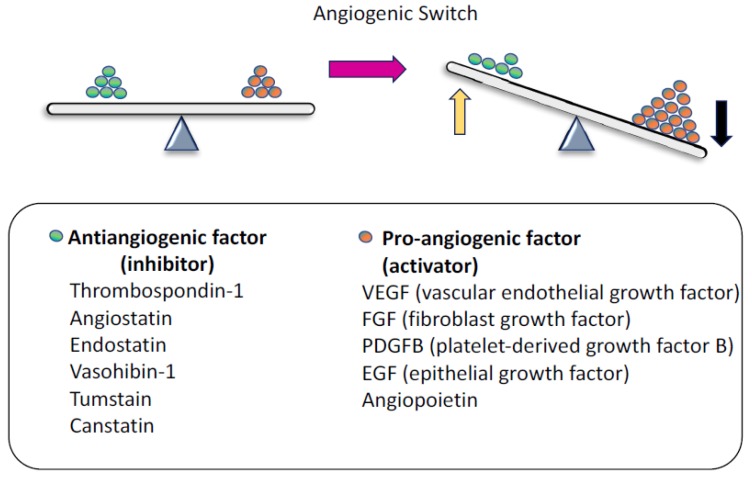
Figure 1
Figure 1
Angiogenesis is regulated by a balance of angiogenic and antiangiogenic factors. In angiogenesis, Pro-angiogenic supporters activate endothelial cells (ECs). In contrast, antiangiogenic factors suppress EC activation. When the angiogenic switch is turned on, there are more angiogenic (black arrow) than antiangiogenic factors present (yellow arrow).
Figure 2
Figure 2
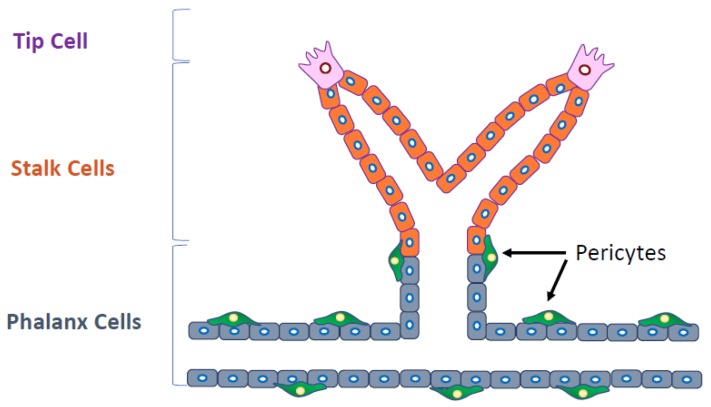
Several types of endothelial cells (ECs) are involved in angiogenesis. Cells at the tip of the blood vessel branch (tip cells) guide the direction of vessel sprouting. Stalk cells, which are highly proliferative, follow tip cells, and phalanx cells improve the perfusion and oxygenation of newly formed blood vessels. Pericytes attach to phalanx cells (black arrows).
Figure 3
Figure 3
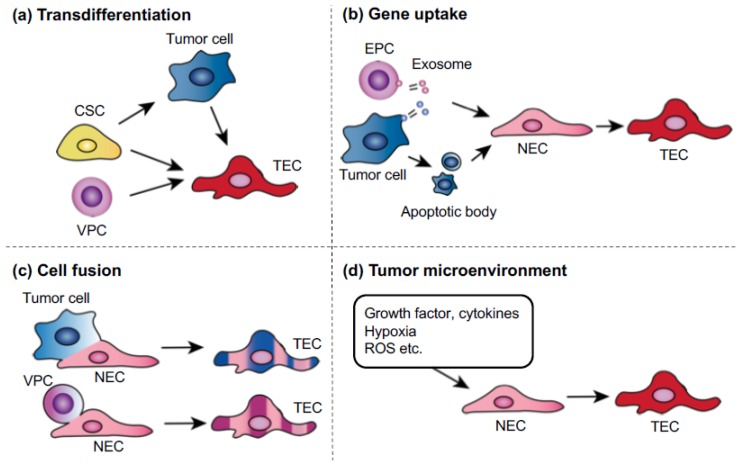
Possible mechanisms of tumor endothelial cells (TEC) abnormalities. (a) Transdifferentiation: tumor cells, cancer stem cells, or vascular progenitor cells (VPCs) might transdifferentiate into TECs. (b) Uptake of oncogenes or gene transfer: ECs can take up human tumor oncogenes by phagocytosis of apoptotic bodies or exosomes, which are released from either endothelial progenitor cells or tumor cells. (c) Cell fusion: malignant tumor cells can fuse with normal endothelial cells (NECs) or circulating VPCs. (d) Tumor microenvironment: growth factors or cytokines in the tumor microenvironment might be factors that cause genetic instability. Hypoxia in tumors is known to cause genetic changes, such as the upregulation of survival factors, not only in tumor cells.
Figure 4
Figure 4
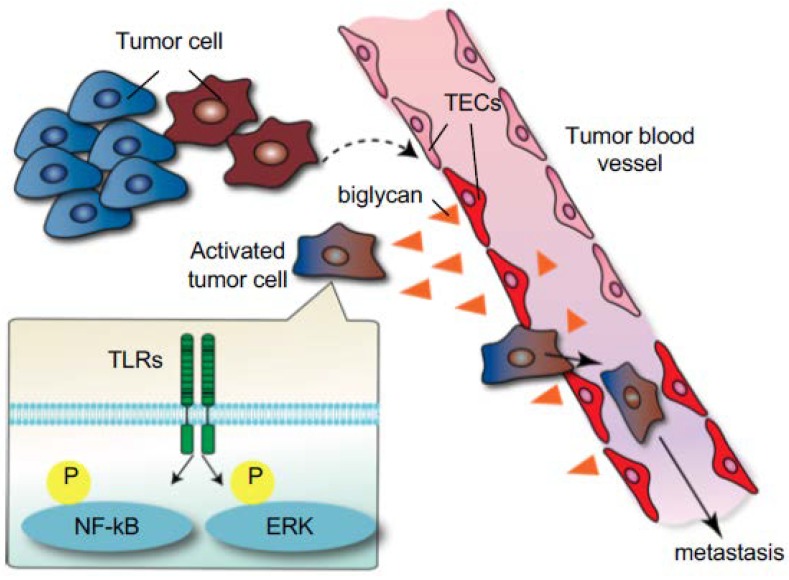
Induction of tumor metastasis by tumor endothelial cells TECs through biglycan secretion. The interaction between tumor cells and the microenvironment alters TEC phenotypes (dotted arrow). In turn, these altered TECs express high levels of biglycan, which induces tumor cells to metastasize through the activation of NF-κB and ERK signaling (black arrow) [73]. (Reprinted from Maishi et al., Sci. Rep. 2016, with permission from Sci. Rep.).

References

    1. Folkman J. Tumor angiogenesis: Therapeutic implications. N. Engl. J. Med. 1971;285:1182–1186. - PubMed
    1. Folkman J., Kerbel R. Role of angiogenesis in tumor growth and metastasis. Clinical translation of angiogenesis inhibitors. Semin. Oncol. 2002;29:15–18. doi: 10.1053/sonc.2002.37263. - DOI - PubMed
    1. Nielsen M., Thomsen J.L., Primdahl S., Dyreborg U., Andersen J.A. Breast cancer and atypia among young and middle-aged women: A study of 110 medicolegal autopsies. Br. J. Cancer. 1987;56:814–819. doi: 10.1038/bjc.1987.296. - DOI - PMC - PubMed
    1. Senger D.R., Galli S.J., Dvorak A.M., Perruzzi C.A., Harvey V.S., Dvorak H.F. Tumor cells secrete a vascular permeability factor that promotes accumulation of ascites fluid. Science. 1983;219:983–985. doi: 10.1126/science.6823562. - DOI - PubMed
    1. Ferrara N., Henzel W.J. Pituitary follicular cells secrete a novel heparin-binding growth factor specific for vascular endothelial cells. Biochem. Biophys. Res. Commun. 1989;161:851–858. doi: 10.1016/0006-291X(89)92678-8. - DOI - PubMed

LinkOut - more resources