. 2018 May 8;115(19):E4512-E4521.
doi: 10.1073/pnas.1717070115. Epub 2018 Apr 25.

An atypical N-ethylmaleimide sensitive factor enables the viability of nematode-resistant Rhg1 soybeans

Affiliations

An atypical N-ethylmaleimide sensitive factor enables the viability of nematode-resistant Rhg1 soybeans

Adam M Bayless et al. Proc Natl Acad Sci U S A. .

Abstract

N-ethylmaleimide sensitive factor (NSF) and α-soluble NSF attachment protein (α-SNAP) are essential eukaryotic housekeeping proteins that cooperatively function to sustain vesicular trafficking. The "resistance to Heterodera glycines 1" (Rhg1) locus of soybean (Glycine max) confers resistance to soybean cyst nematode, a highly damaging soybean pest. Rhg1 loci encode repeat copies of atypical α-SNAP proteins that are defective in promoting NSF function and are cytotoxic in certain contexts. Here, we discovered an unusual NSF allele (Rhg1-associated NSF on chromosome 07; NSFRAN07 ) in Rhg1+ germplasm. NSFRAN07 protein modeling to mammalian NSF/α-SNAP complex structures indicated that at least three of the five NSFRAN07 polymorphisms reside adjacent to the α-SNAP binding interface. NSFRAN07 exhibited stronger in vitro binding with Rhg1 resistance-type α-SNAPs. NSFRAN07 coexpression in planta was more protective against Rhg1 α-SNAP cytotoxicity, relative to WT NSFCh07 Investigation of a previously reported segregation distortion between chromosome 18 Rhg1 and a chromosome 07 interval now known to contain the Glyma.07G195900 NSF gene revealed 100% coinheritance of the NSFRAN07 allele with disease resistance Rhg1 alleles, across 855 soybean accessions and in all examined Rhg1+ progeny from biparental crosses. Additionally, we show that some Rhg1-mediated resistance is associated with depletion of WT α-SNAP abundance via selective loss of WT α-SNAP loci. Hence atypical coevolution of the soybean SNARE-recycling machinery has balanced the acquisition of an otherwise disruptive housekeeping protein, enabling a valuable disease resistance trait. Our findings further indicate that successful engineering of Rhg1-related resistance in plants will require a compatible NSF partner for the resistance-conferring α-SNAP.

Keywords: NSF; Rhg1; plant disease resistance; soybean cyst nematode; α-SNAP.


Conflict of interest statement

Conflict of interest statement: A patent application covering the presently described work has been filed by the Wisconsin Alumni Research Foundation.

Figures
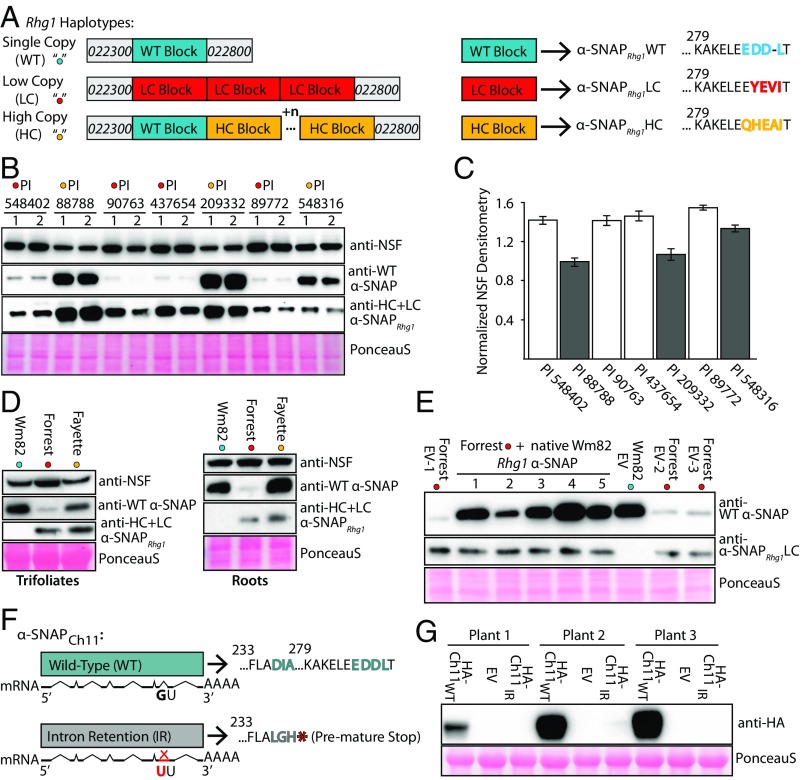
Fig. 1.
Fig. 1.
WT α-SNAP proteins are much less abundant while NSF is more abundant in Rhg1LowCopy soybeans. (A) Schematic of Rhg1 haplotype classes. (Left) Rhg1 WT (shown blue), Rhg1 LC (shown red), Rhg1 HC (shown orange; n = variable HC-type repeat numbers); not drawn to scale. The C-terminal amino acid polymorphisms encoded by the Rhg1 α-SNAPs are shown at Right. HC Rhg1 haplotypes retain a single WT-like Rhg1 repeat. (B) Immunoblot of WT α-SNAPs, Rhg1 resistance-type α-SNAPs and NSF in roots of soybean HG test varieties (two samples for each genotype). Rhg1LC varieties (red dot; 3 Rhg1 copies): PI 548402 (Peking), PI 89772, PI 437654, PI 90763; Rhg1HC varieties (orange dot): PI 88788 (9 copies), PI 209332 (10 copies), PI 548316 (7 copies). PonceauS staining shows similar loading of total protein. (C) Densitometry indicating total NSF expression in HG type test lines. (D) Like B, but immunoblots for trifoliate leaves or roots of Wm82 and modern Rhg1LC and Rhg1HC varieties Forrest and Fayette. (E) Immunoblots for total WT α-SNAPs and α-SNAPRhg1LC in Forrest (Rhg1LC) transgenic roots transformed with an empty vector (EV; three transgenic lines) or with the native Wm82 α-SNAPRhg1WT locus (five transgenic lines), or in WT Wm82 roots transformed with EV. (F) Schematic of chromosome 11 α-SNAP alleles with exon/intron models, and nucleotide and amino acid polymorphisms. (G) The encoded α-SNAPCh11 intron retention protein, unlike the WT α-SNAPCh11, does not accumulate. Anti-HA immunoblot of total protein from N. benthamiana leaves is agroinfiltrated to express empty vector, N-HA-α-SNAPCh11, or N-HA-α-SNAPCh11-IR (intron retention). PonceauS staining shows similar loading of total protein.
Fig. 2.
Fig. 2.
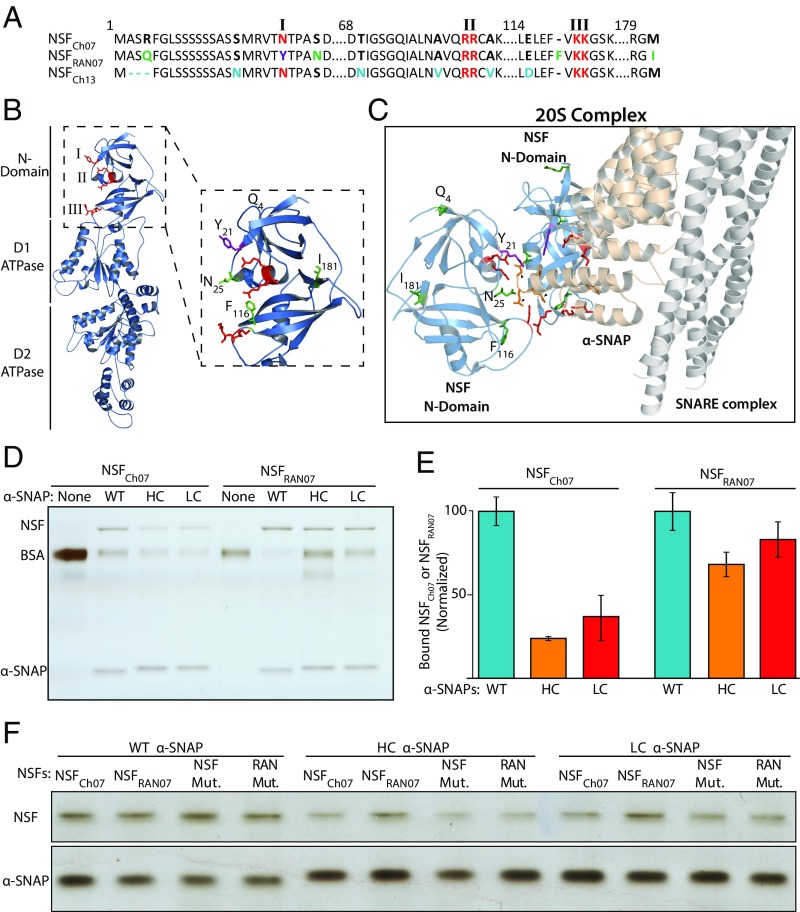
Rhg1-containing lines carry an NSFCh07 allele (RAN07) with N-domain polymorphisms at the α-SNAP binding interface that enhance binding with polymorphic Rhg1 resistance-type α-SNAPs. (A) Alignment of N-terminal domains of soybean NSFCh07, NSFCh13, and NSFRAN07. Large identical regions are omitted. N-domain residues corresponding to those that bind α-SNAP are colored red (N21, RR82–83, KK117–118). NSFRAN07 polymorphisms R4Q, S25N, 116F, and M181I are colored green or purple (N21Y); unique NSFCh13 residues are colored light blue. (B) NSFRAN07 modeled to NSFCHO cryo-EM structure (3J97A, State II). NSF residue patches implicated in α-SNAP binding are colored red and labeled I, II, or III. Zoomed-in view shows NSFRAN07 N-domain polymorphisms colored green or purple (N21Y). (C) Cryo-EM structure of mammalian 20S supercomplex, masked to show only SNARE bundle (white), one α-SNAP (yellow), and two NSF N domains (light blue). Shown are the mammalian residues; conserved NSF N-domain patches (I, R10; II, RK67-68; III, KK104–105) are shown in red, and α-SNAP C-terminal contacts (D217DEED290–293) are shown in orange. Black arrowheads point to three orange α-SNAP residues EED291–293 corresponding to sites of C-terminal polymorphisms in α-SNAPRhg1HC and α-SNAPRhg1LC. NSFRAN07 polymorphism sites are colored green, except N21Y is in purple. (D) Silver-stained SDS/PAGE showing amount of recombinant NSFCh07 or NSFRAN07 bound in vitro by a fixed quantity of the recombinant α-SNAP protein indicated on second line: no-α-SNAP control (None) or WT, LC or HC Rhg1 α-SNAP. (E) Densitometric quantification of NSFCh07 or NSFRAN07 bound as in D by the Rhg1 α-SNAPs denoted at bottom; data are from three independent experiments, and error bars show SEM. (F) Like D, but showing recombinant NSFCh07, NSFRAN07, or mutants of either, bound in vitro by Rhg1 α-SNAPs. NSF Mut. and RAN Mut. refer to NSFCh07 N21A F115A and NSFRAN07 Y21N F116^, respectively.
Fig. 3.
Fig. 3.
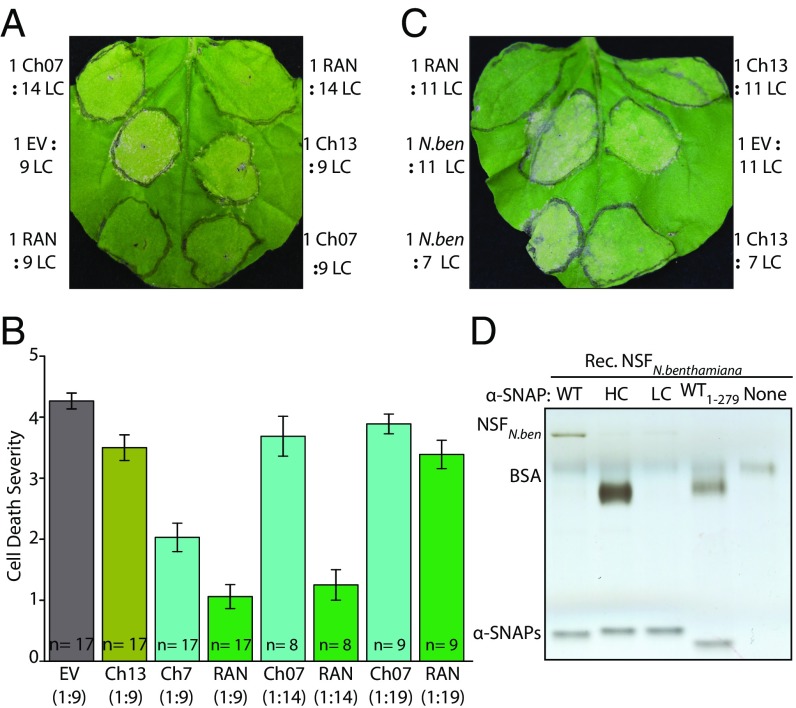
Coexpression of soybean NSFs reduces cell death symptoms caused by α-SNAPRhg1LC; NSFRAN07 gives strongest protection. (A) N. benthamiana leaves ∼6 d after agroinfiltration with 9:1 or 14:1 strain mixture (9 or 14 parts Agrobacterium that delivers LC [α-SNAPRhg1LC] to one part Agrobacterium that delivers the indicated soybean NSF [NSFCh07, NSFRAN07, NSFCh13] or EV control). (B) Scoring of cell death severity, across multiple independent experiments, in N. benthamiana leaf patches coexpressing NSFCh07, NSFRAN07, or NSFCh13; n is number of leaves scored; error bars show SEM. (C) Like A, but 7:1 or 11:1 mixed cultures expressing α-SNAPRhg1LC with NSFRAN07, NSFN.benth, NSFCh13, or empty vector. (D) Silver-stained SDS/PAGE of recombinant NSFN.benth bound in vitro by recombinant WT, LC, or HC Rhg1 α-SNAP proteins or WT α-SNAP lacking the final 10 C-terminal residues (WT1–279).
Fig. 4.
Fig. 4.
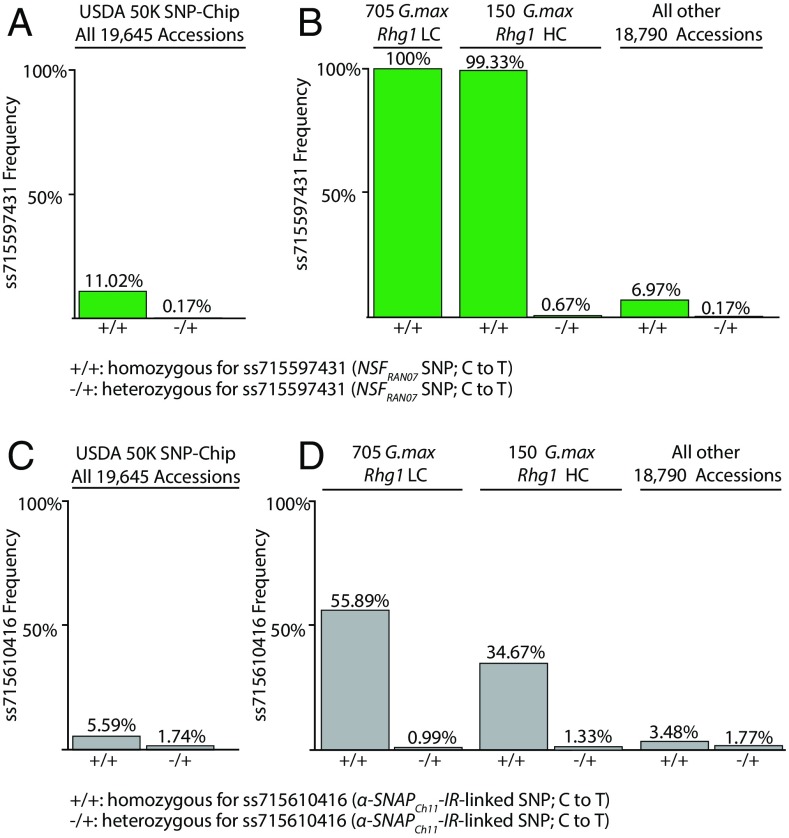
All soybeans in the USDA germplasm collection that carry an Rhg1+ SNP signature also carry the R4Q NSFRAN07 polymorphism. (A) Frequency of SoySNP50K SNP ss715597431 (corresponding to NSFRAN07 R4Q) in all 19,645 SoySNP50K-genotyped Glycine max accessions. (B) Frequency of ss715597431 in all USDA collection G. max with Rhg1LC or Rhg1HC haplotype signatures, or in the remainder of SoySNP50K-genotyped G. max. (C) Frequency of SoySNP50K SNP ss715610416 that is closest marker for α-SNAPCh11-IR allele, across all 19,645 genotyped USDA G. max accessions. (D) Frequency of ss715610416 in all USDA collection G. max with Rhg1LC or Rhg1HC haplotype signatures, or in remainder of SoySNP50K-genotyped G. max.

References

    1. Kyndt T, Vieira P, Gheysen G, de Almeida-Engler J. Nematode feeding sites: Unique organs in plant roots. Planta. 2013;238:807–818. - PubMed
    1. Niblack TL, Lambert KN, Tylka GL. A model plant pathogen from the kingdom Animalia: Heterodera glycines, the soybean cyst nematode. Annu Rev Phytopathol. 2006;44:283–303. - PubMed
    1. Jones JT, et al. Top 10 plant-parasitic nematodes in molecular plant pathology. Mol Plant Pathol. 2013;14:946–961. - PMC - PubMed
    1. Mitchum MG. Soybean resistance to the soybean cyst nematode Heterodera glycines: An update. Phytopathology. 2016;106:1444–1450. - PubMed
    1. Allen TW, et al. Soybean yield loss estimates due to diseases in the United States and Ontario, Canada, from 2010 to 2014. Plant Health Prog. 2017;18:19–27.

Publication types

MeSH terms

Substances

Associated data

LinkOut - more resources