. 2018 Apr;556(7702):447-451.
doi: 10.1038/s41586-018-0042-1. Epub 2018 Apr 25.

Quaternary stereocentres via an enantioconvergent catalytic SN1 reaction

Affiliations

Quaternary stereocentres via an enantioconvergent catalytic SN1 reaction

Alison E Wendlandt et al. Nature. 2018 Apr.

Abstract

The unimolecular nucleophilic substitution (SN1) mechanism features prominently in every introductory organic chemistry course. In principle, stepwise displacement of a leaving group by a nucleophile via a carbocationic intermediate enables the construction of highly congested carbon centres. However, the intrinsic instability and high reactivity of the carbocationic intermediates make it very difficult to control product distributions and stereoselectivity in reactions that proceed via SN1 pathways. Here we report asymmetric catalysis of an SN1-type reaction mechanism that results in the enantioselective construction of quaternary stereocentres from racemic precursors. The transformation relies on the synergistic action of a chiral hydrogen-bond-donor catalyst with a strong Lewis-acid promoter to mediate the formation of tertiary carbocationic intermediates at low temperature and to achieve high levels of control over reaction enantioselectivity and product distribution. This work provides a foundation for the enantioconvergent synthesis of other fully substituted carbon stereocentres.


Conflict of interest statement

The authors declare no competing financial interests.

Figures

Figure 1
Figure 1. Approaches to the enantiocontrolled construction of quaternary stereocenters
a, Traditional methods for synthesis of quaternary stereocenter-containing molecules employ stereochemically defined prochiral substrates. b, SN1 approach to the construction of quaternary stereocenters. c, Enantioselective allylation of propargyl acetates using chiral squaramide catalysts and TMSOTf promoter. TMS, trimethylsilyl; Np, naphthyl.
Figure 2
Figure 2. Asymmetric allylation of propargyl acetates
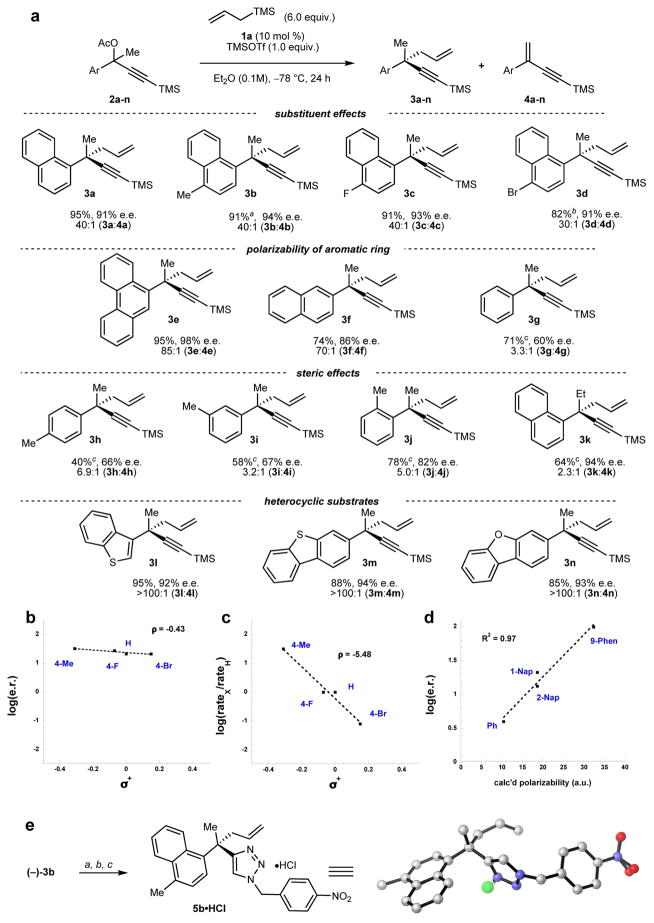
a, Substrate scope. Reactions were run on 0.6 mmol scale with 0.1 equiv. 1a, 1.0 equiv. TMSOTf, and 6.0 equiv. allyltrimethylsilane in 0.1M Et2O at −78 °C for 24 h. a Reaction time was 4 h. b Reaction time was 14 d. c NMR yield. b, Hammett plot of σ+ values of substituents in 2ad versus enantiomer ratios obtained in the formation of 3ad. c, Hammett plot of σ+ values on substituents in 2ad versus relative reaction rates determined for each substrate. d, Linear free energy plot of the calculated polarizability of the aromatic rings in 2a, 2eg versus enantiomer ratios obtained in the formation of 3a, 3eg. e, The absolute configuration of (–)-3b was determined by X-ray crystallography (structure shown), following derivatization to triazole 5b; the configuration of all other products was assigned by analogy. Conditions: (a) TBAF (2.0 equiv.), THF, r.t.; (b) 4-nitrobenzylbromide (1.1 equiv.), NaN3 (1.1 equiv.), CuSO4 (0.1 equiv.), sodium ascorbate (0.2 equiv.), tBuOH/H2O (1:2), 50 °C; (c) HCl (3M in Et2O).
Figure 3
Figure 3. Kinetic data and catalytic cycle
a, Reaction progress kinetic analysis of the reaction of 2b with allyltrimethylsilane. 0.047M; [allyltrimethylsilane]0 = 0.195M; different excess: [2b]0= 0.08M; [allyltrimethylsilane]0 = 0.315M. b, Proposed catalytic mechanism for the enantioselective allylation of propargyl acetates.
Figure 4
Figure 4. Mechanistic studies probing the post-rate-limiting steps of the allylation reaction
a, Crossover experiment establishing irreversible formation of alkene byproduct. b, Partial reaction with scalemic 2g demonstrating that allylation proceeds via a stereoablative mechanism rather than by a dynamic kinetic resolution process. c, Predicted and measured 12C/13C kinetic isotope effects (KIEs).

Comment in

References

    1. Quasdorf KW, Overman LE. Catalytic enantioselective synthesis of quaternary carbon stereocentres. Nature. 2014;516:181–191. - PMC - PubMed
    1. Liu Y, Han SJ, Liu WB, Stoltz BM. Catalytic Enantioselective Construction of Quaternary Stereocenters: Assembly of Key Building Blocks for the Synthesis of Biologically Active Molecules. Acc Chem Res. 2015;48:740–751. - PMC - PubMed
    1. Das JP, Marek I. Enantioselective synthesis of all-carbon quaternary stereogenic centers in acyclic systems. Chem Commun. 2011;47:4593–4623. - PubMed
    1. Feng J, Holmes M, Krische MJ. Acyclic Quaternary Carbon Stereocenters via Enantioselective Transition Metal Catalysis. Chem Rev. 2017;117:12564–12580. - PMC - PubMed
    1. Wilson RM, Jen WS, MacMillan DWC. Enantioselective Organocatalytic Intramolecular Diels−Alder Reactions. The Asymmetric Synthesis of Solanapyrone D. J Am Chem Soc. 2005;127:11616–11617. - PubMed

Publication types

LinkOut - more resources