. 2018 Apr 25;8(1):6523.
doi: 10.1038/s41598-018-24654-y.

Critical roles of TRPV2 channels, histamine H1 and adenosine A1 receptors in the initiation of acupoint signals for acupuncture analgesia

Affiliations

Critical roles of TRPV2 channels, histamine H1 and adenosine A1 receptors in the initiation of acupoint signals for acupuncture analgesia

Meng Huang et al. Sci Rep. .

Abstract

Acupuncture is one of the most promising modalities in complimentary medicine. However, the underlying mechanisms are not well understood yet. We found that in TRPV2 knockout male mice, acupuncture-induced analgesia was suppressed with a decreased activation of mast cells in the acupoints stimulated. The mast cell stabilizer sodium cromolyn could suppress the release of adenosine in the acupoints on male rats. A direct injection of adenosine A1 receptor agonist or histamine H1 receptor agonist increased β-endorphin in the cerebral-spinal fluid in the acute adjuvant arthritis male rats and thus replicated the analgesic effect of acupuncture. These observations suggest that the mast cell is the central structure of acupoints and is activated by acupuncture through TRPV2 channels. The mast cell transduces the mechanical stimuli to acupuncture signal by activating either H1 or A1 receptors, therefore triggering the acupuncture effect in the subject. These findings might open new frontiers for acupuncture research.


Conflict of interest statement

The authors declare no competing interests.

Figures

Figure 1
Figure 1
Different acupuncture effects between TRPV2 knockout (KO) and wild-type (WT) mice. The pain threshold data are presented as the mean ± s.e.m. On day 1, the inflammatory pain model was established. Before establishing the model, the pre-modelling pain threshold was measured. On day 3, the first, post-modelling pain threshold was measured. Acupuncture treatment was performed on the left Zusanli acupoint (ST36) for 30 min, and 20 min later, the post-acupuncture pain threshold was measured. TRPV2-KO is the gene knockout group; TRPV2-WT is the littermate wild-type group. The knockout of the TRPV2 gene inhibited the analgesic effect triggered by acupuncture in this inflammatory-pain mouse model. *vs TRPV2-WT P < 0.05, **vs TRPV2-WT P < 0.01.
Figure 2
Figure 2
Difference in degranulation ratios of mast cells at ST36 of TRPV2-knockout and wild-type mice after acupuncture. The data for degranulation of mast cells are presented as the mean ± s.e.m. The TRPV2-KO group is the gene knockout group; the TRPV2-WT group is the littermate control group. **vs. TRPV2-WT P < 0.01.
Figure 3
Figure 3
The degranulation of mast cells at ST36 induced by acupuncture and its inhibition by sodium cromolyn. After each experimental rat was sacrificed, a 5 × 5 × 5 mm3 volume of skin and muscle tissue from the ST36 acupoint was taken. After 48 hours of fixation in formalin solution, the tissue was cut into 5 μm paraffin sections, with the section plane perpendicular to the skin’s surface. After staining with toluidine blue, the mast cells were dark purple in colour as shown in (a) for Model group, (b) for ACU group and (c) for CRO + ACU group.The acupuncture time at the ST36 acupoints of the animals in the ACU and CRO + ACU groups was 30 min. Sodium cromolyn solution was injected at the acupoint 5 min before acupuncture for the CRO + ACU group. After acupuncture, degranulation of the mast cells was detected in the tissue at the acupoint, as shown by the hollow arrows in the figure. The cell boundaries of mast cells were blurred, and scattered granules were visible in the surrounding regions. In the specimens in the Model group and CRO + ACU group, the mast cells were found to manifest generally clear boundaries, as shown by the black arrows in the figure. (d) The difference of degranulation ratios amomg these three groups is shown in bar graph. The data are presented as the mean ± s.e.m. **vs. ACU P < 0.01. Sodium cromolyn was found to inhibit the mast cell degranulation triggered by acupuncture.
Figure 4
Figure 4
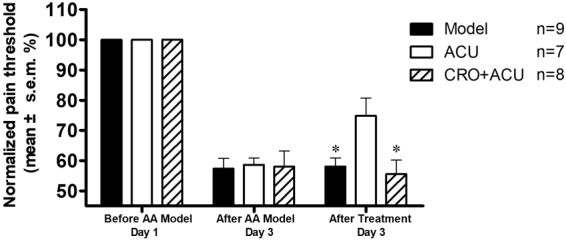
Effect of sodium cromolyn injection on acupuncture analgesia. Pain threshold was normalized according to pain thresholds determined prior to establishing the AA model; the data are presented as the mean ± s.e.m. in the figure. On day 1, the AA model was established. Before establishing the model, the pre-modelling pain threshold was measured. On day 3, first, the post-modelling pain threshold was measured, and the post-treatment pain threshold was measured 20 min after treatment. For the ACU group, acupuncture was performed at the ST36 acupoint for 20 min. For the CRO + ACU group, sodium cromolyn solution was injected locally at the acupoint 5 min before acupuncture. The Model group was restrained for 20 min. Sodium cromolyn was found to inhibit the analgesic effect induced by acupuncture in AA model rats. * vs ACU group, P < 0.05.
Figure 5
Figure 5
Acupuncture-induced change in adenosine at rat ST36. A microdialysis probe was used to collect tissue fluid specimens at the acupoint, and adenosine concentrations were measured using HPLC. Each data point represents the mean ± s.e.m. of the adenosine concentration in the specimen collected at 30-min intervals. The ACU group was administered 30 min of acupuncture, as represented by the shadow. For the CRO + ACU group, sodium cromolyn solution was injected at the acupoint 5 min before acupuncture, which is represented by the dotted line. Sodium cromolyn was found to inhibit an increase in the adenosine concentration triggered by acupuncture. *vs ACU group, P < 0.05.
Figure 6
Figure 6
Local injection of sodium cromolyn into ST36 did not inhibit the analgesic effect caused by A1 receptor activation at this acupoint. The pain threshold was normalised according to the pre-modelling pain threshold; the data are presented as the mean ± s.e.m. On day 1, the AA model was established; however, the pre-modelling pain threshold was measured before establishing the model. On day 3, the post-modelling pain threshold was measured first, and the post-treatment pain threshold was measured 20 min after the treatment. For the ACU group, acupuncture was performed at ST36 for 20 min. For the A1R group, CCPA solution was injected locally at the acupoint. For the CRO + A1R group, sodium cromolyn was injected locally at the acupoint 5 min before the injection of CCPA. *vs ACU group, P < 0.05.
Figure 7
Figure 7
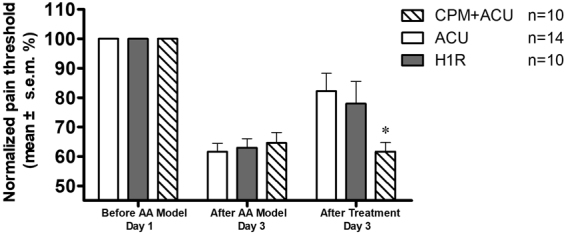
Effects of histamine H1 agonism and antagonism on the acupuncture analgesia. The pain threshold was normalised according to the pre-modelling pain threshold. The data are presented as the mean ± s.e.m. On day 1, the AA model was established; however, before establishing the model, the pre-modelling pain threshold was measured. On day 3, the post-modelling pain threshold was measured first, and the post treatment pain threshold was measured 20 min after treatment. For the ACU group, acupuncture was performed at ST36 for 20 min. For the H1R group, the H1 agonist solution was locally injected at the acupoint. For the CPM + ACU group, the H1 receptor antagonist was locally injected at the acupoint 5 min before acupuncture. Both acupuncture and the activation of the H1 receptor at the ST36 acupoint were found to lead to analgesic effects. The H1 receptor antagonist was found to inhibit the analgesic effect triggered by acupuncture. * vs ACU group, P < 0.05.
Figure 8
Figure 8
Effects of acupuncture and the influences of mast cells, the A1 receptor and the H1 receptor on β-endorphin in the cerebrospinal fluid of animals. ELISA analysis was used to measure the concentrations of β-endorphin in the cerebrospinal fluid of rats. The Control and Model groups were the blank control and the AA model control, respectively. For the ACU group, acupuncture was performed at ST36 for 20 min. For the H1R group, an H1 agonist solution was locally injected at the acupoint. For the CPM + ACU group, the H1 receptor antagonist was locally injected at the acupoint 5 min before acupuncture. For the A1R group, CCPA solution was injected locally at the acupoint. For the CRO + A1R group, sodium cromolyn was injected locally at the acupoint 5 min before the injection of CCPA. For the CRO + ACU group, sodium cromolyn solution was injected at the acupoint 5 min before the acupuncture. For the CRO + A1R group, sodium cromolyn solution was injected at the acupoint 5 min before the injection of the CCPA solution. The EDP concentration in the model group was found to be significantly lower than that of the blank control group. Acupuncture was shown to elevate the EDP concentration, whereas sodium cromolyn or the H1 receptor antagonist was shown to inhibit such an effect. Direct activation of the H1 receptor was shown to increase the EDP concentration. Activation of the A1 receptor was shown to increase the EDP concentration, whereas sodium cromolyn did not demonstrate the ability to inhibit such an effect. *vs Model P < 0.05; **vs Model P < 0.01; # vs ACU P < 0.05.

References

    1. Vickers AJ, et al. Acupuncture for chronic pain: individual patient data meta-analysis. Arch. Intern. Med. 2012;172:1444–1453. doi: 10.1001/archinternmed.2012.3654. - DOI - PMC - PubMed
    1. Yuan, Q. L. et al. Acupuncture for musculoskeletal pain: a meta-analysis and meta-regression of sham-controlled randomized clinical trials. Sci. Rep. 6, 30675; 10.1038/srep30675 (2016). - PMC - PubMed
    1. Vas J, et al. Acupuncture as a complementary therapy to the pharmacological treatment of osteoarthritis of the knee: randomised controlled trial. Br. Med. J. 2004;329:1216–1219. doi: 10.1136/bmj.38238.601447.3A. - DOI - PMC - PubMed
    1. Berman BM, Lao L, Wen LL, Gilpin AMK, Hochberg MC. Effectiveness of acupuncture as adjunctive therapy in osteoarthritis of the knee: a randomized, controlled trial. Ann. Intern. Med. 2004;141:901–910. doi: 10.7326/0003-4819-141-12-200412210-00006. - DOI - PubMed
    1. Macpherson H, et al. Acupuncture and counselling for depression in primary care: a randomised controlled trial. PloS Med. 2013;10:e1001518. doi: 10.1371/journal.pmed.1001518. - DOI - PMC - PubMed

Publication types

MeSH terms

LinkOut - more resources