


Different ways to estimate treatment effects in randomised controlled trials
- PMID: 29696162
- PMCID: PMC5898524
- DOI: 10.1016/j.conctc.2018.03.008
Different ways to estimate treatment effects in randomised controlled trials
Erratum in
-
Erratum regarding missing Declaration of Competing Interest statements in previously published articles.Contemp Clin Trials Commun. 2020 Dec 10;20:100688. doi: 10.1016/j.conctc.2020.100688. eCollection 2020 Dec. Contemp Clin Trials Commun. 2020. PMID: 33392412 Free PMC article.
Abstract
Background: Regarding the analysis of RCT data there is a debate going on whether an adjustment for the baseline value of the outcome variable should be made. When an adjustment is made, there is a lot of misunderstanding regarding the way this should be done. Therefore, the aims of this educational paper are: 1) to explain different methods used to estimate treatment effects in RCTs, 2) to illustrate the different methods with a real life example and 3) to give an advise on how to analyse RCT data.
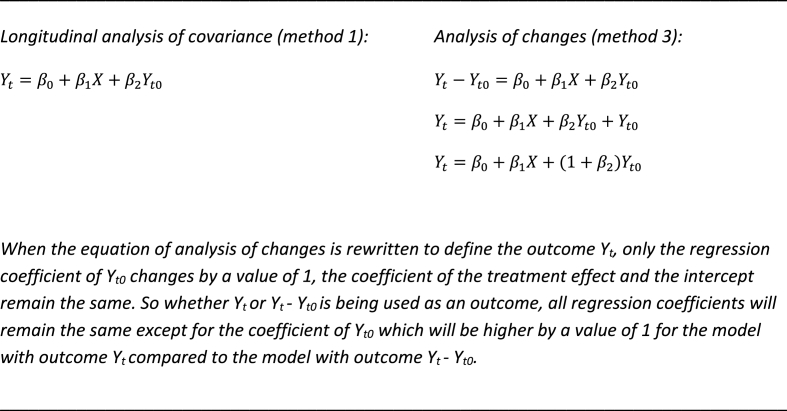
Methods: Longitudinal analysis of covariance, repeated measures analysis in which also the baseline value is used as outcome and the analysis of changes were theoretically explained and applied to an example dataset investigating a systolic blood pressure lowering treatment.
Results: It was shown that differences at baseline should be taken into account and that regular repeated measures analysis and regular analysis of changes did not adjust for the baseline differences between the groups and therefore lead to biased estimates of the treatment effect. In the real life example, due to the differences at baseline between the treatment and control group, the different methods lead to different estimates of the treatment effect.
Conclusion: Regarding the analysis of RCT data, it is advised to use longitudinal analysis of covariance or a repeated measures analysis without the treatment variable, but with the interaction between treatment and time in the model.
Keywords: Analysis of changes; Longitudinal of covariance; Randomised controlled trials; Regression to the mean; Repeated measures.
Figures
References
-
- Fitzmaurice G.M., Laird N.M., Ware J.H. Wiley; Hoboken, NJ: 2004. Applied Longitudinal Data Analysis.
-
- Jamieson J. Analysis of covariance (ANCOVA) with different scores. Int. J. Psychother. 2004;52:277–283. - PubMed
-
- Mayer-Hamblett N., Kronmal R.A. Improving the estimation of change form baseline in a continuous outcome measure in a clinical trial setting. Contemp. Clin. Trials. 2005;26:2–16. - PubMed
-
- Breukelen G.J.P. ANCOVA verus change from baseline had more power in randomized studies and more bias in nonrandomized studies. J. Clin. Epidemiol. 2006;59:920–925. - PubMed
-
- Winkens B., Breukelen G.J.P., Schouten H.J.A., Berger M.P.F. Randomized clinical trials with a pre- and a post-treatment measurement: repeated measures versus ANCOVA models. Contemp. Clin. Trials. 2007;28:713–719. - PubMed
LinkOut - more resources
Full Text Sources
Other Literature Sources
