


Does intra-individual neurocognitive variability relate to neuroinvasive disease and quality of life in West Nile Virus?
- PMID: 29696579
- PMCID: PMC6105392
- DOI: 10.1007/s13365-018-0641-5
Does intra-individual neurocognitive variability relate to neuroinvasive disease and quality of life in West Nile Virus?
Abstract
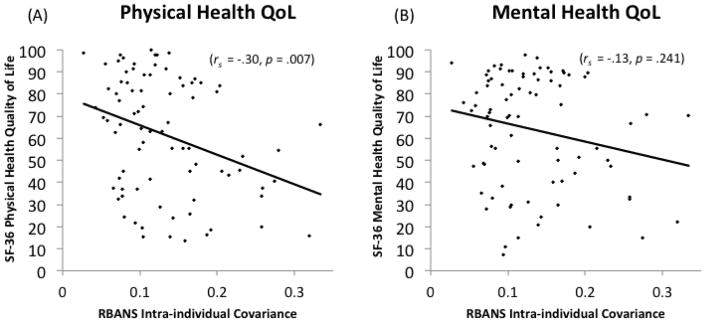
West Nile Virus (WNV) can be a neuroinvasive pathogen that may produce persistent mild-to-moderate neurocognitive impairments in some infected persons. Intra-individual variability (IIV) is an index of a person's performance across a neuropsychological test or battery, which is an indicator of neurocognitive control and integrity of prefrontal systems. The present study examined possible associations of IIV to neurological health and well-being in WNV infection. Participants included 84 adults with a range of clinical WNV disease (31 West Nile Encephalitis, 16 West Nile Meningitis, 37 West Nile Fever) who completed the Repeatable Battery for the Assessment of Neuropsychological Status (RBANS). IIV was operationalized as covariance of variation (CoV), or the intra-individual standard deviation across 5 age-adjusted RBANS standard scores divided by the mean of standard scores. Participants were assessed for health-related quality of life (QoL) using the RAND 36-item short form health survey (SF-36). Analyses revealed that the West Nile Encephalitis group had higher neurocognitive CoV compared to the West Nile Fever group, and this difference was associated with a medium effect size (Cohen's d = .52). Mixed linear models controlling for estimated IQ, activities of daily living, depression, neuroinvasive disease groups, and fatigue showed that higher RBANS CoV was associated with lower physical, but not mental health QoL. In persons with WNV infection, there is a modest association between elevations in IIV and encephalitis, and even subtle disruptions in neuropsychological functioning show relationships with important self-reported functioning as measured by physical health quality of life. Future studies should examine whether IIV predicts long-term health outcomes (e.g., mortality) in individuals infected with WNV.
Keywords: Encephalitis; Intra-individual variability; Neuroinvasive disease; Neuropsychology; Quality of life; West Nile Virus.
Conflict of interest statement
Conflict of Interest
The authors, David P. Sheppard, Steven Paul Woods, Rodrigo Hasbun, Lucrecia Salazar, Melissa S. Nolan, & Kristy O. Murray, declare that they have no conflict of interest.
Figures
References
-
- Brandt J, Spencer M, Folstein M. The Telephone Interview for Cognitive Status 1988
-
- Brewster P, Tuokko H, MacDonald S. Inter-test variability contributes independently to the five-year prediction of Alzheimer’s disease in nondemented older adults. Alzheimers Dement. 2012;8:369. doi: 10.1016/j.jalz.2012.05.1010. - DOI
Publication types
MeSH terms
Grants and funding
LinkOut - more resources
Full Text Sources
Other Literature Sources
Medical
