Randomized Controlled Trial
. 2018 Jan-Dec:12:1753466618770997.
doi: 10.1177/1753466618770997.

Influence of the Vibralung Acoustical Percussor on pulmonary function and sputum expectoration in individuals with cystic fibrosis

Affiliations
Randomized Controlled Trial

Influence of the Vibralung Acoustical Percussor on pulmonary function and sputum expectoration in individuals with cystic fibrosis

Courtney M Wheatley et al. Ther Adv Respir Dis. 2018 Jan-Dec.

Abstract

Background: The Vibralung Acoustical Percussor is a new airway clearance therapy (ACT) utilizing intrapulmonary sound waves in addition to positive expiratory pressure (PEP). We evaluated the safety of the Vibralung and collected preliminary data on its ability to mediate sputum expectoration in individuals with cystic fibrosis (CF).

Methods: Over two separate studies, 10 and 11 mild to moderate CF patients were recruited for study I and II, respectively. Study I: Vibralung was used for 20 min with either no sound (NS: PEP only) or sound (S: PEP and sound) on randomized visits. Pulmonary function, diffusion capacity of the lungs for carbon monoxide and nitric oxide (DLCO/DLNO), symptoms, and peripheral oxygen saturation (SpO2) were measured at baseline and at 1 and 4 h post treatment. Expectorated sputum was collected over 4 h post treatment. Study II: over 5 days of in-hospital therapy, the Vibralung or vibratory vest therapy (Vest) were used for two therapy sessions per day, with sputum collected for 20 min following each therapy and pulmonary function accessed pre and post each 5-day period (days 1-5 or 7-11) in a randomized crossover design.

Results: Vibralung usage resulted in no change from baseline to 4 h post in pulmonary function, SpO2 or symptoms ( p > 0.05). At 4 h post therapy, the DLCO- and DLNO-derived measure of alveolar-capillary unit function (DM/ VC) showed improvement (DM/ VC = 12.5 ± 5.5 versus 7.3 ± 18.8% change, S versus NS) with no difference between S and NS ( p = 0.74). Sputum expectoration was similar between S and NS conditions (wet sputum = 10.5 ± 4.6 versus 9.9 ± 3.2 g, S versus NS, p = 0.25). There were no differences in the improvement in pulmonary function between Vibralung and Vest during either 5-day period during the hospital stay.

Conclusions: Vibralung was well tolerated and caused no detrimental changes in pulmonary function metrics. The Vibralung appears to be a safe ACT in individuals with CF.

Keywords: airway clearance therapy; cystic fibrosis; diffusing capacity of the lungs for carbon monoxide and nitric oxide; high-frequency chest wall oscillation/compression; oscillatory positive expiratory pressure; pulmonary function; sputum expectoration/clearance.


Conflict of interest statement

Conflict of interest statement: The authors declare that there is no conflict of interest.

Figures

Figure 1.
Figure 1.
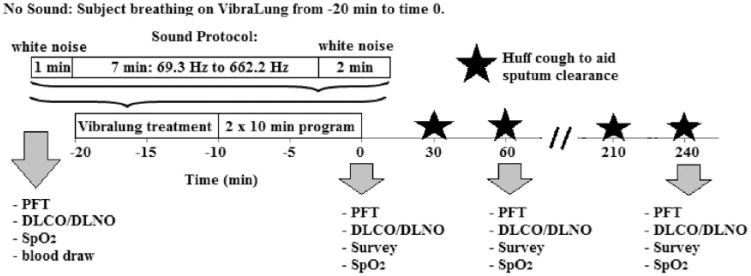
Phase I schematic. The horizontal axis represents time (min) relative to the Vibralung treatment. Two randomized visits were performed where the participants breathed on the Vibralung device: one with sound and one without sound. Assessments were performed at the time points as marked by the grey arrows. Huff cough was performed every 30 min indicated by the black star. PFT, pulmonary function; DLCO/DLNO, diffusion capacity of the lungs for carbon monoxide and nitric oxide; SpO2, peripheral oxygen saturation; Survey, Likert survey to assess symptoms.
Figure 2.
Figure 2.
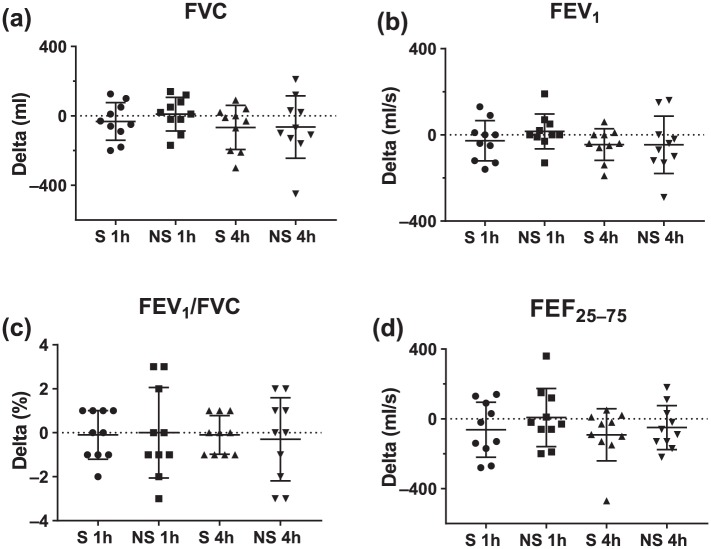
Change in pulmonary function following sound- or no-sound-Vibralung use. Absolute change (delta) from baseline to 1 or 4 h post-Vibralung treatment for the sound (S: PEP and sound, 1 h post = circles; 4 h post = triangles) and no sound (NS: PEP only, 1 h post = squares; 4 h post = inverted triangle) visits for basic spirometry metrics. Scatter plots provide the individual data, as well as summarize the median (middle band) and the first and third quartiles (whiskers) across all patients: (a) forced vital capacity (FVC); (b) forced expiratory volume in 1 s of the FVC (FEV1); (c) ratio of FEV1 over FVC (FEV1/FVC); (d) forced expiratory volume at 25–75% of the FVC (FEF25–75). PEP, positive expiratory pressure.
Figure 3.
Figure 3.
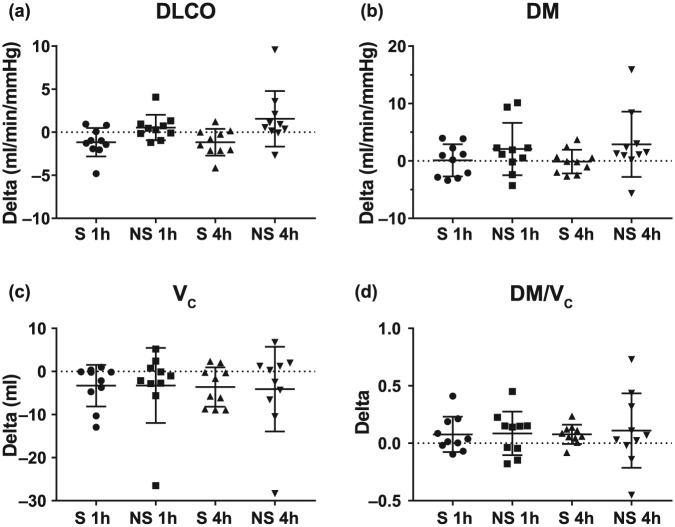
Change in diffusion capacity of the lung for carbon monoxide and its components following sound or no sound Vibralung use. Absolute change (delta) from baseline to 1 h or 4 h post-Vibralung treatment for the sound (S: PEP and sound, 1 h post = circles; 4 h post = triangles) and no sound (NS: PEP only, 1 h post = squares; 4 h post = inverted triangle) visits for lung diffusion capacity for carbon monoxide and its components metrics. Scatter plots provide the individual data as well as summarize the median (middle band) and the first and third quartiles (whiskers) across all patients: (a) diffusion capacity of the lung for carbon monoxide (DLCO); (b) alveolar–capillary membrane conductance (DM); (c) pulmonary–capillary membrane conductance (VC); (d) ratio of DM/VC, measure of a function unit of diffusion. PEP, positive expiratory pressure.
Figure 4.
Figure 4.
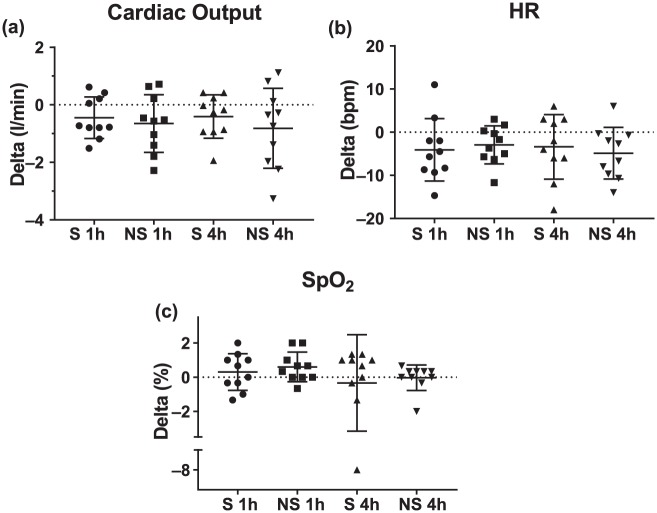
Change in cardiac function following sound or no sound Vibralung use. Absolute change (delta) from baseline to 1 or 4 h post Vibralung treatment for the sound (S: PEP and sound, 1 h post = circles; 4 h post = triangles) and no sound (NS: PEP only, 1 h post = squares and 4 h post = inverted triangle) visits for basic cardiac function metrics. Scatter plots provide the individual data as well as summarize the median (middle band) and the first and third quartiles (whiskers) across all patients: (a) cardiac output; (b) heart rate (HR); (c) peripheral oxygen saturation (SpO2). PEP, positive expiratory pressure; bpm, beats per min.
Figure 5.
Figure 5.
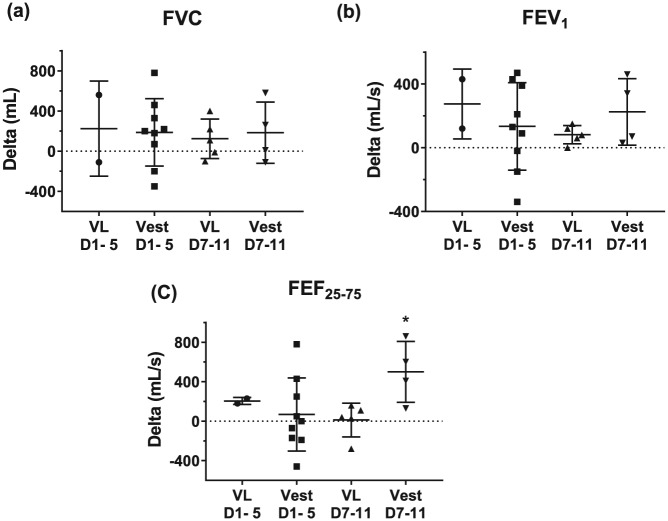
Change in pulmonary function over 5-day period with Vibralung or Vest use. Absolute change (delta) from day 1 to 5 or day 7 to 11 (days 1–5 or days 7–11) when using Vibralung (Vibralung: days 1–5 = circles; days 7–11 = triangles) or Vest (days 1–5 = squares; days 7–12 = inverted triangles) as primary ACT treatment for basic spirometry metrics. Scatter plots provide the individual data as well as summarize the median (middle band) and the first and third quartiles (whiskers) across all patients: (a) forced vital capacity (FVC); (b) forced expiratory volume in 1 s of the FVC (FEV1); (c) forced expiratory volume at 25–75% of the FVC (FEF25–75). *p < 0.05 versus Vibralung days 7–12. ACT, airway clearance therapy; VL, Vibralung; Vest, vibratory vest therapy.

References

    1. Quinton PM. Cystic fibrosis: a disease in electrolyte transport. FASEB J 1990; 4: 2709–2717. - PubMed
    1. Rowe SM, Miller S, Sorscher EJ. Cystic fibrosis. N Engl J Med 2005; 352: 1992–2001. - PubMed
    1. Boucher RC. Airway surface dehydration in cystic fibrosis: pathogenesis and therapy. Annu Rev Med 2007; 58: 157–170. - PubMed
    1. Flume PA, Robinson KA, O’Sullivan BP, et al. Cystic fibrosis pulmonary guidelines: airway clearance therapies. Respir Care 2009; 54: 522–537. - PubMed
    1. Shepherd SL, Hovell MF, Harwood IR, et al. A comparative study of the psychosocial assets of adults with cystic fibrosis and their healthy peers. Chest 1990; 97: 1310–1316. - PubMed

Publication types

MeSH terms