


Differences in Transmission and Disease Severity Between 2 Successive Waves of Chikungunya
- PMID: 29697796
- PMCID: PMC6233685
- DOI: 10.1093/cid/ciy356
Differences in Transmission and Disease Severity Between 2 Successive Waves of Chikungunya
Abstract
Background: Chikungunya, an arboviral disease, caused massive epidemics in Central and South America in 2014-2016. In a prospective pediatric cohort study, we examined the introduction of chikungunya in a naive population and investigated transmission and clinical characteristics.
Methods: Children presenting to the study health center with a chikungunya-like illness or undifferentiated fever were tested for chikungunya virus (CHIKV) infection by reverse transcriptase-polymerase chain reaction (RT-PCR) and serological assays. Inapparent CHIKV infections in the intervening year were determined by seroconversion in healthy blood samples collected annually.
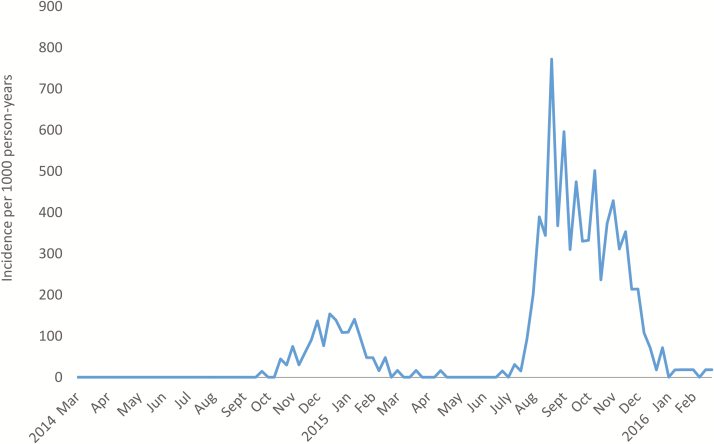
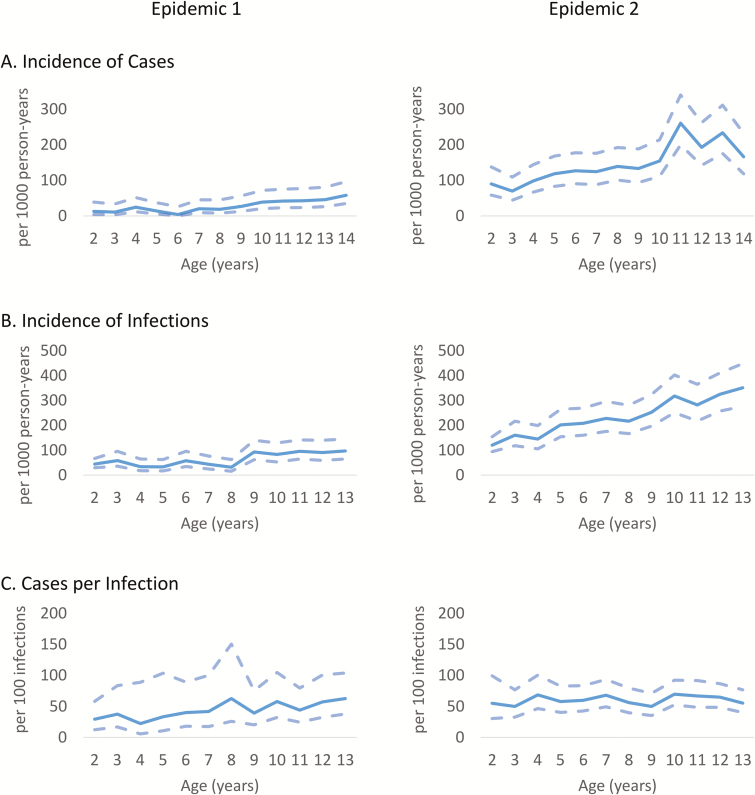
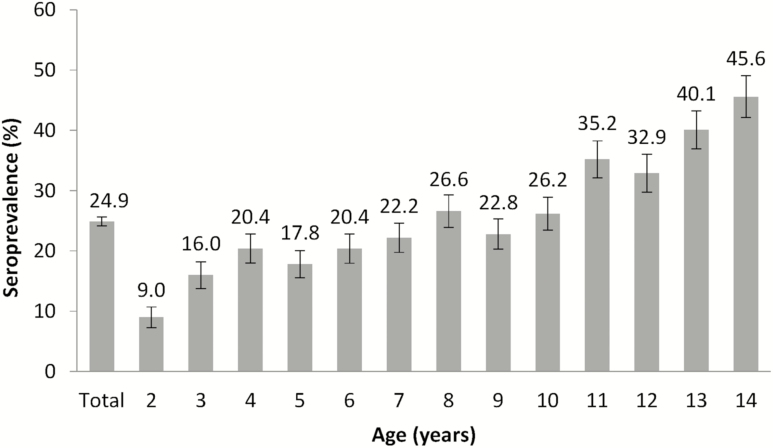
Results: A total of 4353 children participated in the cohort study from March 2014 to February 2016 during the 2 epidemic waves of chikungunya. A total of 539 cases of chikungunya were documented, for an incidence rate of 80.2 cases per 1000 person-years (95% confidence interval [CI]: 73.7, 87.2); and a total of 893 CHIKV infections were documented, for an incidence rate of 137.1 infections per 1000 person-years (95% CI: 128.4, 146.4). The seroprevalence of anti-CHIKV antibodies increased linearly with age, with seroprevalence of >45% in 14-year-old children at the end of Epidemic 2. Symptom presentation varied between the epidemics, with Epidemic 2 exhibiting both a higher symptomatic-to-inapparent ratio (1:1.20 in Epidemic 1 vs. 1:0.65 in Epidemic 2) and more severe clinical presentation among cases. The mean reproduction number was also greater in Epidemic 2 than in Epidemic 1.
Conclusions: The intensity of transmission and severity of clinical presentation varied between the 2 epidemics, with higher transmission intensity associated with greater disease severity.
Figures
Comment in
-
Transmission Dynamics and Disease Severity in Children Infected With East Central South African (ECSA) or ECSA-diverged Clades of Chikungunya Virus.Clin Infect Dis. 2019 Jan 1;68(1):171-172. doi: 10.1093/cid/ciy534. Clin Infect Dis. 2019. PMID: 29982440 No abstract available.
-
Reply to Gérardin et al.Clin Infect Dis. 2019 Jan 1;68(1):172-174. doi: 10.1093/cid/ciy535. Clin Infect Dis. 2019. PMID: 29982451 Free PMC article. No abstract available.
References
-
- Pan American Health Organization. Geographic spread of chikungunya in the Americas, December 2013-December 2017, 2018. Available at: http://ais.paho.org/phip/viz/ed_chikungunya_amro.asp. Accessed 4 December 2018.
-
- Rosario en Multinoticias (9 de Julio de 2014). El 19 digital, 2014. Accessed 7 September 2014 https://www.el19digital.com/articulos/ver/titulo:20342-rosario-en-multin....
-
- Renault P, Balleydier E, D’Ortenzio E, Bâville M, Filleul L. Epidemiology of chikungunya infection on Reunion Island, Mayotte, and neighboring countries. Med Mal Infect 2012; 42:93–101. - PubMed
-
- Sergon K, Njuguna C, Kalani R, et al. Seroprevalence of chikungunya virus (CHIKV) infection on Lamu Island, Kenya, October 2004. Am J Trop Med Hyg 2008; 78:333–7. - PubMed
-
- Sergon K, Yahaya AA, Brown J, et al. Seroprevalence of chikungunya virus infection on Grande Comore Island, union of the Comoros, 2005. Am J Trop Med Hyg 2007; 76:1189–93. - PubMed
Publication types
MeSH terms
Substances
Grants and funding
LinkOut - more resources
Full Text Sources
Other Literature Sources
Medical
