Patterns of perceived partner responsiveness and well-being in Japan and the United States
- PMID: 29698009
- PMCID: PMC5922804
- DOI: 10.1037/fam0000378
Patterns of perceived partner responsiveness and well-being in Japan and the United States
Abstract
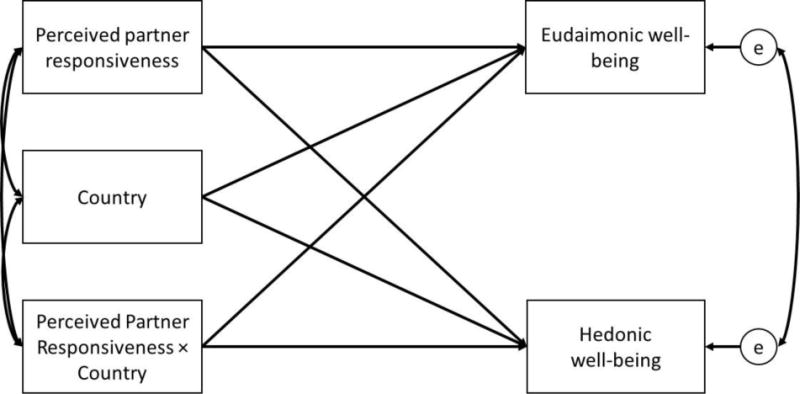
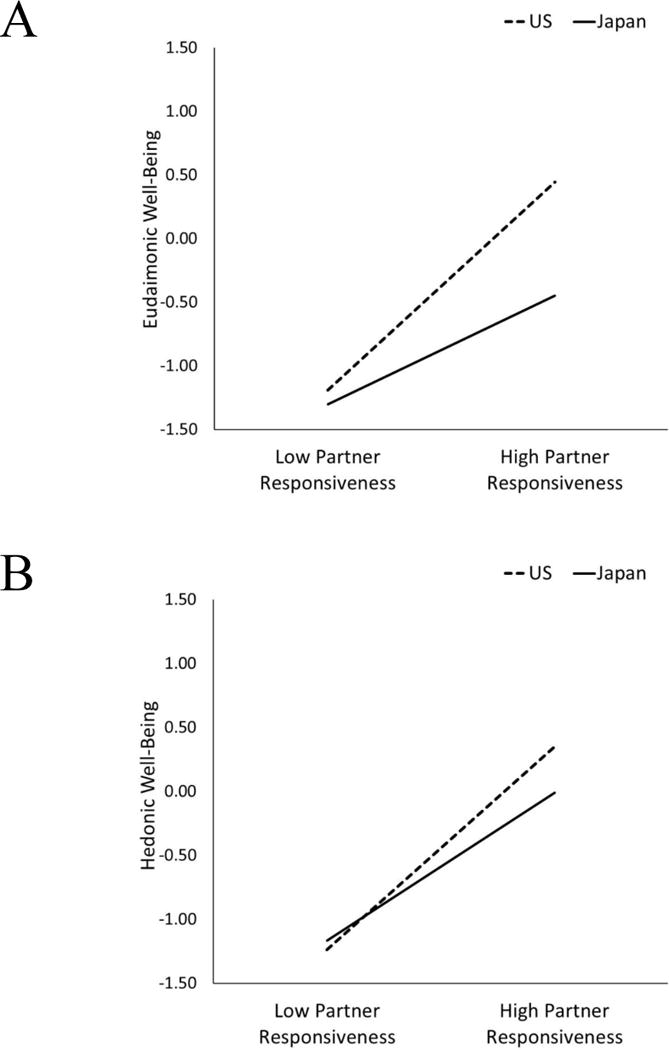
Quality of marital relationships is consistently linked to personal well-being. However, almost all of the studies linking marital processes to well-being have been conducted in Western (particularly North American) countries. Growing evidence shows that perceived partner responsiveness is a central relationship process predicting well-being in Western contexts but little is known about whether this association generalizes to other countries. The present work investigated whether the predictive role of perceived partner responsiveness in well-being differs across the United States and Japan-2 contexts with contrasting views on how the self is conceptualized in relation to the social group. A large life span sample of married or long-term cohabiting adults (n = 3,079, age range = 33-83 in the United States and n = 861, age range = 30-79 in Japan) completed measures of perceived partner responsiveness, hedonic and eudaimonic well-being, and demographic (age, gender, education) and personality (extraversion and neuroticism) covariates known to predict well-being. Perceived partner responsiveness positively predicted hedonic and eudaimonic well-being both in the U.S. and in Japan. However, perceived partner responsiveness more strongly predicted both types of well-being in the United States as compared with Japan. The difference in slopes across the 2 countries was greater for eudaimonic as compared with hedonic well-being. The interaction between perceived partner responsiveness and country held even after controlling for demographic factors and personality traits. By showing that the role of perceived partner responsiveness in well-being may be influenced by cultural context, our findings contribute to achieving a more nuanced picture of the role of relationships in personal well-being. (PsycINFO Database Record
(c) 2018 APA, all rights reserved).
Figures
References
-
- Adams G, Anderson SL, Adonu JK. The cultural grounding of closeness and intimacy. In: Mashek DJ, Aron A, editors. The handbook of closeness and intimacy. Mahwah, NJ: Lawrence Erlbaum Associates; 2004. pp. 321–339.
-
- Beckes L, Coan JA. The distress-relief dynamic in attachment bonding. In: Zayas V, Hazan C, editors. Bases of adult attachment: Linking brain, mind and behavior. New York: Springer; 2015. pp. 11–33.
-
- Bowlby J. A secure base: Clinical applications of attachment theory. London: Routledge; 1988.
-
- Byrne BM, Shavelson RJ, Muthén B. Testing for the equivalence of factor covariance and mean structures: The issue of partial measurement invariance. Psychological Bulletin. 1989;105:456–466. doi: 10.1037/0033-2909.105.3.456. - DOI
-
- Chen FF. Sensitivity of goodness of fit indexes to lack of measurement invariance. Structural Equation Modeling. 2007;14:464–504. doi: 10.1080/10705510701301834. - DOI
MeSH terms
Grants and funding
LinkOut - more resources
Full Text Sources
Other Literature Sources