. 2018 Apr 25;18(1):61.
doi: 10.1186/s12862-018-1173-6.

Admixture, evolution, and variation in reproductive isolation in the Boechera puberula clade

Affiliations

Admixture, evolution, and variation in reproductive isolation in the Boechera puberula clade

Martin P Schilling et al. BMC Evol Biol. .

Abstract

Background: Hybridization is very common in plants, and the incorporation of new alleles into existing lineages (i.e. admixture) can blur species boundaries. However, admixture also has the potential to increase standing genetic variation. With new sequencing methods, we can now study admixture and reproductive isolation at a much finer scale than in the past. The genus Boechera is an extraordinary example of admixture, with over 400 hybrid derivates of varying ploidy levels. Yet, few studies have assessed admixture in this genus on a genomic scale.

Results: In this study, we used Genotyping-by-Sequencing (GBS) to clarify the evolution of the Boechera puberula clade, whose six members are scattered across the western United States. We further assessed patterns of admixture and reproductive isolation within the group, including two additional species (B. stricta and B. retrofracta) that are widespread across North America. Based on 14,815 common genetic variants, we found evidence for some cases of hybridization. We find evidence of both recent and more ancient admixture, and that levels of admixture vary across species.

Conclusions: We present evidence for a monophyletic origin of the B. puberula group, and a split of B. puberula into two subspecies. Further, when inferring reproductive isolation on the basis of presence and absence of admixture, we found that the accumulation of reproductive isolation between species does not seem to occur linearly with time since divergence in this system. We discuss our results in the context of sexuality and asexuality in Boechera.

Keywords: Apomixis; Hybridization; Reproductive isolation; Speciation.


Conflict of interest statement

Competing interests

The authors declare that they have no competing interests.

Publisher’s Note

Springer Nature remains neutral with regard to jurisdictional claims in published maps and institutional affiliations.

Figures
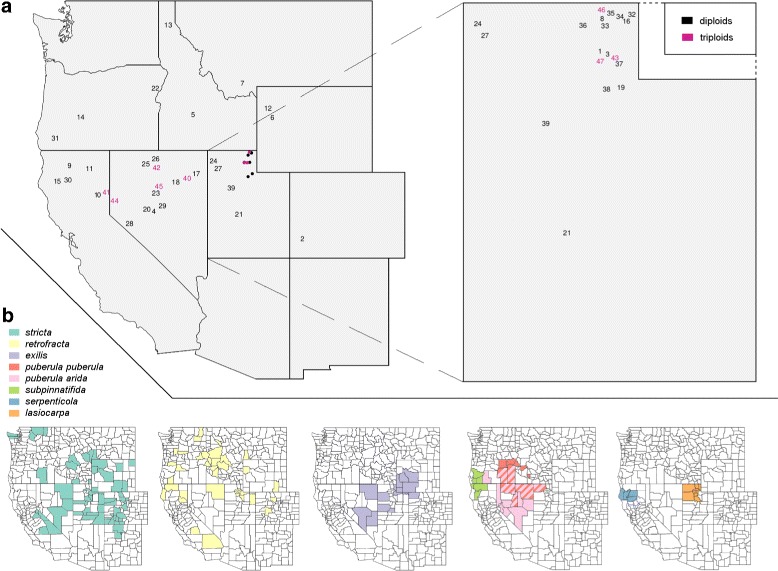
Fig. 1
Fig. 1
Sampling locations and distribution ranges of select Boechera taxa in western United States. a Sampling locations of diploid and triploid Boechera populations including blowup of UT (see locality numbers and nominal taxa in Table 1). Note that we added a small amount of noise to GPS coordinates, in order to make all of the the locality numbers visible. Exact geographic coordinates are provided in Table 1. b Documented distributions of Boechera species across the western United States. Maps include only sexual diploids identified by their epithets. Note that these county-level distributions are based solely on specimens whose identification has been confirmed by microsatellite studies [56]. Both B. retrofracta and B. stricta have wider distributions across North America
Fig. 2
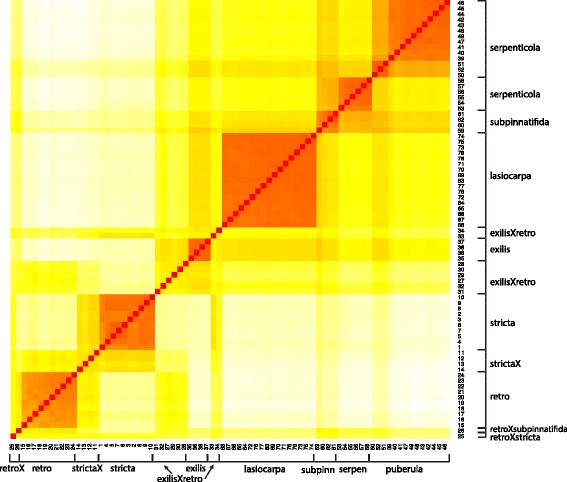
Fig. 2
Heatmap of distance matrix between all 79 diploid individuals sampled. Numbers correspond to ids in Table 1 and Additional file 1: Table S1. Red cells indicates most similar comparisons, white is most different, and yellow and orange are intermediate. Broad taxon assignments are indicated. Note that “strictaX” refers to B. stricta x B. retrofracta (11,13,14) and B. stricta x B. subpinnatifida (12). Samples 47 and 75 (labeled puberula and lasiocarpa, (respectively, in figure) were initially assigned as B. retrofracta
Fig. 3
Fig. 3
Admixture proportions for eight taxa and neighbor-joining tree of B. puberula group members as well as B. stricta and B. retrofracta based on common variants (n= 14,815)
Fig. 4
Fig. 4
Admixture proportions based on 14,815 common variants. Each bar represents Bayesian point estimates of admixture proportions for each respective individual, and thus the proportion of inheritance of each genome to the respective species. Results of 6-10 presumed source species are shown here, with k = 8 being the best model based on DIC values. Groups 1 & 2 denote groups with differential admixture patterns. Results for k of 2 through 16 are shown in Additional file 1: Figure S4
Fig. 5
Fig. 5
Graph structure inferred by treemix with four migration or admixture events for 79 diploid Boechera specimens, rooted with B. stricta. Arrows are colored by migration weight and branch lengths are proportional to genetic drift
Fig. 6
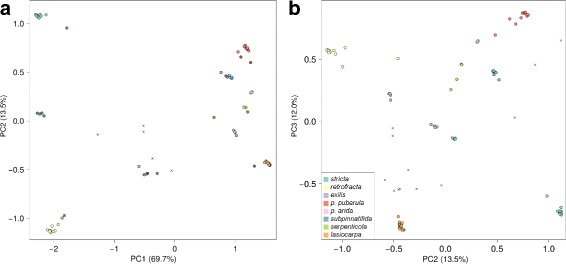
Fig. 6
Statistical summary of genetic variation based on principal component analysis of 14,815 common variants, with a PC1 against PC2, and b PC2 against PC3, with colors assigned to individuals with posterior estimated admixture proportions above 95%, where the legend in b is used for both figures. Hybrids with less than 95% admixture proportions are drawn as crosses, and hybrids with more than 50% admixture proportions from a particular species are drawn as colored circles in the respective color with a cross

References

    1. Harrison RG. Hybrid zones: window on evolutionary process. Oxf Surv Evol Biol. 1990;7:69–128.
    1. Harrison RG. Hybrid Zones and the Evolutionary Process. New York: Oxford University Press; 1993.
    1. Rieseberg LH, Kim S-C, Randell Ra, Whitney KD, Gross BL, Lexer C, Clay K. Hybridization and the colonization of novel habitats by annual sunflowers. Genetica. 2007; 129(2):149–65. 10.1007/s10709-006-9011-y. - PMC - PubMed
    1. Rieseberg LH, Willis JH. Plant Speciation. Science. 2007; 317(5840):910–4. 10.1126/science.1137729. - PMC - PubMed
    1. Rieseberg LH. Evolution: Replacing genes and traits through hybridization. Curr Biol. 2009; 19(3):119–22. 10.1016/j.cub.2008.12.016. - PubMed

Publication types

LinkOut - more resources