


A methodological framework for the evaluation of syndromic surveillance systems: a case study of England
- PMID: 29699520
- PMCID: PMC5921418
- DOI: 10.1186/s12889-018-5422-9
A methodological framework for the evaluation of syndromic surveillance systems: a case study of England
Abstract
Background: Syndromic surveillance complements traditional public health surveillance by collecting and analysing health indicators in near real time. The rationale of syndromic surveillance is that it may detect health threats faster than traditional surveillance systems permitting more timely, and hence potentially more effective public health action. The effectiveness of syndromic surveillance largely relies on the methods used to detect aberrations. Very few studies have evaluated the performance of syndromic surveillance systems and consequently little is known about the types of events that such systems can and cannot detect.
Methods: We introduce a framework for the evaluation of syndromic surveillance systems that can be used in any setting based upon the use of simulated scenarios. For a range of scenarios this allows the time and probability of detection to be determined and uncertainty is fully incorporated. In addition, we demonstrate how such a framework can model the benefits of increases in the number of centres reporting syndromic data and also determine the minimum size of outbreaks that can or cannot be detected. Here, we demonstrate its utility using simulations of national influenza outbreaks and localised outbreaks of cryptosporidiosis.
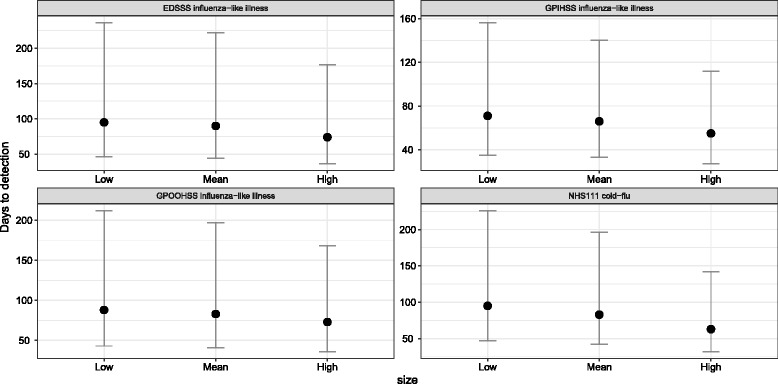
Results: Influenza outbreaks are consistently detected with larger outbreaks being detected in a more timely manner. Small cryptosporidiosis outbreaks (<1000 symptomatic individuals) are unlikely to be detected. We also demonstrate the advantages of having multiple syndromic data streams (e.g. emergency attendance data, telephone helpline data, general practice consultation data) as different streams are able to detect different outbreak types with different efficacy (e.g. emergency attendance data are useful for the detection of pandemic influenza but not for outbreaks of cryptosporidiosis). We also highlight that for any one disease, the utility of data streams may vary geographically, and that the detection ability of syndromic surveillance varies seasonally (e.g. an influenza outbreak starting in July is detected sooner than one starting later in the year). We argue that our framework constitutes a useful tool for public health emergency preparedness in multiple settings.
Conclusions: The proposed framework allows the exhaustive evaluation of any syndromic surveillance system and constitutes a useful tool for emergency preparedness and response.
Keywords: Cryptosporidiosis; Influenza; Scenarios; Simulation; Syndromic surveillance.
Conflict of interest statement
Ethics approval and consent to participate
This project was evaluated and approved by the Faculty of Medicine and Health Sciences Research Ethics Committee from the University of East Anglia in Norwich, UK. The Research Ethics Committee reference number is 2016/17-101.
Consent for publication
Not applicable. This study does not include any individual person level data.
Competing interests
The authors declare that they have no competing interests.
Publisher’s Note
Springer Nature remains neutral with regard to jurisdictional claims in published maps and institutional affiliations.
Figures


References
-
- Henning KJ. What is Syndromic Surveillance? MMWR Suppl. 2004;24:5–11. - PubMed
-
- Smith GE, Elliot AJ, Ibbotson S, Morbey RA, Edeghere O, Hawker J, Catchpole M, Endericks T, Fisher P, McCloskey B. Novel public health risk assessment process developed to support syndromic surveillance for the 2012 Olympic and Paralympic Games. J Public Health (Oxf) 2016;39:e111–e117. - PMC - PubMed
MeSH terms
Grants and funding
LinkOut - more resources
Full Text Sources
Other Literature Sources
