


Therapeutic potential to reduce brain injury in growth restricted newborns
- PMID: 29700828
- PMCID: PMC6265565
- DOI: 10.1113/JP275428
Therapeutic potential to reduce brain injury in growth restricted newborns
Abstract
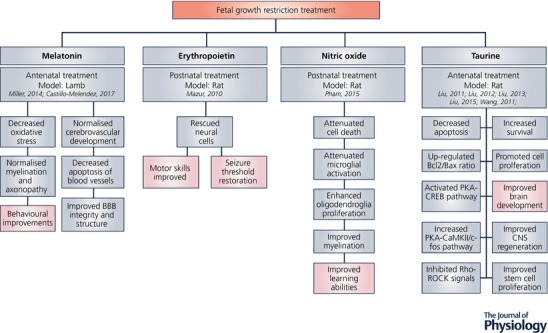
Brain injury in intrauterine growth restricted (IUGR) infants is a major contributing factor to morbidity and mortality worldwide. Adverse outcomes range from mild learning difficulties, to attention difficulties, neurobehavioral issues, cerebral palsy, epilepsy, and other cognitive and psychiatric disorders. While the use of medication to ameliorate neurological deficits in IUGR neonates has been identified as warranting urgent research for several years, few trials have been reported. This review summarises clinical trials focusing on brain protection in the IUGR newborn as well as therapeutic interventions trialled in animal models of IUGR. Therapeutically targeting mechanisms of brain injury in the IUGR neonate is fundamental to improving long-term neurodevelopmental outcomes. Inflammation is a key mechanism in neonatal brain injury; and therefore an appealing target. Ibuprofen, an anti-inflammatory drug currently used in the preterm neonate, may be a potential therapeutic candidate to treat brain injury in the IUGR neonate. To better understand the potential of ibuprofen and other therapeutic agents to be neuroprotective in the IUGR neonate, long-term follow-up information of neurodevelopmental outcomes must be studied. Where agents such as ibuprofen are shown to be effective, have a good safety profile and are relatively inexpensive, they can be widely adopted and lead to improved outcomes.
Keywords: growth retardation; ibuprofen; inflammation.
© 2018 The Authors. The Journal of Physiology © 2018 The Physiological Society.
Figures
References
-
- Als H, Duffy FH, McAnulty G, Butler SC, Lightbody L, Kosta S, Weisenfeld NI, Robertson R, Parad RB, Ringer SA, Blickman JG, Zurakowski D & Warfield SK (2012). NIDCAP improves brain function and structure in preterm infants with severe intrauterine growth restriction. J Perinatol 32, 797–803. - PMC - PubMed
-
- Als H, Duffy FH, McAnulty GB, Fischer CB, Kosta S, Butler SC, Parad RB, Blickman JG, Zurakowski D & Ringer SA (2011). Is the Newborn Individualized Developmental Care and Assessment Program (NIDCAP) effective for preterm infants with intrauterine growth restriction? J Perinatol 31, 130–136. - PMC - PubMed
-
- Alves de Alencar Rocha AK, Allison BJ, Yawno T, Polglase GR, Sutherland AE, Malhotra A, Jenkin G, Castillo‐Melendez M & Miller SL (2017). Early‐ versus late‐onset fetal growth restriction differentially affects the development of the fetal sheep brain. Dev Neurosci 39, 141–155. - PubMed
-
- Ambat MT, Ostrea EM Jr & Aranda JV (2008). Effect of ibuprofen L‐lysinate on bilirubin binding to albumin as measured by saturation index and horseradish peroxidase assays. J Perinatol 28, 287–290. - PubMed
Publication types
MeSH terms
Grants and funding
LinkOut - more resources
Full Text Sources
Other Literature Sources
