Review
. 2018 Apr 27;23(5):1030.
doi: 10.3390/molecules23051030.

Transient Sulfenic Acids in the Synthesis of Biologically Relevant Products

Affiliations
Review

Transient Sulfenic Acids in the Synthesis of Biologically Relevant Products

Anna Barattucci et al. Molecules. .

Abstract

Sulfenic acids as small molecules are too unstable to be isolated and their transient nature offers the possibility to involve them in concerted processes that lead to the obtainment of functional groups such as sulfoxides, sulfones, and disulfides. All these functions are present in a number of natural and synthetic drugs and can represent structural motives inducing biologically relevant properties. In this small review the generation and reactions of sulfenic acid bearing naturally occurring residues are described. Carbohydrate and aminoacid-derived sulfenic acids have been used in concerted addition with triple bonds to obtain alliin derivatives and thiosugars in enantiomerically pure form. Glycoconjugates with sulfinyl, sulfonyl, and disulfane functional groups and pyridine-derived disulfides have been obtained from bis- and tris-sulfinyl precursors of sulfenic acids. Small families of such compounds have been subjected to preliminary biological tests. Starting from the evidence that the control of molecular architecture and the presence of suitable functional groups can play a significant role on the exhibition of biological properties, apoptotic effects on malignant cells by glycoconjugates and inhibitory activity against the important human pathogen S. aureus by pyrimidine-derived disulfides have been found.

Keywords: alliin derivatives; disulfides; glycoconjugates; pyrimidine derivatives; sulfenic acids; sulfones; sulfoxides.


Conflict of interest statement

The authors declare no conflict of interest.

Figures
Scheme 1
Scheme 1
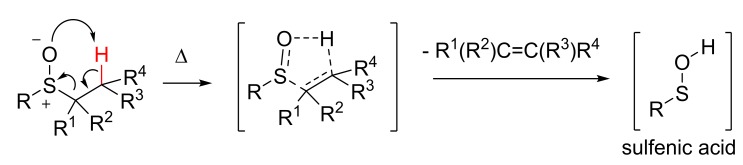
Generation of transient sulfenic acids.
Scheme 2
Scheme 2
Synthetic route to sulfoxide precursors and their thermolysis temperature.
Scheme 3
Scheme 3
Sulfoxides and disulfides from sulfenic acids.
Scheme 4
Scheme 4
From alliin to allicin, via allylsulfenic acid.
Scheme 5
Scheme 5
Synthetic pathways for in situ generating l-cysteine-derived sulfenic acids A, B, and C.
Scheme 6
Scheme 6
The synthetic pathways to thiosaccharides 17 and 18.
Scheme 7
Scheme 7
From bis-sulfenic acid to glycoconjugate 19.
Figure 1
Figure 1
Effect of compound 19 on apoptosis: (a) U937 cells were exposed for 24 h to different concentrations of control vehicle (DMSO), PAGP, compounds 1921. Apoptosis was evaluated by fluorescence microscopy after staining of the cells with acridine orange; (b) Molt-3 cells were exposed for 24 h to different concentrations of control vehicle (DMSO) and compound 19. Apoptosis was evaluated as described in (a).
Figure 2
Figure 2
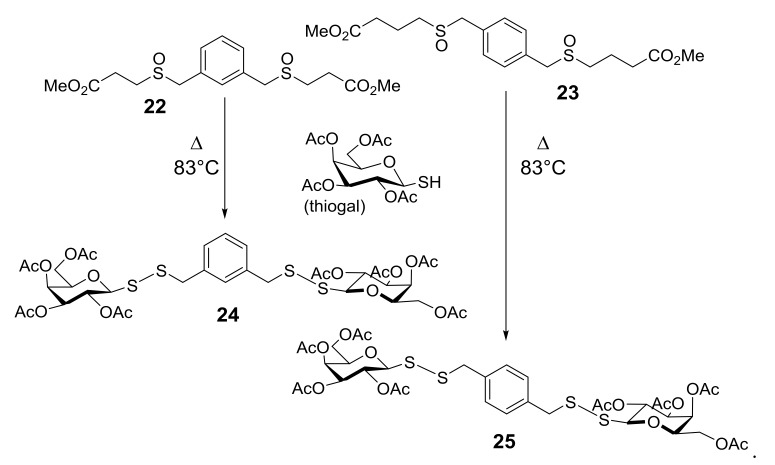
(a) Effects of bis(disulfides) 24 and 25 and thiogal on the cytotoxicity in U937 cells after 24 h incubation, in comparison with other molecules of the same family. Percentage nuclei showing apoptotic features at microscopy analysis following staining with acridine orange; (b) Effects of bis(disulfide) 25 on apoptosis in U937 transfectants overexpressing Bcl-2 (U937mBCL2) and in U937 control transfectants (U937pMEP), after 24 h incubation.
Scheme 8
Scheme 8
From bis-sulfinyl 22 and 23 precursors of sulfenic acids to glycoconjugates 24 and 25.
Figure 3
Figure 3
Effect of compound 24 on apoptosis in U937 cells and in peripheral blood mononuclear cells (PBMC). U937 cells and PBMC were treated with 0, 1, 10, 50, and 100 μM of compound 24 for 24 and 48 h, respectively. Apoptosis was evaluated by hypodiploid nuclei analysis after DNA staining with propidium iodide. Percentages of hypodiploid nuclei (M1) are reported in the cytograms.
Scheme 9
Scheme 9
From tris-sulfinyl precursors of sulfenic acids to pyrimidine-derived tris-disulfide 26.

References

    1. Feng M., Tang B., Liang S.H., Jiang X. Sulfur Containing Scaffolds in Drugs: Synthesis and Application in Medicinal Chemistry. Curr. Top. Med. Chem. 2016;16:1200–1216. doi: 10.2174/1568026615666150915111741. - DOI - PMC - PubMed
    1. Ilardi E.A., Vitaku E., Njardarson J.T. Data-Mining for Sulfur and Fluorine: An Evaluation of Pharmaceuticals to Reveal Opportunities for Drug Design and Discovery. J. Med. Chem. 2014;57:2832–2842. doi: 10.1021/jm401375q. - DOI - PubMed
    1. Han J., Soloshonok V.A., Klika K.D., Drabowicz J., Wzorek A. Chiral sulfoxides: Advances in asymmetric synthesis and problems with the accurate determination of the stereochemical outcome. Chem. Soc. Rev. 2018;47:1307–1350. doi: 10.1039/C6CS00703A. - DOI - PubMed
    1. Bentley R. Role of sulfur chirality in the chemical processes of biology. Chem. Soc. Rev. 2005;34:609–624. doi: 10.1039/b418284g. - DOI - PubMed
    1. Liu N.-W., Liang S., Manolikakes G. Recent Advances in the Synthesis of Sulfones. Synthesis. 2016;48:1939–1973. doi: 10.1055/s-0035-1560444. - DOI

MeSH terms

LinkOut - more resources