


Bioactive Bromotyrosine-Derived Alkaloids from the Polynesian Sponge Suberea ianthelliformis
- PMID: 29702602
- PMCID: PMC5983277
- DOI: 10.3390/md16050146
Bioactive Bromotyrosine-Derived Alkaloids from the Polynesian Sponge Suberea ianthelliformis
Abstract
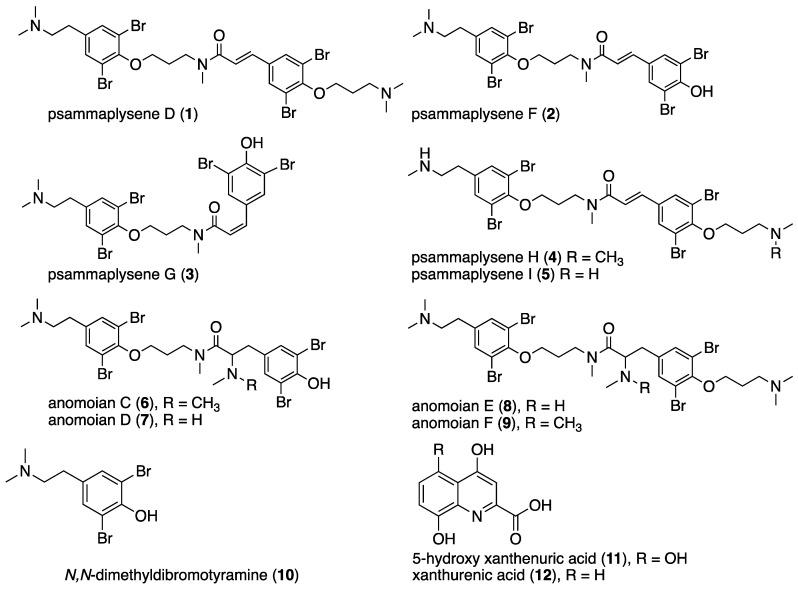
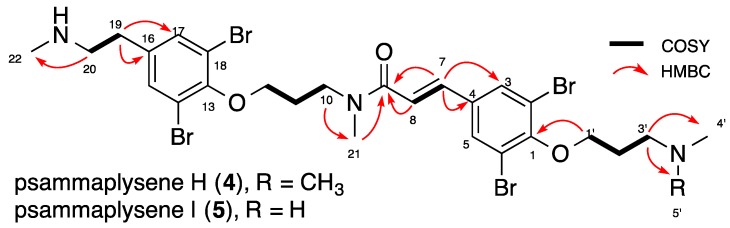
Herein, we describe the isolation and spectroscopic identification of eight new tetrabrominated tyrosine alkaloids 2⁻9 from the Polynesian sponge Suberea ianthelliformis, along with known major compound psammaplysene D (1), N,N-dimethyldibromotyramine, 5-hydroxy xanthenuric acid, and xanthenuric acid. Cytotoxicity and acetylcholinesterase inhibition activities were evaluated for some of the isolated metabolites. They exhibited moderate antiproliferative activity against KB cancer cell lines, but psammaplysene D (1) displayed substantial cytotoxicity as well as acetylcholinesterase inhibition with IC50 values of 0.7 μM and 1.3 μM, respectively.
Keywords: Suberea ianthelliformis; acetylcholinesterase inhibition; brominated tyrosine alkaloids; cytotoxicity.
Conflict of interest statement
The authors declare no conflict of interest.
Figures



References
-
- Rahboek L., Christophersen C. The Alkaloids: Chemistry and Biology. Volume 57. Academic Press; Cambridge, MA, USA: 2001. p. 185. - PubMed
-
- Nuñez C.V., Almeida E.V.R., Granato A.C., Marques S.O., Santos K.O., Pereira F.R., Macedo M.L., Ferreira A.G., Hajdu E., Pinheiro U.S., et al. Chemical variability within the marine sponge Aplysina fulva. Biochem. Syst. Ecol. 2008;36:283–296. doi: 10.1016/j.bse.2007.09.008. - DOI
-
- Puyana M., Pawlik J., Blum J., Fenical W. Metabolite variability in Caribbean sponges of the genus Aplysina. Rev. Bras. Farmacogn. 2015;25:592–599. doi: 10.1016/j.bjp.2015.08.002. - DOI
-
- König G.M., Wright A.D. Agelorins A and B, and 11-Epi-fistularin-3, Three New Antibacterial Fistularin-3 Derivatives from the Tropical Marine Sponge Agelas oroides. Heterocycles. 1993;36:1351–1358. doi: 10.3987/COM-92-6317. - DOI
-
- Nicacio K.J., Ióca L.P., Fróes A.M., Leomil L., Appolinario L.R., Thompson C.C., Thompson F.L., Ferreira A.G., Williams D.E., Andersen R.J., et al. Cultures of the Marine Bacterium Pseudovibrio denitrificans Ab134 Produce Bromotyrosine-Derived Alkaloids Previously Only Isolated from Marine Sponges. J. Nat. Prod. 2017;80:235–240. doi: 10.1021/acs.jnatprod.6b00838. - DOI - PubMed
MeSH terms
Substances
LinkOut - more resources
Full Text Sources
Other Literature Sources
Research Materials
