


Anatomy of an online misinformation network
- PMID: 29702657
- PMCID: PMC5922526
- DOI: 10.1371/journal.pone.0196087
Anatomy of an online misinformation network
Abstract
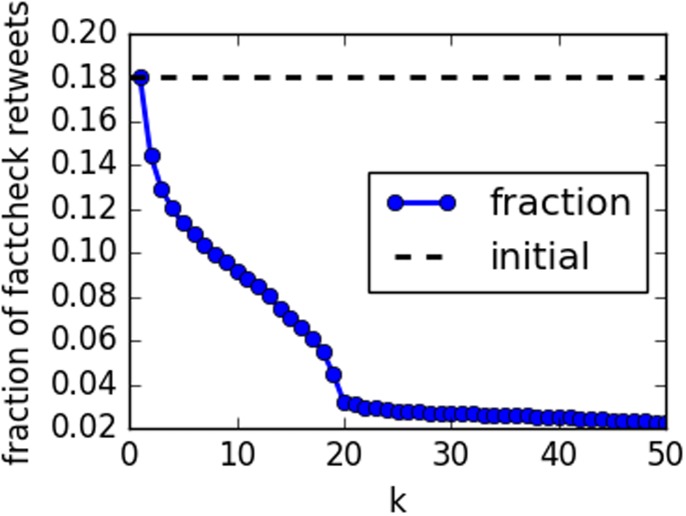
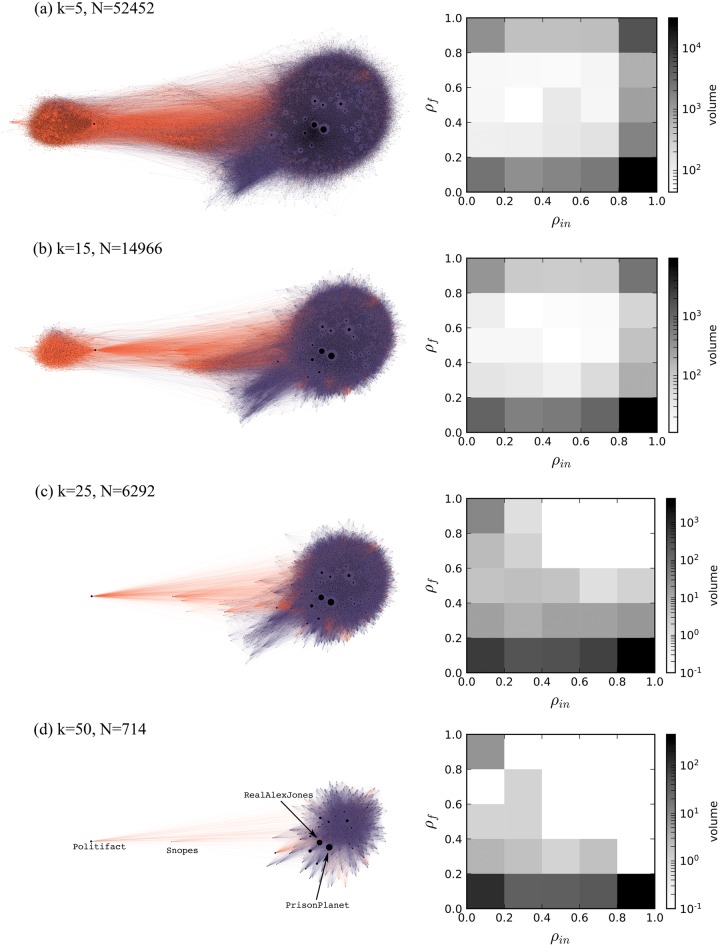
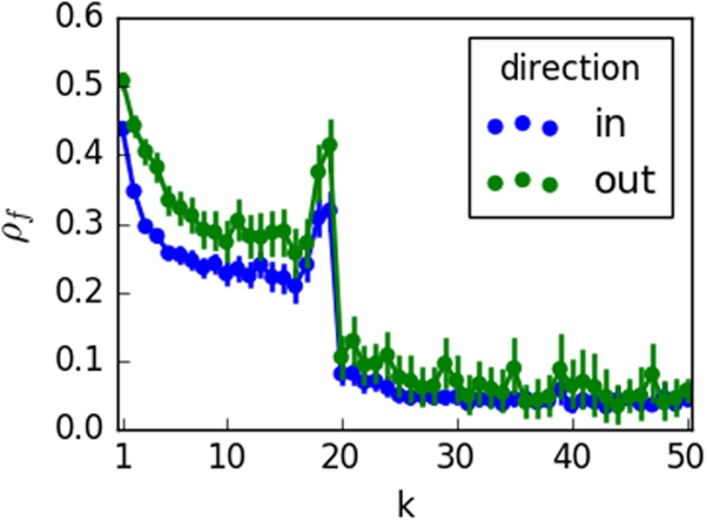
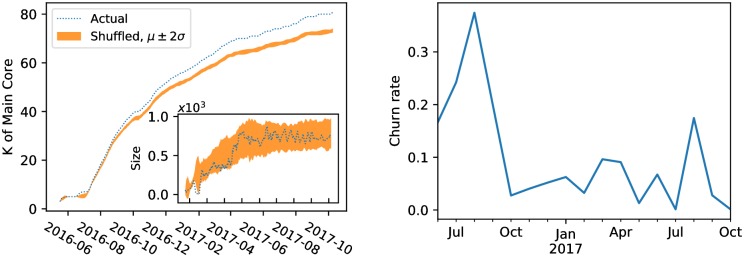
Massive amounts of fake news and conspiratorial content have spread over social media before and after the 2016 US Presidential Elections despite intense fact-checking efforts. How do the spread of misinformation and fact-checking compete? What are the structural and dynamic characteristics of the core of the misinformation diffusion network, and who are its main purveyors? How to reduce the overall amount of misinformation? To explore these questions we built Hoaxy, an open platform that enables large-scale, systematic studies of how misinformation and fact-checking spread and compete on Twitter. Hoaxy captures public tweets that include links to articles from low-credibility and fact-checking sources. We perform k-core decomposition on a diffusion network obtained from two million retweets produced by several hundred thousand accounts over the six months before the election. As we move from the periphery to the core of the network, fact-checking nearly disappears, while social bots proliferate. The number of users in the main core reaches equilibrium around the time of the election, with limited churn and increasingly dense connections. We conclude by quantifying how effectively the network can be disrupted by penalizing the most central nodes. These findings provide a first look at the anatomy of a massive online misinformation diffusion network.
Conflict of interest statement
Figures
References
-
- Barthel M, Mitchell A, Holcomb J. Many Americans Believe Fake News Is Sowing Confusion; 2016. Available from: http://www.journalism.org/2016/12/15/many-americans-believe-fake-news-is....
-
- Gottfried J, Shearer E. News Use Across Social Media Platforms 2017; 2017. Available from: http://www.journalism.org/2017/09/07/news-use-across-social-media-platfo....
-
- Barthel M, Mitchell A. Americans’ Attitudes About the News Media Deeply Divided Along Partisan Lines; 2017. Available from: http://www.journalism.org/2017/05/10/americans-attitudes-about-the-news-....
-
- Ratkiewicz J, Conover M, Meiss M, Gonçalves B, Patil S, Flammini A, et al. Truthy: Mapping the Spread of Astroturf in Microblog Streams. In: Proceedings of the 20th International Conference Companion on World Wide Web. WWW’11. New York, NY, USA: ACM; 2011. p. 249–252. Available from: http://doi.acm.org/10.1145/1963192.1963301. - DOI
-
- Xiang W, Zhilin Z, Xiang Y, Yan J, Bin Z, Shasha L. Finding the hidden hands: a case study of detecting organized posters and promoters in SINA weibo. China Communications. 2015;12(11):1–13. doi: 10.1109/CC.2015.7366237 - DOI
Publication types
MeSH terms
LinkOut - more resources
Full Text Sources
Other Literature Sources
Research Materials
