


Prenatal fine particulate exposure associated with reduced childhood lung function and nasal epithelia GSTP1 hypermethylation: Sex-specific effects
- PMID: 29703190
- PMCID: PMC5923186
- DOI: 10.1186/s12931-018-0774-3
Prenatal fine particulate exposure associated with reduced childhood lung function and nasal epithelia GSTP1 hypermethylation: Sex-specific effects
Abstract
Background: In utero exposure to particulate matter with an aerodynamic diameter of less than 2.5 μm (PM2.5) has been linked to child lung function. Overlapping evidence suggests that child sex and exposure timing may modify effects and associations may be mediated through glutathione S-transferase P1 (GSTP1) methylation.
Methods: We prospectively examined associations among prenatal PM2.5 exposure and child lung function and GSTP1 methylation in an urban pregnancy cohort study. We employed a validated satellite-based spatiotemporally resolved prediction model to estimate daily prenatal PM2.5 exposure over gestation. We used Baysian distributed lag interaction models (BDLIMs) to identify sensitive windows for prenatal PM2.5 exposure on child lung function and nasal epithelia GSTP1 methylation at age 7 years, and to examine effect modification by child sex.
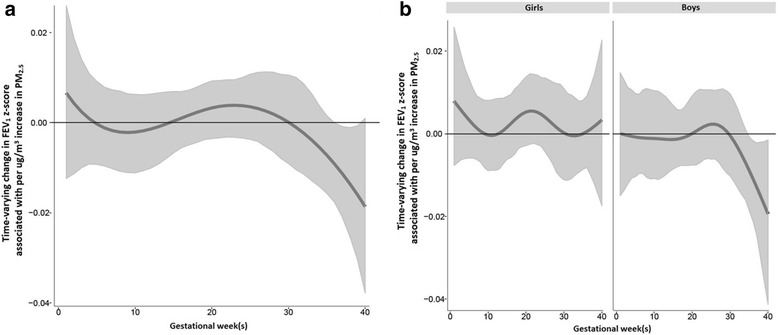
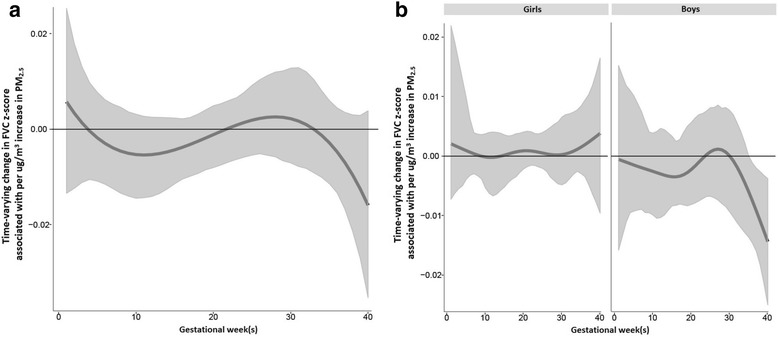
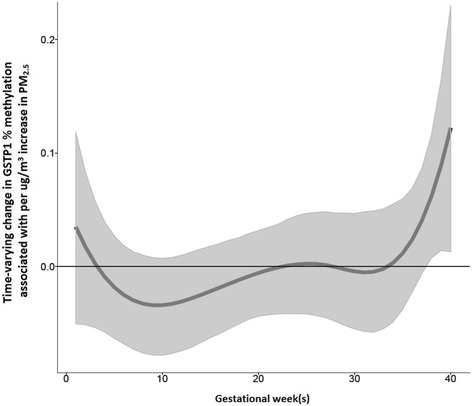
Results: BDLIMs identified a sensitive window for prenatal PM2.5 exposure at 35-40 weeks gestation [cumulative effect estimate (CEE) = - 0.10, 95%CI = - 0.19 to - 0.01, per μg/m3 increase in PM2.5] and at 36-40 weeks (CEE = - 0.12, 95%CI = - 0.20 to - 0.01) on FEV1 and FVC, respectively, in boys. BDLIMs also identified a sensitive window of exposure at 37-40 weeks gestation between higher prenatal PM2.5 exposure and increased GSTP1 percent methylation. The association between higher GSTP1 percent methylation and decreased FEV1 was borderline significant in the sample as a whole (β = - 0.37, SE = 0.20, p = 0.06) and in boys in stratified analyses (β = - 0.56, SE = 0.29, p = 0.05).
Conclusions: Prenatal PM2.5 exposure in late pregnancy was associated with impaired early childhood lung function and hypermethylation of GSTPI in DNA isolated from nasal epithelial cells. There was a trend towards higher GSTP1 percent methylation being associated with reduced FEV1. All findings were most evident among boys.
Conflict of interest statement
Ethics approval and consent to participate
We declare that we received ethics approval and consent to participate.
Competing interests
The authors declare that they have no competing interests.
Publisher’s Note
Springer Nature remains neutral with regard to jurisdictional claims in published maps and institutional affiliations.
Figures
References
Publication types
MeSH terms
Substances
Grants and funding
- U01 HL072494)/HL/NHLBI NIH HHS/United States
- T32 ES007142/ES/NIEHS NIH HHS/United States
- D43 TW009575/TW/FIC NIH HHS/United States
- R01 MD006086/MD/NIMHD NIH HHS/United States
- P30 ES000002/ES/NIEHS NIH HHS/United States
- U01 HL072494/HL/NHLBI NIH HHS/United States
- R01 MD006086/National Center on Minority Health and Health Disparities/International
- R01 HL080674/HL/NHLBI NIH HHS/United States
- P30ES009089/ES/NIEHS NIH HHS/United States
- P30 ES006096/ES/NIEHS NIH HHS/United States
- P30 ES023515/ES/NIEHS NIH HHS/United States
- T32 ES007142/National Institute of Environmental Health Sciences (US)/International
- R00 ES024116/ES/NIEHS NIH HHS/United States
- K23 HL135349/HL/NHLBI NIH HHS/United States
- R01 ES010932/ES/NIEHS NIH HHS/United States
- K99 ES027496/ES/NIEHS NIH HHS/United States
- P30 ES009089/ES/NIEHS NIH HHS/United States
LinkOut - more resources
Full Text Sources
Other Literature Sources
Research Materials
Miscellaneous
