. 2018 Apr 12:9:771.
doi: 10.3389/fimmu.2018.00771. eCollection 2018.

Mesenchymal Stromal Cells and Their Extracellular Vesicles Enhance the Anti-Inflammatory Phenotype of Regulatory Macrophages by Downregulating the Production of Interleukin (IL)-23 and IL-22

Affiliations

Mesenchymal Stromal Cells and Their Extracellular Vesicles Enhance the Anti-Inflammatory Phenotype of Regulatory Macrophages by Downregulating the Production of Interleukin (IL)-23 and IL-22

Kati Hyvärinen et al. Front Immunol. .

Abstract

Resolution-phase macrophage population orchestrates active dampening of the inflammation by secreting anti-inflammatory and proresolving products including interleukin (IL)-10 and lipid mediators (LMs). We investigated the effects of both human bone marrow-derived mesenchymal stromal cells (MSCs) and MSC-derived extracellular vesicles (MSC-EVs) on mature human regulatory macrophages (Mregs). The cytokines and LMs were determined from cell culture media of Mregs cultivated with MSCs and MSC-EVs. In addition, the alterations in the expression of cell surface markers and the phagocytic ability of Mregs were investigated. Our novel findings indicate that both MSC coculture and MSC-EVs downregulated the production of IL-23 and IL-22 enhancing the anti-inflammatory phenotype of Mregs and amplifying proresolving properties. The levels of prostaglandin E2 (PGE2) were substantially upregulated in MSC coculture media, which may endorse proresolving LM class switching. In addition, our results manifest, for the first time, that MSC-EVs mediate the Mreg phenotype change via PGE2. These data suggest that both human MSC and MSC-EVs may potentiate tolerance-promoting proresolving phenotype of human Mregs.

Keywords: extracellular vesicles; interleukin-23; mesenchymal stromal cells; prostaglandin E2; regulatory macrophages; resolution.


Figures
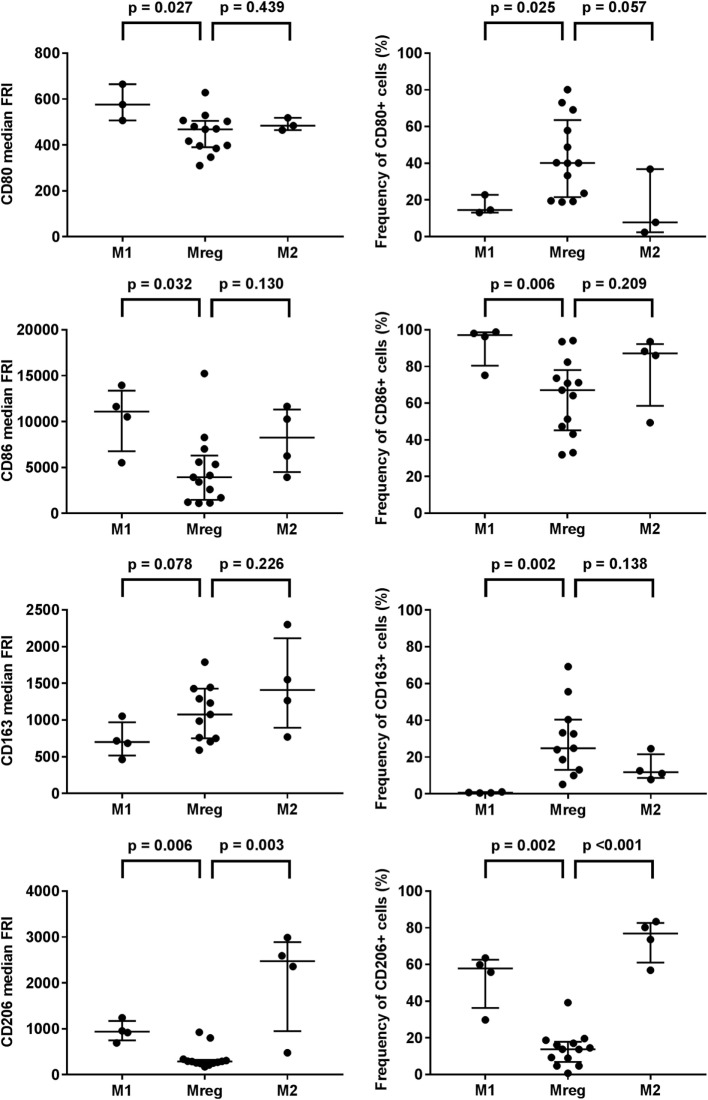
Figure 1
Figure 1
Phenotypes of M1, M2, and Mreg subtypes. The antibody staining was performed with PE-CD80, PE-Cy7-CD86, BV421-CD163, and APC-CD206 according to the manufacturers’ instructions. The median fluorescence intensities (left panel) and frequencies of positive cells (right panel) were determined with flow cytometry analysis. The significance in pairwise variation between M1 and Mreg, and M2 and Mreg was analyzed using the Mann–Whitney U test. The results are presented as median with interquartile range. The number of biological replicates varied from 3 to 13. Abbreviations: FRI, fluorescence intensity; M1, classically activated “host defense” macrophage; M2, alternatively activated “wound-healing” macrophage; Mreg, regulatory macrophage.
Figure 2
Figure 2
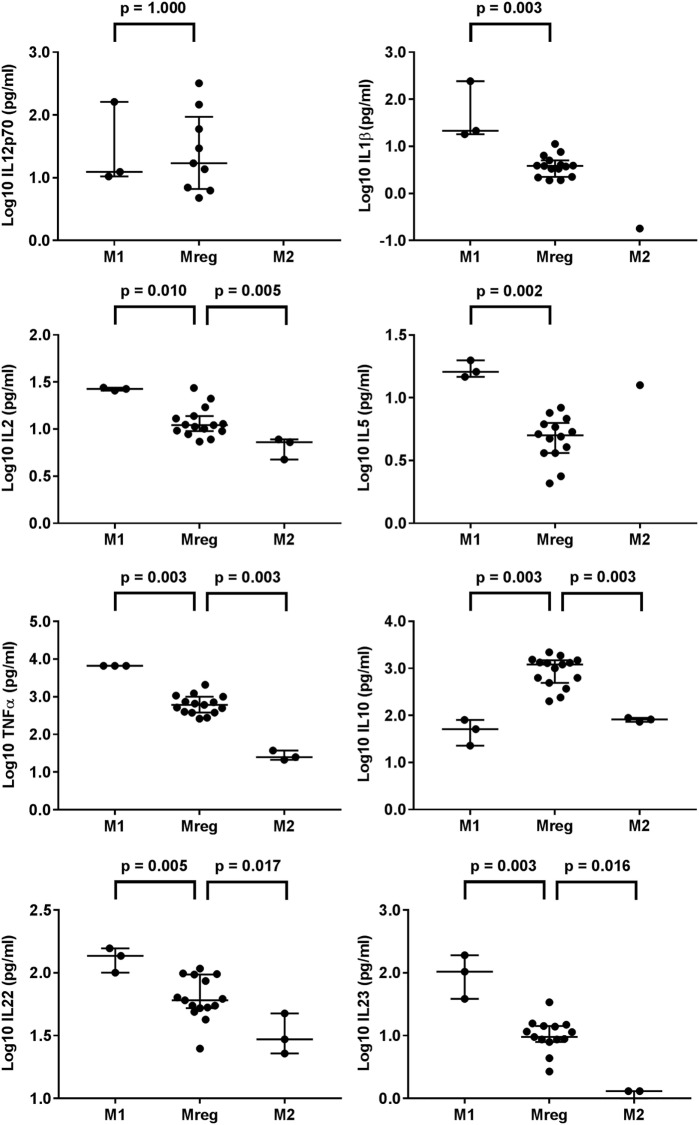
Level of cytokines in Mreg-, M1-, and M2-conditioned media. The media were analyzed for 18 cytokines, and measures within the cytokine-specific detection range were included in the analysis. The values of cell culture media cytokines were log10-transformed. The significance in pairwise variation between M1 and Mreg, and M2 and Mreg was analyzed using the Mann–Whitney U test, and the results are expressed as median with interquartile range. The number of biological replicates varies from 3 (for M1 and M2) to 15 for Mreg. Abbreviations: IL, interleukin; M1, classically activated “host defense” macrophage; M2, alternatively activated “wound-healing” macrophage; Mreg, regulatory macrophage.
Figure 3
Figure 3
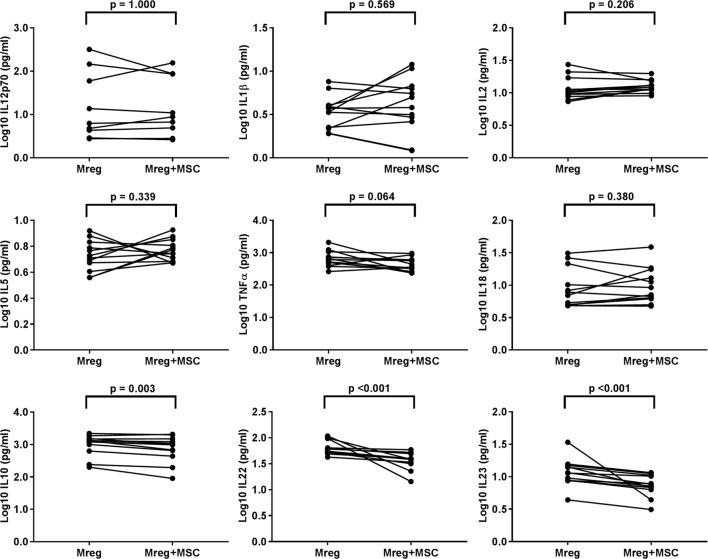
Effect of MSC coculture on the level of cytokines in Mreg-conditioned media. The media were analyzed for 18 cytokines and measures within the cytokine-specific detection range were included in the analysis. The values of cell culture media cytokines were log10-transformed. The variation of cytokines between Mreg-conditioned media with and without MSC coculture was analyzed by the Wilcoxon matched-pairs signed-rank test. The number of biological replicates varied from 9 to 12. Abbreviations: IL, interleukin; Mreg, regulatory macrophage; MSC, mesenchymal stromal cell.
Figure 4
Figure 4
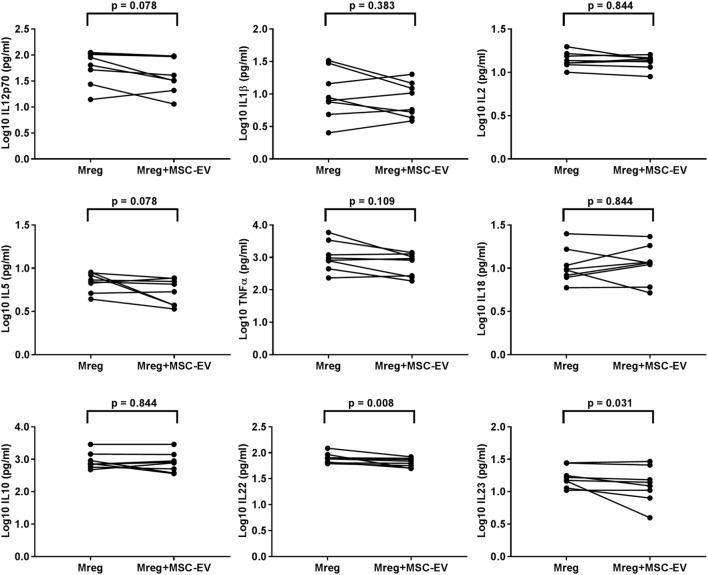
Effect of MSC-derived extracellular vesicles on the level of cytokines in Mreg-conditioned media. The media were analyzed for 18 cytokines, and measures within the cytokine-specific detection range were included in the analysis. The values of cell culture media cytokines were log10-transformed. The variation of cytokines between Mreg-conditioned media with and without MSC-EVs was analyzed by the Wilcoxon matched-pairs signed-rank test. The number of biological replicates is 8. Abbreviations: EV, extracellular vesicle; IL, interleukin; Mreg, regulatory macrophage; MSC, mesenchymal stromal cell; MSC-EVs, MSC-derived extracellular vesicles.
Figure 5
Figure 5
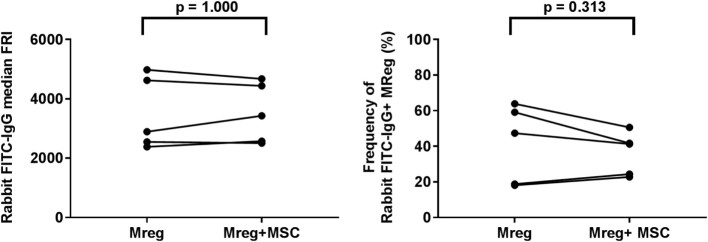
Effect of MSC coculture on the phagocytic ability of Mreg. The phagocytic ability of Mregs was assessed using latex beads coated with FITC-labeled rabbit IgG. The median FRI (left panel) and frequencies of positive cells (right panel) were determined with flow cytometry analysis. The variations between Mreg with and without MSC coculture were analyzed by the Wilcoxon matched-pairs signed-rank test. The number of biological replicates is 5. Abbreviations: FRI, fluorescence intensity; IgG, immunoglobulin G; Mreg, regulatory macrophage; MSC, mesenchymal stromal cell.

References

    1. Wynn TA, Vannella KM. Macrophages in tissue repair, regeneration, and fibrosis. Immunity (2016) 44:450–62. 10.1016/j.immuni.2016.02.015 - DOI - PMC - PubMed
    1. Newson J, Motwani MP, Kendall AC, Nicolaou A, Muccioli GG, Alhouayek M, et al. Inflammatory resolution triggers a prolonged phase of immune suppression through COX-1/mPGES-1-derived prostaglandin E2. Cell Rep (2017) 20:3162–75. 10.1016/j.celrep.2017.08.098 - DOI - PMC - PubMed
    1. Mosser DM, Edwards JP. Exploring the full spectrum of macrophage activation. Nat Rev Immunol (2008) 8:958–69. 10.1038/nri2448 - DOI - PMC - PubMed
    1. Murray P, Allen J, Biswas S, Fisher E, Gilroy D, Goerdt S, et al. Macrophage activation and polarization: nomenclature and experimental guidelines. Immunity (2014) 41:14–20. 10.1016/j.immuni.2014.06.008 - DOI - PMC - PubMed
    1. Murray PJ. Macrophage polarization. Annu Rev Physiol (2016) 79:541–66. 10.1146/annurev-physiol-022516-034339 - DOI - PubMed

Publication types