Review
. 2018 Apr 13:9:418.
doi: 10.3389/fpls.2018.00418. eCollection 2018.

The Sequenced Angiosperm Genomes and Genome Databases

Affiliations
Review

The Sequenced Angiosperm Genomes and Genome Databases

Fei Chen et al. Front Plant Sci. .

Abstract

Angiosperms, the flowering plants, provide the essential resources for human life, such as food, energy, oxygen, and materials. They also promoted the evolution of human, animals, and the planet earth. Despite the numerous advances in genome reports or sequencing technologies, no review covers all the released angiosperm genomes and the genome databases for data sharing. Based on the rapid advances and innovations in the database reconstruction in the last few years, here we provide a comprehensive review for three major types of angiosperm genome databases, including databases for a single species, for a specific angiosperm clade, and for multiple angiosperm species. The scope, tools, and data of each type of databases and their features are concisely discussed. The genome databases for a single species or a clade of species are especially popular for specific group of researchers, while a timely-updated comprehensive database is more powerful for address of major scientific mysteries at the genome scale. Considering the low coverage of flowering plants in any available database, we propose construction of a comprehensive database to facilitate large-scale comparative studies of angiosperm genomes and to promote the collaborative studies of important questions in plant biology.

Keywords: angiosperm genomes; big data; comparative genomics; data sharing; genome database.


Figures
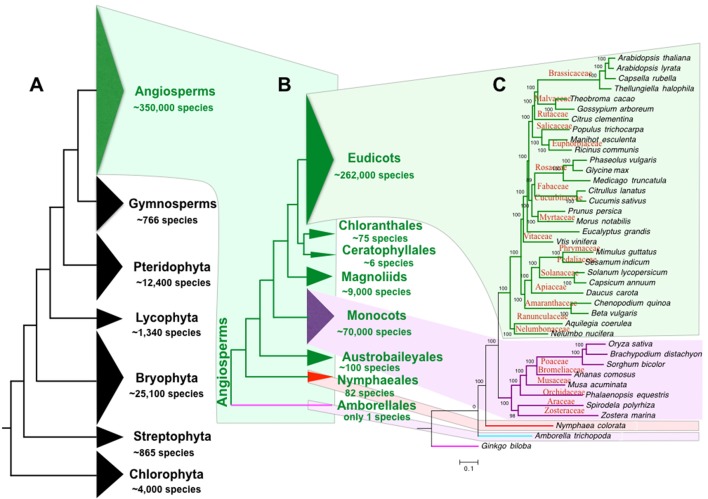
Figure 1
Figure 1
Phylogeny and species of green plants and angiosperms. (A) The tree of the plant life ranging from green algae to flowering plants. (B) The tree of angiosperm life. (C) Angiosperm species tree of representative references genomes. The angiosperm species number is estimated by www.theplantlist.org. Species number of other plant phylum is reported by Pryer et al. (2002). The number of Nymphaeales and other angiosperms species is summarized by Borsch et al. (2008) and Zeng et al. (2014), respectively.
Figure 2
Figure 2
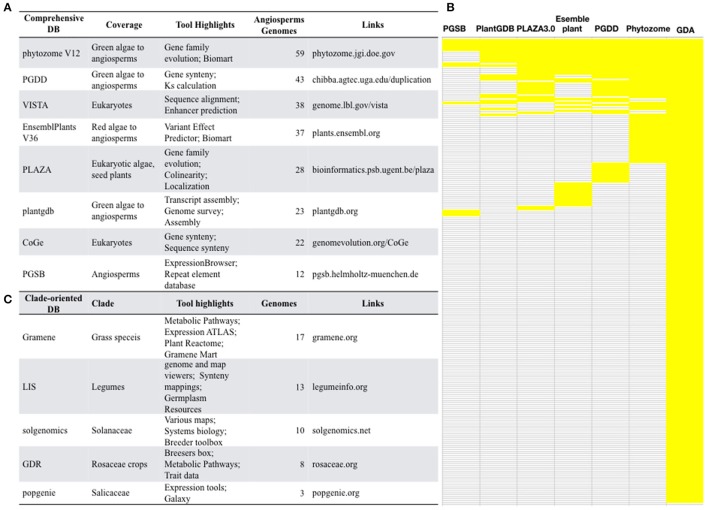
Selected well-constructed genome databases for/covering angiosperms. (A) Comprehensive databases and their featured tools and indexed genomes. (B) Small-scale genome databases for specific clade of angiosperms. (C) A comparison of the comprehensive genome databases. PGSB, Plant Genome and Systems Biology; PlantGDB, Plant Genome Database; PGDD, Plant Genome Duplication Database; GDA, Genome Database for Angiosperms.
Figure 3
Figure 3
The proposed genome database for angiosperms (GDA, www.angiosperms.org). (A) The menu of the database. (B,C) Statistics of the sequenced genomes in all the angiosperm orders. (D) Statistics of the sequenced crop genomes. (E) Timeline for the genome updates and related hyperlinks. (F) Ongoing projects for specific angiosperms. (G) BLAST page for all the released 235 angiosperm genomes, CDS, and protein information.
Figure 4
Figure 4
The tripal toolkit for genome database construction. (A) The Tripal is a biological application of Drupal. (B) core modules of Tripal. (C) carious modules developed during the last several years. (D) The successful applications of tripal in 12 angiosperm plant projects.

References

    1. Adam-Blondon A.-F., Alaux M., Pommier C., Cantu D., Cheng Z., Cramer G. R., et al. (2016). Towards an open grapevine information system. Hort. Res. 3:16056. 10.1038/hortres.2016.56 - DOI - PMC - PubMed
    1. Badouin H., Gouzy J., Grassa C. J., Murat F., Staton S. E., Cottret L., et al. (2017). The sunflower genome provides insights into oil metabolism, flowering and Asterid evolution. Nature 546, 148–152. 10.1038/nature22380 - DOI - PubMed
    1. Balick M. J., Cox P. A. (1996). Plants, People, and Culture: the Science of Ethnobotany. New York, NY: Scientific American Library.
    1. Bell C. D., Soltis D. E., Soltis P. S. (2010). The age and diversification of the angiosperms re-revisited. Am. J. Bot. 97, 1296–1303. 10.3732/ajb.0900346 - DOI - PubMed
    1. Borsch T., Löhne C., Wiersema J. (2008). Phylogeny and evolutionary patterns in Nymphaeales: integrating genes, genomes and morphology. Taxon 57, 1052–1081. Available online at: http://www.ingentaconnect.com/content/iapt/tax/2008/00000057/00000004/ar...

LinkOut - more resources