Caregiver Burden in Semantic Dementia with Right- and Left-Sided Predominant Cerebral Atrophy and in Behavioral-Variant Frontotemporal Dementia
- PMID: 29706989
- PMCID: PMC5921212
- DOI: 10.1159/000487851
Caregiver Burden in Semantic Dementia with Right- and Left-Sided Predominant Cerebral Atrophy and in Behavioral-Variant Frontotemporal Dementia
Abstract
Background: Caregiver burden is a serious concern for family caregivers of dementia patients, but its nature is unclear in patients with semantic dementia (SD). This study aimed to clarify caregiver burden for right- (R > L) and left-sided (L > R) predominant SD versus behavioral-variant frontotemporal dementia (bvFTD) patients.
Methods: Using the Japanese version of the Zarit Burden Interview (ZBI) and the Neuropsychiatric Inventory, we examined caregiver burden and behavioral and psychological symptoms of dementia (BPSD) in 43 first-visit outpatient/family caregiver dyads (bvFTD, 20 dyads; SD [L > R], 13 dyads; SD [R > L], 10 dyads).
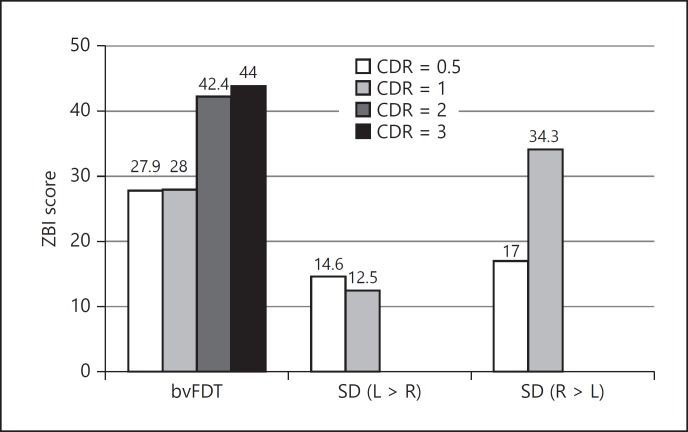
Results: We found a significant difference in ZBI score between the 3 diagnostic groups. Post hoc tests revealed a significantly higher ZBI score in the bvFTD than in the SD (L > R) group. The ZBI scores in the SD (L > R) and SD (R > L) groups were not significantly different, although the effect size was large. Caregiver burden was significantly correlated with BPSD scores in all groups and was correlated with activities of daily living and instrumental activities of daily living decline in the bvFTD and SD (R > L) groups.
Conclusion: Caregiver burden was highest in the bvFTD group, comparatively high in the SD (R > L) group, and lowest in the SD (L > R) group. Adequate support and intervention for caregivers should be tailored to differences in caregiver burden between these patient groups.
Keywords: Behavioral and psychological symptoms of dementia; Family caregivers; Frontotemporal lobar degeneration; Zarit Burden Interview.
Figures
References
-
- Svendsboe E, Terum T, Testad I, Aarsland D, Ulstein I, Corbett A, Rongve A. Caregiver burden in family carers of people with dementia with Lewy bodies and Alzheimer's disease. Int J Geriatr Psychiatry. 2016;31:1075–1083. - PubMed
-
- Cuijpers P. Depressive disorders in caregivers of dementia patients: a systematic review. Aging Ment Health. 2005;9:325–330. - PubMed
-
- Liu J, Wang LN, Tan JP, Ji P, Gauthier S, Zhang YL, Ma TX, Liu SN. Burden, anxiety and depression in caregivers of veterans with dementia in Beijing. Arch Gerontol Geriatr. 2012;55:560–563. - PubMed
-
- Joling KJ, van Marwijk HWJ, Veldhuijzen AE, van der Horst HE, Scheltens P, Smit F, van Hout HPJ. The two-year incidence of depression and anxiety disorders in spousal caregivers of persons with dementia: who is at the greatest risk? Am J Geriatr Psychiatry. 2014;23:293–303. - PubMed
LinkOut - more resources
Full Text Sources
Other Literature Sources