


Cognitive Behavior Therapy as Augmentation for Sertraline in Treating Patients with Persistent Postural-Perceptual Dizziness
- PMID: 29707579
- PMCID: PMC5863356
- DOI: 10.1155/2018/8518631
Cognitive Behavior Therapy as Augmentation for Sertraline in Treating Patients with Persistent Postural-Perceptual Dizziness
Abstract
Background: Persistent postural-perceptual dizziness (PPPD) is a common vestibular disorder. This study was conducted to assess whether the addition of cognitive behavior therapy (CBT) could significantly improve the efficacy and acceptability of sertraline in treating PPPD.
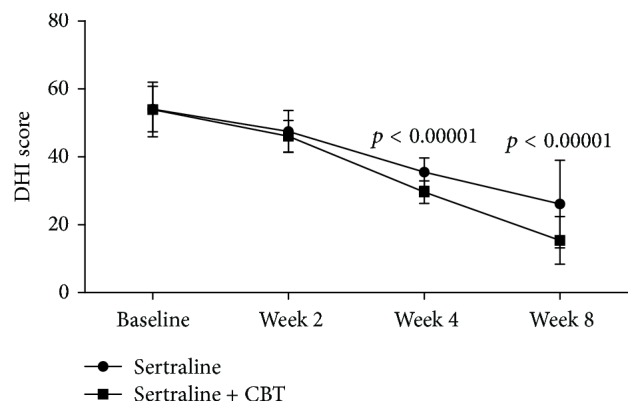
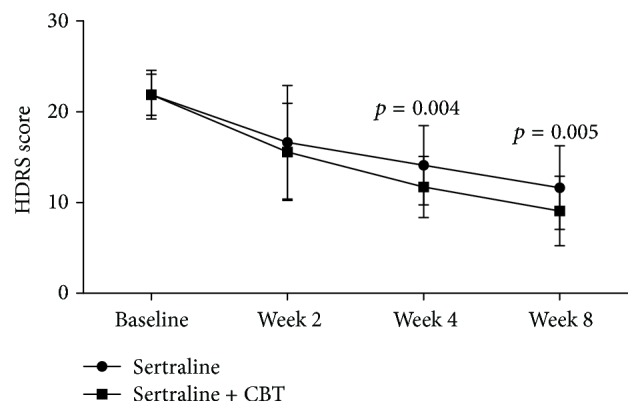
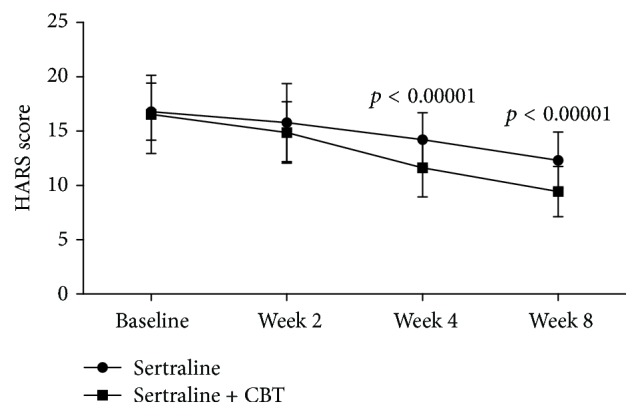
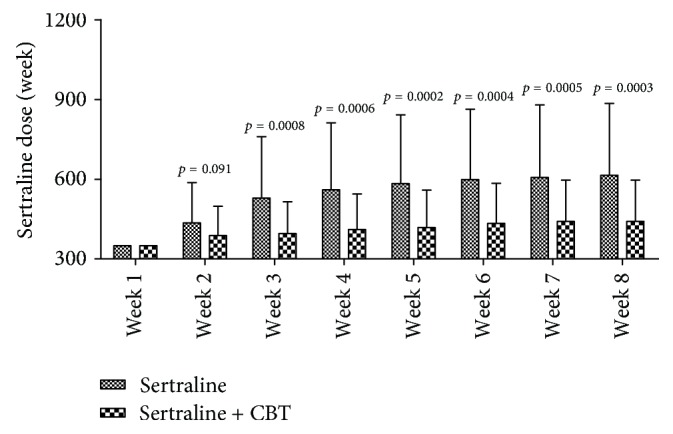
Methods: PPPD patients were recruited and randomly assigned to control and experiment groups. Patients in both groups received sertraline 50-200 mg/day, and only patients in the experiment group received CBT (twice a week, one hour per time). The treatment was continued for eight weeks. At baseline, week 2, week 4, and week 8, the 25-item Dizziness Handicap Inventory (DHI), Hamilton Anxiety Rating Scale (HARS), and Hamilton Depression Rating Scale (HDRS) were used to assess the self-perceived handicapping effects caused by PPPD, anxiety, and depressive symptoms, respectively. The dose of sertraline used and the adverse events in both groups were recorded and analyzed.
Results: In total, 91 PPPD patients were randomly assigned to the control group (n = 45) and experiment group (n = 46). After eight weeks of treatment, the average DHI scores, HDRS scores, and HARS scores were significantly decreased in both groups. But compared to the control group, the experiment group had significantly lower average DHI score, HDRS score, and HARS score at weeks 4 and 8. Moreover, the dose of sertraline used in the experiment group was significantly lower than that in the control group, and adverse events occurred more frequently in the control group than in the experiment group (48.9% versus 26.1%, p = 0.025).
Conclusion: These results demonstrated that the addition of CBT could significantly improve the efficacy and acceptability of sertraline in treating PPPD and reduce the dose of sertraline used.
References
-
- Staab J. P., Eckhardt-Henn A., Horii A., et al. Diagnostic criteria for persistent postural-perceptual dizziness (PPPD): consensus document of the committee for the classification of vestibular disorders of the bárány society. Journal of Vestibular Research: Equilibrium & Orientation. 2017;27(4):191–208. doi: 10.3233/VES-170622. - DOI - PMC - PubMed
-
- Yi J., Xing-quan Z. Chronic Subjective Dizziness. Chinese Journal of Stroke. 2013;8(5):388–392.
-
- Benitoorejas J. I. Chronic subjective dizziness. Revista De La Sociedad Otorrinolaringológica De Castilla Y León Cantabria Y La Rioja. 2013;4 pp. 13-19.
Publication types
MeSH terms
Substances
LinkOut - more resources
Full Text Sources
Other Literature Sources
Medical
