


Maternal Language and Child Vocabulary Mediate Relations Between Socioeconomic Status and Executive Function During Early Childhood
- PMID: 29707764
- PMCID: PMC6207477
- DOI: 10.1111/cdev.13065
Maternal Language and Child Vocabulary Mediate Relations Between Socioeconomic Status and Executive Function During Early Childhood
Abstract
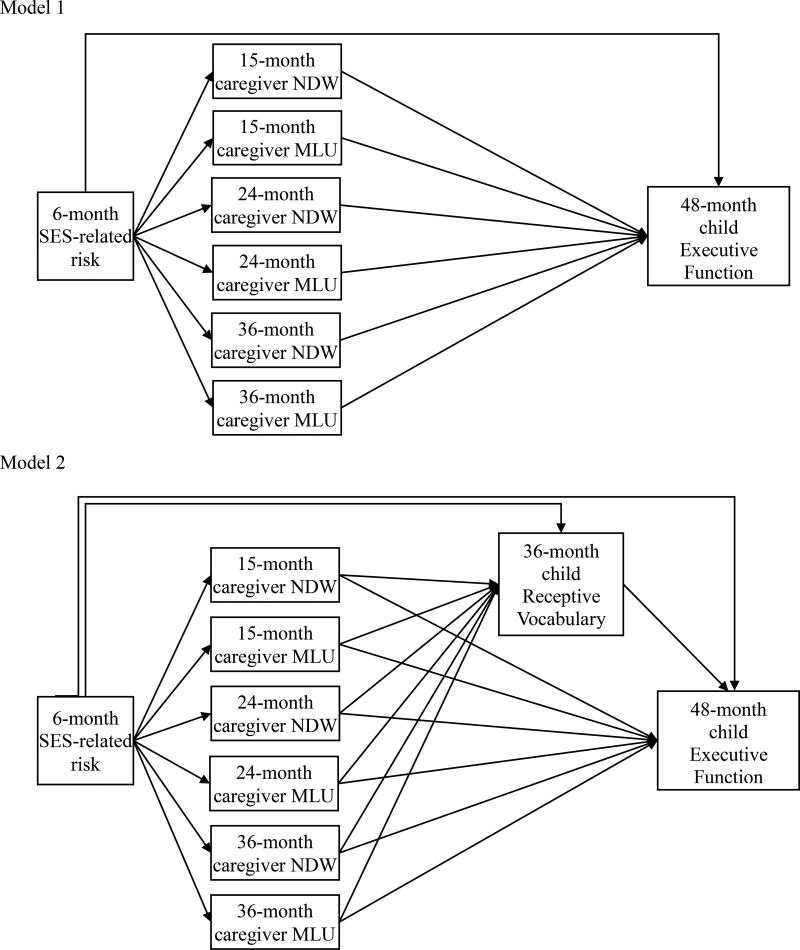
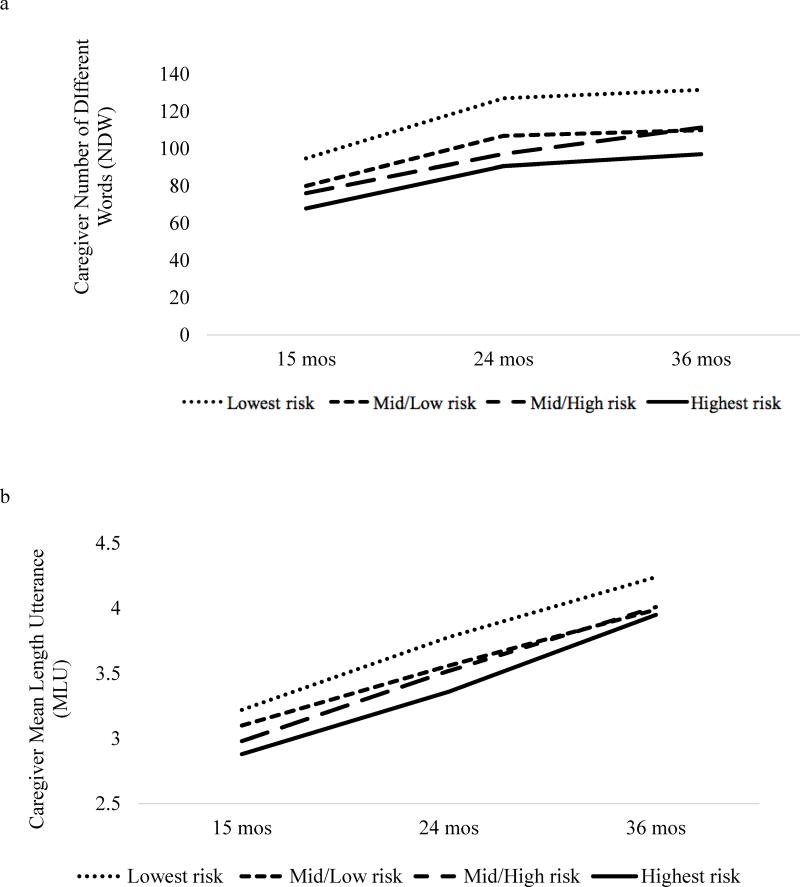
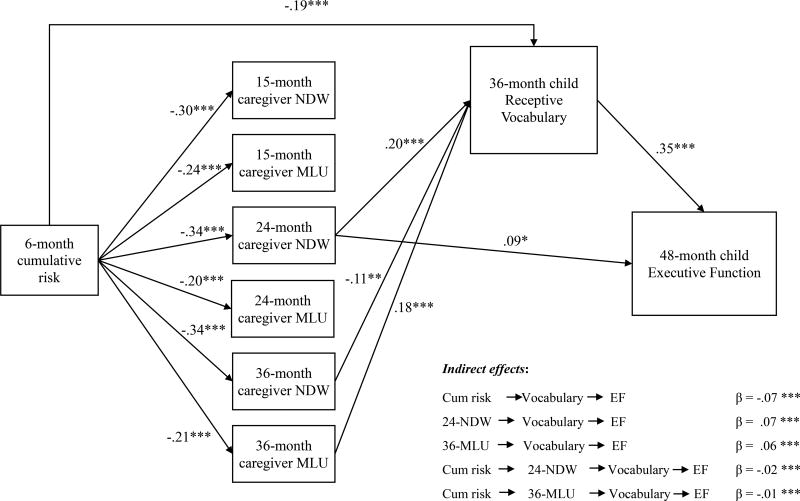
This article examined longitudinal relations among socioeconomic risk, maternal language input, child vocabulary, and child executive function (EF) in a large sample (N = 1,009) recruited for a prospective longitudinal study. Two measures of maternal language input derived from a parent-child picture book task, vocabulary diversity (VOCD), and language complexity, showed variation by socioeconomic risk at child ages 15, 24, and 36 months. Maternal VOCD at child age 24 months and maternal language complexity at child age 36 months mediated the relation between socioeconomic risk and 48-month child EF, independent of parenting sensitivity. Moreover, 36-month child vocabulary mediated the relation between maternal language input and child EF. These findings provide novel evidence about mechanisms linking socioeconomic risk and child executive function.
© 2018 Society for Research in Child Development.
Figures
References
-
- Bates E. The emergence of symbols: Cognition and communication in infancy. New York, NY: Academic Press; 2014.
-
- Blair C, Ursache A. A bidirectional model of executive functions and self-regulation. In: Vohs KD, Baumeister RF, editors. Handbook of self-regulation: Research, theory, and applications. New York, NY: Guilford Press; 2011. pp. 300–320.
-
- Bornstein MH, Haynes MO, Painter KM. Sources of child vocabulary competence: A multivariate model. Journal of Child Language. 1998;25:367–393. - PubMed
Publication types
MeSH terms
Grants and funding
LinkOut - more resources
Full Text Sources
Other Literature Sources
Medical
