


An Enriched Environment Ameliorates Oxidative Stress and Olfactory Dysfunction in Parkinson's Disease with α-Synucleinopathy
- PMID: 29707965
- PMCID: PMC6047274
- DOI: 10.1177/0963689717742662
An Enriched Environment Ameliorates Oxidative Stress and Olfactory Dysfunction in Parkinson's Disease with α-Synucleinopathy
Abstract
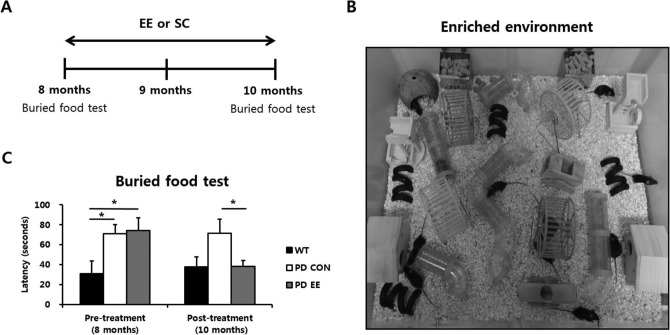
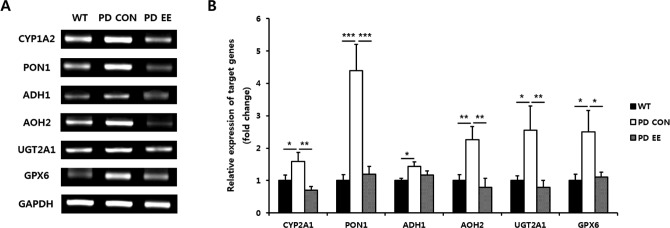
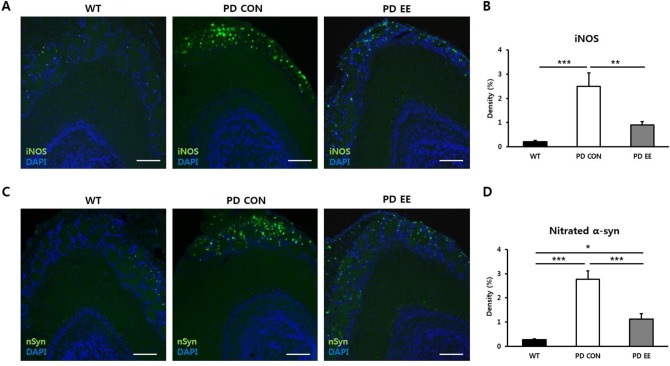
Parkinson's disease (PD) features nonmotor symptoms such as olfactory dysfunction referred to as hyposmia, an initial sign of disease progression. Metabolic dysfunction can contribute to neurodegenerative diseases, and various xenobiotics and endogenous compounds are also involved in the pathogenesis of PD. Although aerobic exercise was found to induce preservation or improvement in olfactory function in PD patients in a recent study, the exact underlying mechanism for this effect is not clear. We aimed to investigate the influence of an enriched environment (EE) on olfactory dysfunction especially via metabolic pathways related to detoxification enzymes. Eight-month-old transgenic (Tg) PD mice that overexpress human A53T α-synuclein (α-syn) were randomly allocated to an EE or standard conditions for 2 mo. The buried food test showed that EE group had significantly improved olfactory function compared to the control group. Reverse transcription polymerase chain reaction (PCR) and real-time quantitative PCR showed that expression of the detoxification enzymes-- cytochrome P450 family 1 subfamily A member 2, paraoxonase 1, alcohol dehydrogenase 1, UDP glucuronosyltransferase family 2 member A1 complex locus, aldehyde oxidase homolog 2, and aldehyde glutathione peroxidase 6--was significantly increased in the olfactory bulb (OB) of the PD control group, but these enzymes were normalized in the EE group. Immunohistochemical staining of the OB showed that oxidative stress and nitrated α-syn were significantly increased in the control group but decreased in the EE group. In conclusion, we suggest that exposure to an EE decreases both oxidative stress and nitrated α-syn, resulting in normalized detoxification enzymes and amelioration of olfactory dysfunction.
Keywords: Parkinson’s disease; detoxification enzymes; enriched environment; olfactory dysfunction; oxidative stress.
Conflict of interest statement
Figures
References
-
- Lee MY, Yu JH, Kim JY, Seo JH, Park ES, Kim CH, Kim H, Cho SR. Alteration of synaptic activity-regulating genes underlying functional improvement by long-term exposure to an enriched environment in the adult brain. Neurorehabil Neural Repair. 2013;27(6):561–574. - PubMed
-
- Rosenzweig MR, Bennett EL, Hebert M, Morimoto H. Social grouping cannot account for cerebral effects of enriched environments. Brain Res. 1978;153(3):563–576. - PubMed
-
- Will B, Galani R, Kelche C, Rosenzweig MR. Recovery from brain injury in animals: relative efficacy of environmental enrichment, physical exercise or formal training (1990-2002). Prog Neurobiol. 2004;72(3):167–182. - PubMed
-
- Cummins RA, Walsh RN, Budtz-Olsen OE, Konstantinos T, Horsfall CR. Environmentally-induced changes in the brains of elderly rats. Nature. 1973;243(5409):516–518. - PubMed
-
- Holloway RL., Jr Dendritic branching: some preliminary results of training and complexity in rat visual cortex. Brain Res. 1966;2(4):393–396. - PubMed
Publication types
MeSH terms
Substances
LinkOut - more resources
Full Text Sources
Other Literature Sources
Medical
Miscellaneous
