Comment
doi: 10.21037/jtd.2018.02.45.
Letter to: acute respiratory distress syndrome in traumatic brain injury: how do we manage it?
Affiliations
- PMID: 29708169
- PMCID: PMC5906358
- DOI: 10.21037/jtd.2018.02.45
Item in Clipboard
Comment
Letter to: acute respiratory distress syndrome in traumatic brain injury: how do we manage it?
J Thorac Dis.
2018 Mar.
No abstract available
Conflict of interest statement
Conflicts of Interest: Drs. Sakka, Tagami, Kirov and Perel are members of the medical advisory board of Pulsion Medical System/GETINGE, Feldkirchen, Germany.
Figures
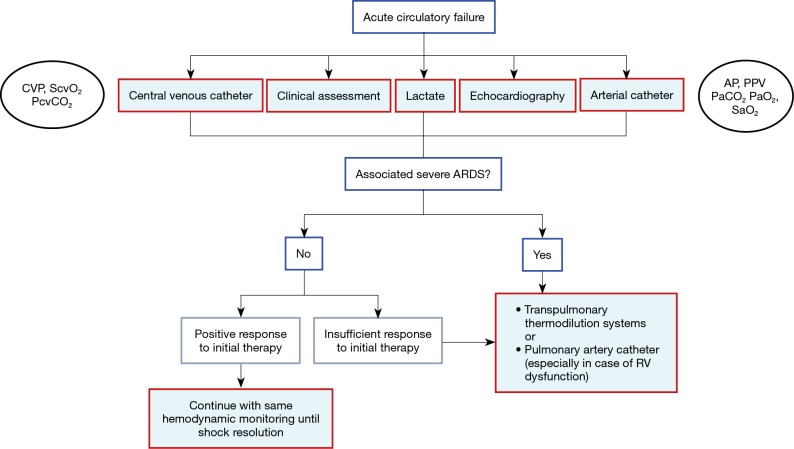
Simplified algorithm for the choice of hemodynamic monitoring in patients with acute circulatory failure. AP, arterial pressure; ARDS, acute respiratory distress syndrome; CVP, central venous pressure; PaCO2, carbon dioxide pressure in the arterial blood; PaO2, oxygen pressure in the arterial blood; PcvCO2, carbon dioxide pressure in the central venous blood; PPV, pulse pressure variation; RV, right ventricular; SaO2, arterial blood oxygen saturation; ScvO2, central venous blood oxygen saturation. Modified from (10) (with permission).
Comment on
-
Acute respiratory distress syndrome in traumatic brain injury: how do we manage it?J Thorac Dis. 2017 Dec;9(12):5368-5381. doi: 10.21037/jtd.2017.11.03. J Thorac Dis. 2017. PMID: 29312748 Free PMC article. Review.
References
-
- Cecchetti C, Elli M, Stoppa F, et al. Neurogenic pulmonary edema and variations of hemodynamic volumetric parameters in children following head trauma. Minerva Anestesiol 2013;79:1140-6. - PubMed
Publication types
LinkOut - more resources
Full Text Sources
Other Literature Sources