


Temporal evolution of HIV sero-discordancy patterns among stable couples in sub-Saharan Africa
- PMID: 29708995
- PMCID: PMC5927442
- DOI: 10.1371/journal.pone.0196613
Temporal evolution of HIV sero-discordancy patterns among stable couples in sub-Saharan Africa
Abstract
Introduction: Objective was to examine the temporal variation of HIV sero-discordancy in select representative countries (Kenya, Lesotho, Mali, Niger, Tanzania, and Zimbabwe) in sub-Saharan Africa at different HIV epidemic scales. A sero-discordant couple is defined as a stable couple (SC) in which one partner is HIV-positive while the other is HIV-negative.
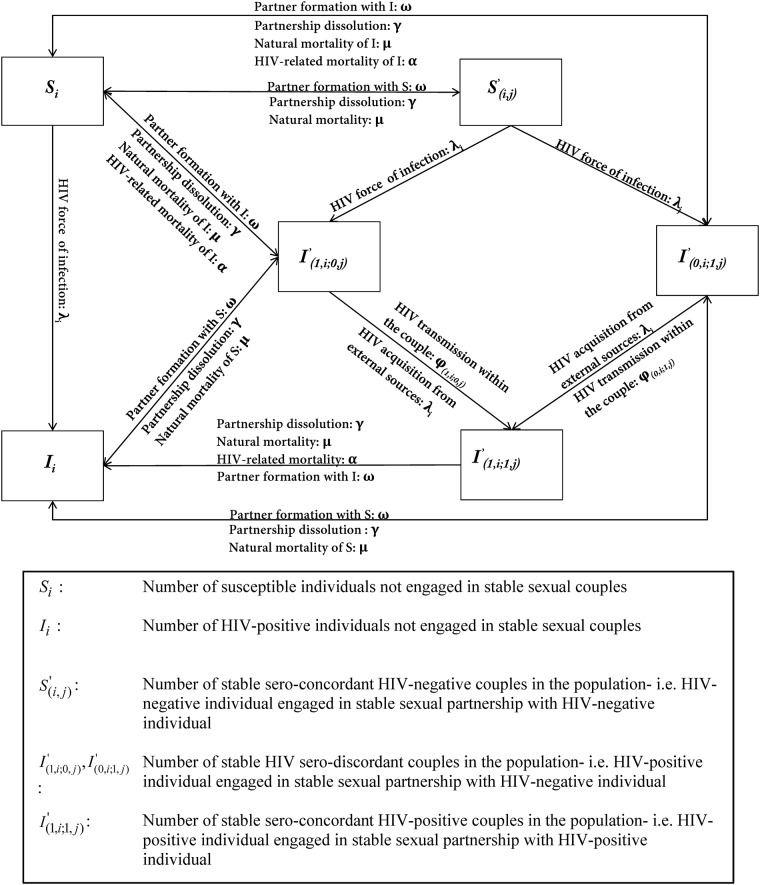
Methods: A deterministic compartmental mathematical model was constructed to describe HIV transmission dynamics. The model was pair-based, that is explicitly modeling formation of SCs and infection dynamics in both SCs and in single individuals. The model accommodated for different forms of infection statuses in SCs. Using population-based nationally-representative epidemiologic and demographic input data, historical (1980-2014) and future (2015-2030) trends of sero-discordancy and other demographic and epidemiologic indicators were projected throughout HIV epidemic phases.
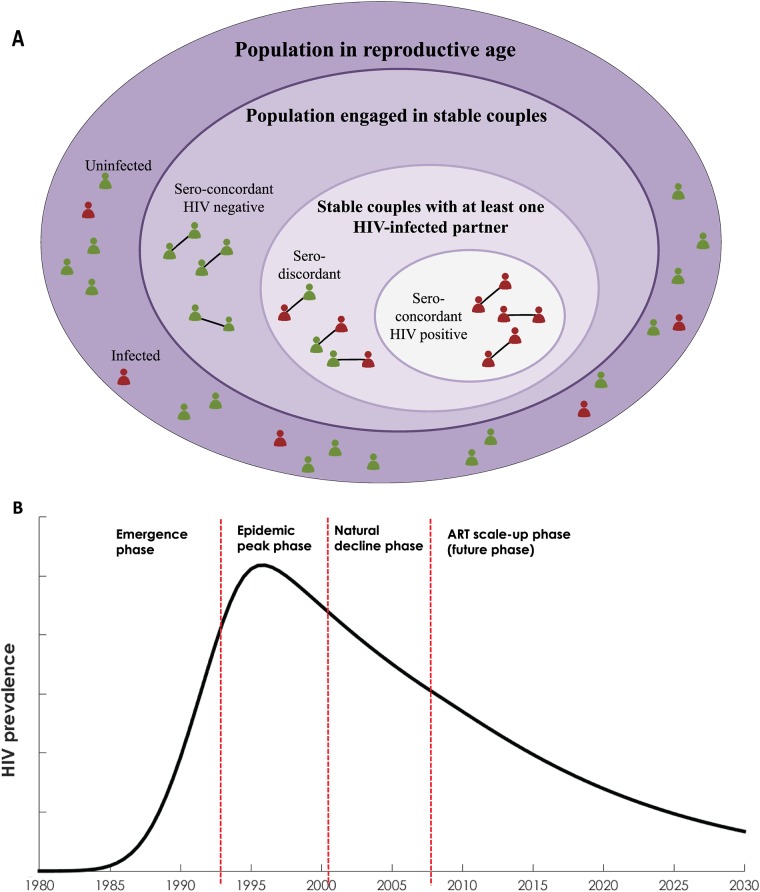
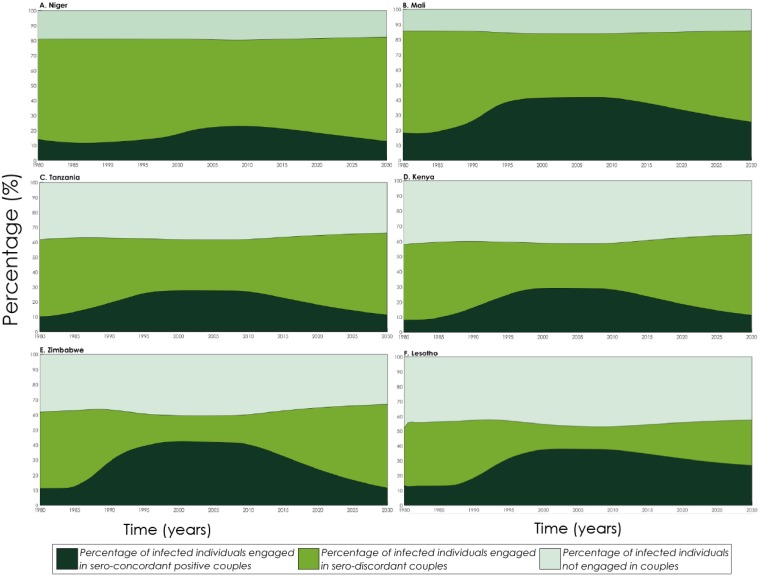
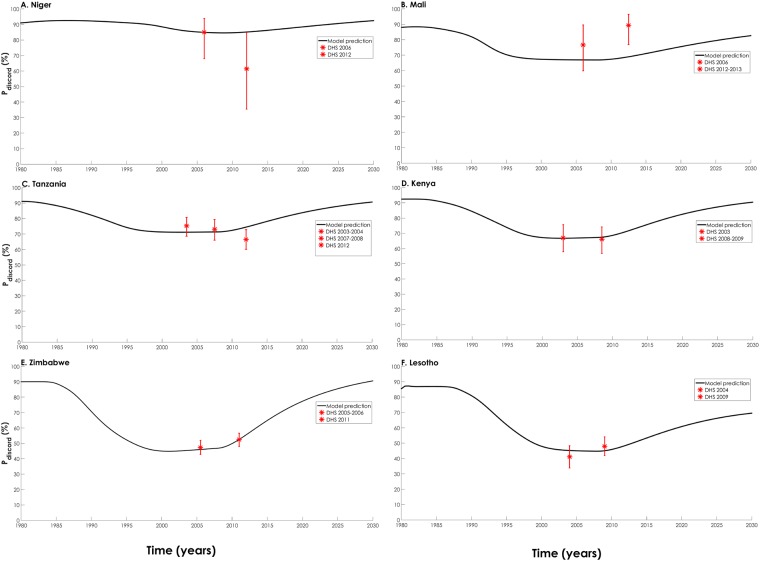
Results: As the epidemics emerged, about 90% of SCs affected by HIV were sero-discordant. This proportion declined to 45%-88% at epidemic peak and stabilized as the epidemics started their natural decline. The largest reductions in sero-discordancy were in high HIV-prevalence countries. As the epidemics further declined with antiretroviral therapy (ART) scale-up, the proportion of sero-discordant couples among HIV-affected couples was projected to increase to 70%-92% by 2030. The proportion of sero-discordant couples among all SCs increased as the epidemics emerged and evolved, then peaked at 2%-20% as the epidemics peaked, and then declined as the epidemics declined to reach 0.3%-16% by 2030.
Conclusions: Sero-discordancy patterns varied with the evolution of the epidemics, and were affected by both epidemic phase and scale. The largest variations were found in high HIV-prevalence countries. The fraction of stable couples that are sero-discordant, as opposed to being sero-concordant positive, was projected to increase with ART scale-up and further HIV incidence decline over the coming two decades. These findings inform strategic planning and resource allocation for interventions among sero-discordant couples.
Conflict of interest statement
Figures
References
-
- Lingappa JR, Lambdin B, Bukusi EA, Ngure K, Kavuma L, Inambao M, et al. Regional differences in prevalence of HIV-1 discordance in Africa and enrollment of HIV-1 discordant couples into an HIV-1 prevention trial. PLoS One. 2008;3(1):e1411 Epub 2008/01/10. doi: 10.1371/journal.pone.0001411 . - DOI - PMC - PubMed
-
- Chemaitelly H, Cremin I, Shelton J, Hallett TB, Abu-Raddad LJ. Distinct HIV discordancy patterns by epidemic size in stable sexual partnerships in sub-Saharan Africa. Sex Transm Infect. 2012;88(1):51–7. Epub 2012/01/18. doi: 10.1136/sextrans-2011-050114 . - DOI - PMC - PubMed
-
- Guthrie BL, de Bruyn G, Farquhar C. HIV-1-discordant couples in sub-Saharan Africa: explanations and implications for high rates of discordancy. Curr HIV Res. 2007;5(4):416–29. Epub 2007/07/14. . - PubMed
-
- Chemaitelly H, Awad SF, Shelton JD, Abu-Raddad LJ. Sources of HIV incidence among stable couples in sub-Saharan Africa. J Int AIDS Soc. 2014;17:18765 Epub 2014/02/25. doi: 10.7448/IAS.17.1.18765 . - DOI - PMC - PubMed
-
- Muessig KE, Cohen MS. Advances in HIV prevention for serodiscordant couples. Curr HIV/AIDS Rep. 2014;11(4):434–46. doi: 10.1007/s11904-014-0225-9 . - DOI - PMC - PubMed
Publication types
MeSH terms
Substances
LinkOut - more resources
Full Text Sources
Other Literature Sources
Medical
Research Materials
