


An action video game for the treatment of amblyopia in children: A feasibility study
- PMID: 29709618
- PMCID: PMC5984723
- DOI: 10.1016/j.visres.2018.04.005
An action video game for the treatment of amblyopia in children: A feasibility study
Abstract
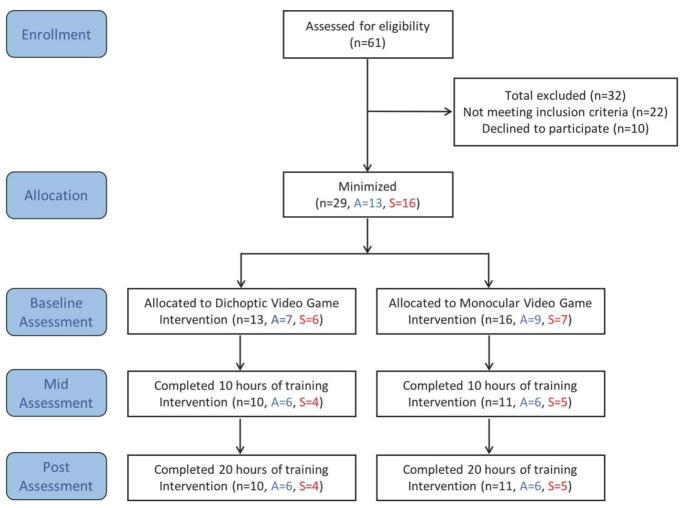
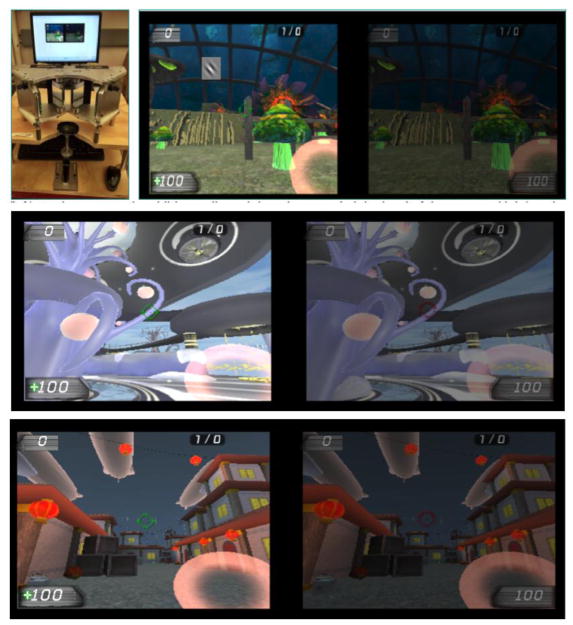
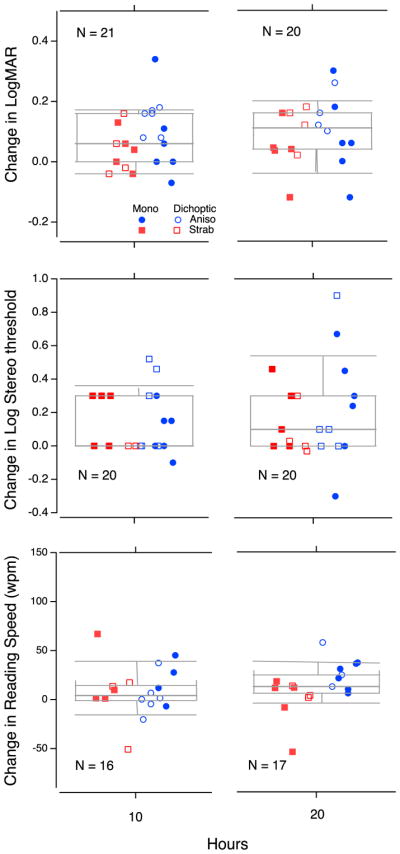
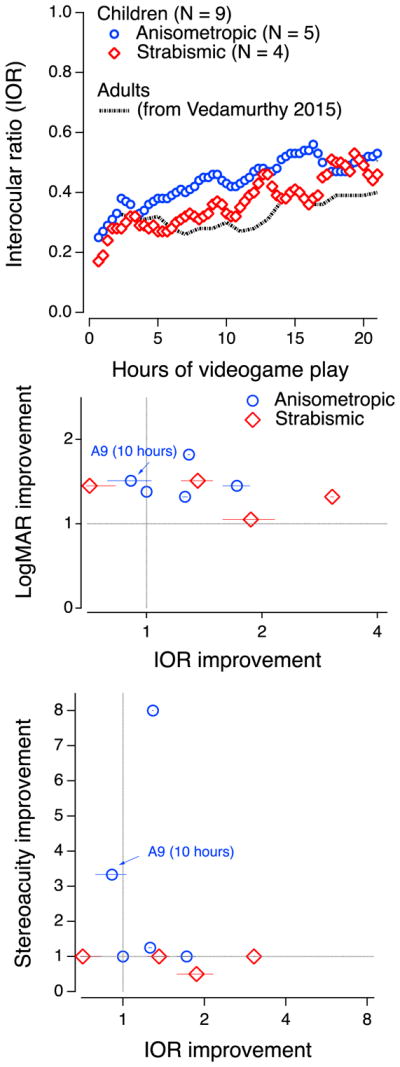
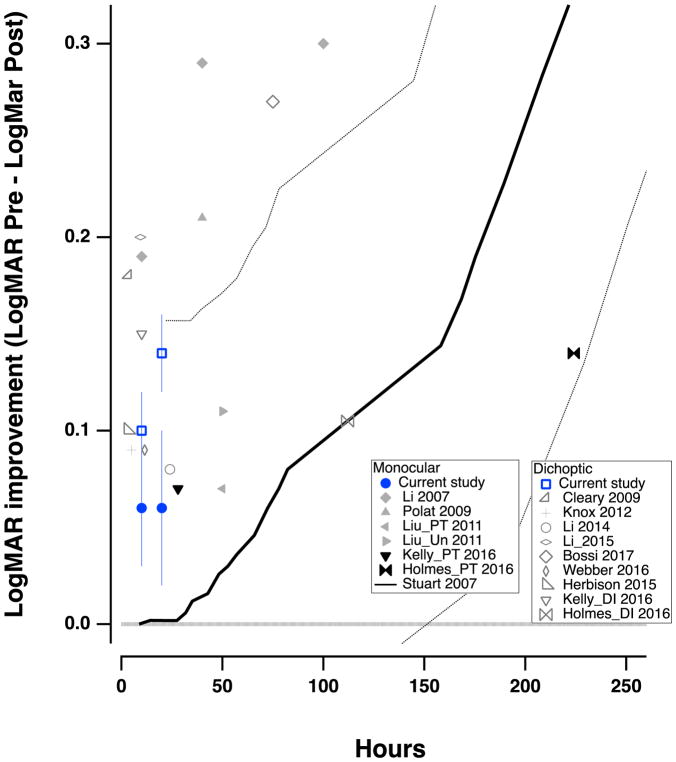
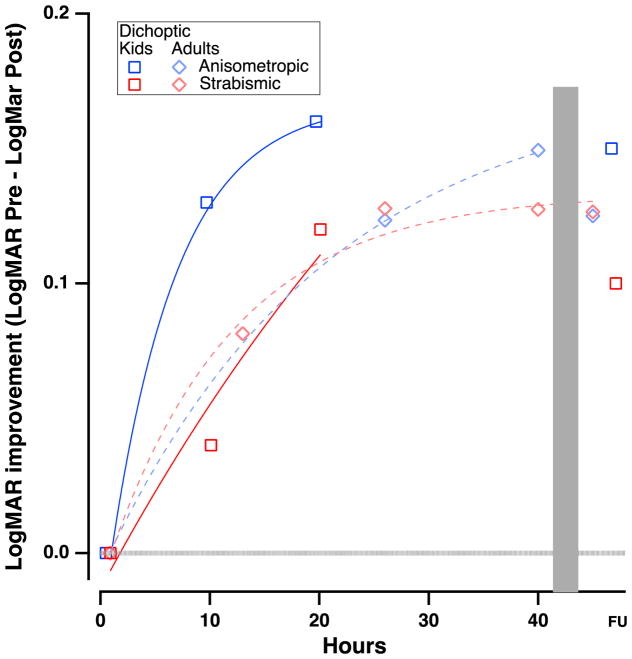
The gold-standard treatment for childhood amblyopia remains patching or penalizing the fellow eye, resulting in an average of about a one line (0.1 logMAR) improvement in visual acuity following ≈120 h of patching in children 3-8 years old. However, compliance with patching and other treatment options is often poor. In contrast, fast-paced action video games can be highly engaging, and have been shown to yield broad-based improvements in vision and attention in adult amblyopia. Here, we pilot-tested a custom-made action video game to treat children with amblyopia. Twenty-one (n = 21) children (mean age 9.95 ± 3.14 [se]) with unilateral amblyopia (n = 12 anisometropic and n = 9 strabismic) completed 20 h of game play either monocularly, with the fellow eye patched (n = 11), or dichoptically, with reduced contrast to the fellow eye (n = 10). Participants were assessed for visual acuity (VA), stereo acuity and reading speed at baseline, and following 10 and 20 h of play. Additional exploratory analyses examined improvements after 6-10 weeks of completion of training (follow-up). Following 20 h of training, VA improved, on average, by 0.14 logMAR (≈38%) for the dichoptic group and by 0.06 logMAR (≈15%) for the monocular group. Similarly, stereoacuity improved by 0.07 log arcsec (≈17%) following dichoptic training, and by 0.06 log arcsec (≈15%) following monocular training. Across both treatment groups, 7 of the 12 individuals with anisometropic amblyopia showed improvement in stereoacuity, whereas only 1 of the 9 strabismic individuals improved. Most improvements were largely retained at follow-up. Our feasibility study therefore suggests that the action video game approach may be used as an effective adjunct treatment for amblyopia in children, achieving results similar to those of the gold-standard treatment in shorter duration.
Keywords: Amblyopia; Children; Dichoptic; Patching; Perceptual learning; Video games.
Copyright © 2018 Elsevier Ltd. All rights reserved.
Figures
References
-
- Gambacorta C, Huang S, Vedamurthy I, Nahum M, Bayliss J, Bavelier D, Levi D. Action Video Games as a Treatment of Amblyopia in Children: A Pilot Study of a novel, child-friendly action game. Poster presented at the Vision Sciences Society; Florida. May, 2014.
-
- Bayliss J, Vedamurthy I, Nahum M, Levi D, Bavelier D. Lazy Eye Shooter: Making a Game Therapy for Visual Recovery in Adult Amblyopia. Abstract accepted for presentation at the Human-Computer Interaction (HCI) international 2013 meeting; Las Vegas, Nevada, USA. 2013.
-
- Vedamurthy I, Nahum M, Bayliss J, Bavelier D, Levi D. Using a Custom-Made Version of the Unreal Tournament Video Game to Improve Vision in Individuals with Amblyopia. Poster presented at the Entertainment Software and Cognitive Neurotherapeutics Society meeting; 2013; Los Angeles, CA, USA. Mar, 2013.
-
- Bayliss JD, Vedamurthy I, Bavelier D, Nahum M, Levi DM. Lazy eye ehooter: a novel game therapy for visual recovery in adult amblyopia. IEEE International Games Innovation Conference Proceedings.2012.
-
- Bavelier D, Green CS, Pouget A, Schrater P. Brain plasticity through the life span: learning to learn and action video games. Annu Rev Neurosci. 2012;35:391–416. - PubMed
Publication types
MeSH terms
Grants and funding
LinkOut - more resources
Full Text Sources
Other Literature Sources
Medical
