Association of T and B Cells Infiltrating Orbital Tissues With Clinical Features of Graves Orbitopathy
- PMID: 29710102
- PMCID: PMC6583879
- DOI: 10.1001/jamaophthalmol.2018.0806
Association of T and B Cells Infiltrating Orbital Tissues With Clinical Features of Graves Orbitopathy
Abstract
Importance: Graves orbitopathy (GO) responds to immunosuppressive treatments when clinically active but poorly when inactive. In other autoimmune diseases, response has been ascribed to a reduction in lymphocytes infiltrating the target organ. It is not known whether active vs inactive GO differs in this regard, which would help in understanding the link between GO immunologic features and clinical behavior.
Objective: To investigate the association between orbital lymphocytic infiltrate and GO clinical features.
Design, setting, and participants: A cohort study aimed at assessing the extent and immunohistochemical phenotype of orbital lymphocytes and associating it with the ophthalmologic features of GO, especially its clinical activity score (CAS), was conducted at a tertiary referral center. Twenty consecutive patients with GO who underwent orbital decompression were included. The study was conducted from January 1 to May 31, 2017.
Exposures: Orbital tissue histology and immunohistochemistry testing as well as ophthalmologic evaluation.
Main outcomes and measures: Association between CAS and orbital lymphocytes, analyzed as total number of lymphocytes and main lymphoid subsets.
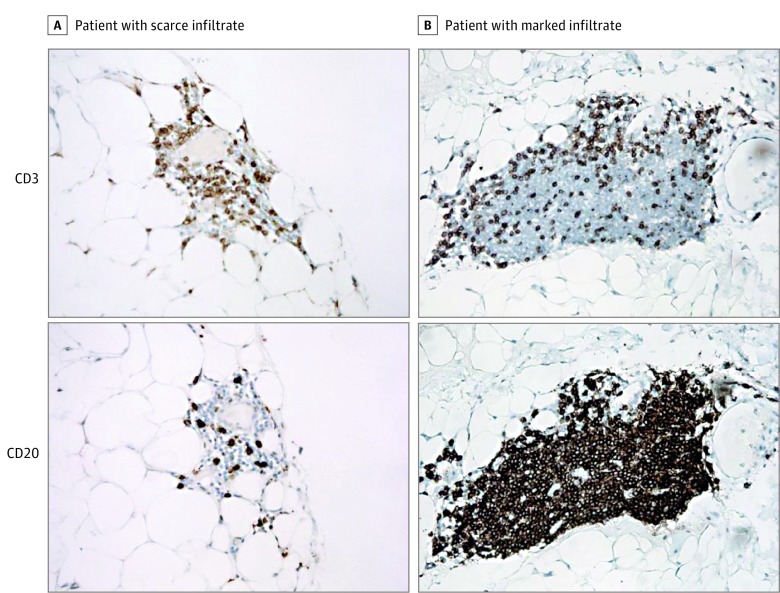
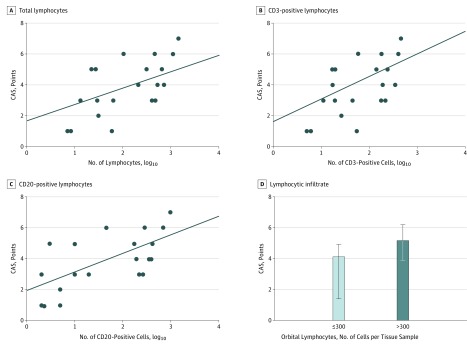
Results: The patient population included 8 men and 12 women, all of white race, with a mean (SD) age of 46 (13) years. With an established cutoff value of 300 lymphoid cells per tissue sample, lymphocytes above this value were found in orbital tissues of 9 of 20 patients (45%), often organized into distinct foci. The lymphocytes comprised a mixture of T (CD3-positive) and B (CD20-positive) cells, suggesting a mature, polyclonal autoimmune response. In a simple linear regression model, the total number of lymphocytes, as well as the number of CD3- and CD20-positive subsets, correlated with CAS (R = 0.63; 95% CI, 0.27-0.84; P = .003; R = 0.59; 95% CI, 0.20-0.82; P = .006; and R = 0.65; 95% CI, 0.30-0.85; P = .002, respectively). In a multiple linear regression model, lymphocytes maintained their effect on CAS when adjusted for 2 additional variables that were correlated with CAS-smoking and GO duration-highlighting even more the important role of orbital lymphocytes in affecting CAS (total number: R = 0.58; 95% CI, 0.18-0.82; P = .01; CD3-positive: R = 0.58; 95% CI, 0.17-0.82; P = .01; and CD20-positive: R = 0.59; 95% CI, 0.19-0.83; P = .01).
Conclusions and relevance: This study shows a correlation between T and B lymphocytes infiltrating orbital tissues and the activity of GO, possibly enhancing our understanding of the association between GO immunologic features and clinical expression.
Conflict of interest statement
Figures
Comment in
-
Lymphocyte Expression in Graves Orbitopathy.JAMA Ophthalmol. 2018 Jun 1;136(6):620-621. doi: 10.1001/jamaophthalmol.2018.1240. JAMA Ophthalmol. 2018. PMID: 29710176 No abstract available.
References
-
- Leo M, Menconi F, Rocchi R, et al. Role of the underlying thyroid disease on the phenotype of Graves’ orbitopathy in a tertiary referral center. Thyroid. 2015;25(3):347-351. - PubMed
-
- Piantanida E, Tanda ML, Lai A, Sassi L, Bartalena L. Prevalence and natural history of Graves’ orbitopathy in the XXI century. J Endocrinol Invest. 2013;36(6):444-449. - PubMed
-
- Bartalena L, Masiello E, Magri F, et al. The phenotype of newly diagnosed Graves’ disease in Italy in recent years is milder than in the past: results of a large observational longitudinal study. J Endocrinol Invest. 2016;39(12):1445-1451. - PubMed
-
- Bahn RS. Current Insights into the pathogenesis of Graves’ ophthalmopathy. Horm Metab Res. 2015;47(10):773-778. - PubMed
-
- Marinò M, Latrofa F, Menconi F, Chiovato L, Vitti P. Role of genetic and non-genetic factors in the etiology of Graves’ disease. J Endocrinol Invest. 2015;38(3):283-294. - PubMed
Publication types
MeSH terms
Substances
LinkOut - more resources
Full Text Sources
Other Literature Sources