Association of Skin Examination Behaviors and Thinner Nodular vs Superficial Spreading Melanoma at Diagnosis
- PMID: 29710122
- PMCID: PMC6128502
- DOI: 10.1001/jamadermatol.2018.0288
Association of Skin Examination Behaviors and Thinner Nodular vs Superficial Spreading Melanoma at Diagnosis
Abstract
Importance: Early melanoma detection strategies include skin self-examination (SSE), physician skin examination (PSE), and promotion of patient knowledge about skin cancer.
Objective: To investigate the association of SSE, PSE, and patient attitudes with the detection of thinner superficial spreading melanoma (SSM) and nodular melanoma (NM), the latter of which tends to elude early detection.
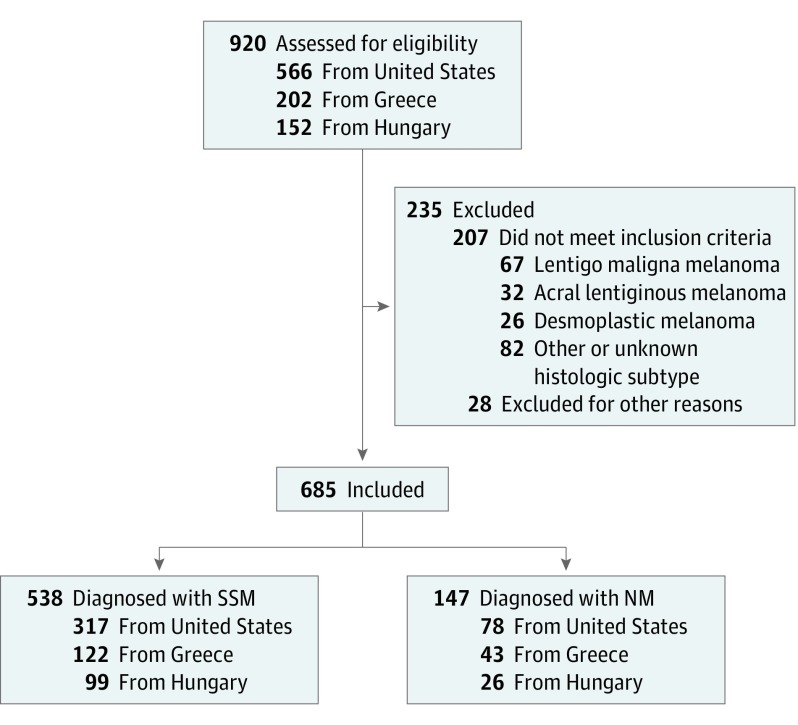
Design, setting, and participants: This cross-sectional, questionnaire-based, multicenter study identified patients with newly diagnosed cutaneous melanoma at 4 referral hospital centers in the United States, Greece, and Hungary. Among 920 patients with a primary invasive melanoma, 685 patients with SSM or NM subtype were included.
Interventions: A standardized questionnaire was used to record sociodemographic information, SSE and PSE practices, and patient perceptions in the year prior to diagnosis.
Main outcomes and measures: Data were analyzed according to histologic thickness, with a 2-mm cutoff for thinner SSM and NM.
Results: Of 685 participants (mean [SD] age, 55.6 [15.1] years; 318 [46%] female), thinner melanoma was detected in 437 of 538 SSM (81%) and in 40 of 147 NM (27%). Patients who routinely performed SSE were more likely to be diagnosed with thinner SSM (odds ratio [OR], 2.61; 95% CI, 1.14-5.40) but not thinner NM (OR, 2.39; 95% CI, 0.84-6.80). Self-detected clinical warning signs (eg, elevation and onset of pain) were markers of thicker SSM and NM. Whole-body PSE was associated with a 2-fold increase in detection of thinner SSM (OR, 2.25; 95% CI, 1.16-4.35) and thinner NM (OR, 2.67; 95% CI, 1.05-6.82). Patient attitudes and perceptions focusing on increased interest in skin cancer were associated with the detection of thinner NM.
Conclusions and relevance: Our findings underscore the importance of complementary practices by patients and physicians for the early detection of melanoma, including regular whole-body PSE, SSE, and increased patient awareness.
Conflict of interest statement
Figures
References
-
- Green AC, Baade P, Coory M, Aitken JF, Smithers M. Population-based 20-year survival among people diagnosed with thin melanomas in Queensland, Australia. J Clin Oncol. 2012;30(13):1462-1467. - PubMed
-
- Whiteman DC, Green AC, Olsen CM. The growing burden of invasive melanoma: projections of incidence rates and numbers of new cases in six susceptible populations through 2031. J Invest Dermatol. 2016;136(6):1161-1171. - PubMed
-
- Baade P, Meng X, Youlden D, Aitken J, Youl P. Time trends and latitudinal differences in melanoma thickness distribution in Australia, 1990-2006. Int J Cancer. 2012;130(1):170-178. - PubMed
Publication types
MeSH terms
LinkOut - more resources
Full Text Sources
Other Literature Sources
Medical