Anti-Tumor Necrosis Factor Therapy and Incidence of Parkinson Disease Among Patients With Inflammatory Bowel Disease
- PMID: 29710331
- PMCID: PMC6142934
- DOI: 10.1001/jamaneurol.2018.0605
Anti-Tumor Necrosis Factor Therapy and Incidence of Parkinson Disease Among Patients With Inflammatory Bowel Disease
Abstract
Importance: Despite established genetic and pathophysiologic links between inflammatory bowel disease (IBD) and Parkinson disease (PD), clinical data supporting this association remain scarce. Although systemic inflammation is considered a potential biological mechanism shared between the 2 diseases, the role of reduced systemic inflammation through IBD-directed anti-tumor necrosis factor (anti-TNF) therapy in PD risk is largely unknown.
Objective: To compare the incidence of PD among individuals with or without IBD and to assess whether PD risk among patients with IBD is altered by anti-TNF therapy.
Design, setting, and participants: This is a retrospective cohort study analyzing information in the Truven Health MarketScan administrative claims database and the Medicare Supplemental Database between January 1, 2000, and March 31, 2016. Individuals were selected who had at least 2 claims for IBD diagnoses, at least 6 months of follow-up, and no prior diagnosis of PD on or before the IBD index date. Exposure to Anti-TNF therapy was measured from the anti-TNF index date to the last date of anti-TNF coverage or the end of enrollment or PD index date, whichever was earliest. Incidence rates per 1000 person-years were calculated, and crude and adjusted incidence rate ratios were estimated by Poisson regression models and presented with 95% CIs.
Main outcomes and measures: Incidence of PD among patients with IBD with or without exposure to anti-TNF therapy.
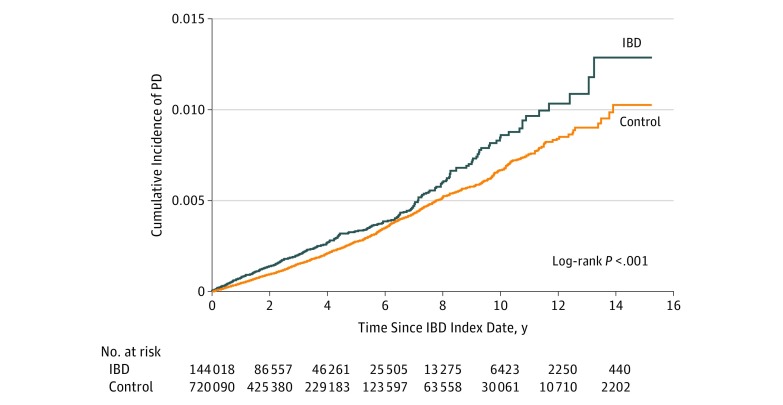
Results: In total, 144 018 individuals with IBD were matched on age, sex, and year of index date with 720 090 unaffected controls. Of them, 1796 individuals had at least 2 PD diagnoses and at least 1 filled PD-related prescription. The mean (SD) age of individuals with IBD was 51 (17) years, and 44% were men. The incidence of PD among patients with IBD was 28% higher than that among unaffected matched controls (adjusted incidence rate ratio, 1.28; 95% CI, 1.14-1.44; P < .001). A 78% reduction in the incidence rate of PD was detected among patients with IBD who were exposed to anti-TNF therapy compared with those who were not exposed (adjusted incidence rate ratio, 0.22; 95% CI, 0.05-0.88; P = .03).
Conclusions and relevance: A higher incidence of PD was observed among patients with IBD than among individuals without IBD. Early exposure to antiinflammatory anti-TNF therapy was associated with substantially reduced PD incidence. These findings support a role of systemic inflammation in the pathogenesis of both diseases. Further studies are required to determine whether anti-TNF treatment administered to high-risk individuals may mitigate PD risk.
Conflict of interest statement
Figures
Comment in
-
Discovering New Benefits From Old Drugs With Big Data-Promise for Parkinson Disease.JAMA Neurol. 2018 Aug 1;75(8):917-920. doi: 10.1001/jamaneurol.2018.0345. JAMA Neurol. 2018. PMID: 29710184 No abstract available.
References
Publication types
MeSH terms
Substances
Grants and funding
LinkOut - more resources
Full Text Sources
Other Literature Sources
Medical