. 2018 Apr 28;18(5):1372.
doi: 10.3390/s18051372.

Integration of 24 Feature Types to Accurately Detect and Predict Seizures Using Scalp EEG Signals

Affiliations

Integration of 24 Feature Types to Accurately Detect and Predict Seizures Using Scalp EEG Signals

Yinda Zhang et al. Sensors (Basel). .

Abstract

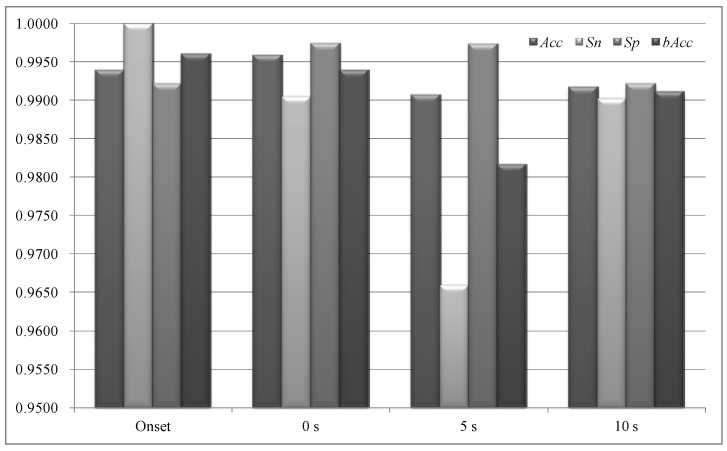
The neurological disorder epilepsy causes substantial problems to the patients with uncontrolled seizures or even sudden deaths. Accurate detection and prediction of epileptic seizures will significantly improve the life quality of epileptic patients. Various feature extraction algorithms were proposed to describe the EEG signals in frequency or time domains. Both invasive intracranial and non-invasive scalp EEG signals have been screened for the epileptic seizure patterns. This study extracted a comprehensive list of 24 feature types from the scalp EEG signals and found 170 out of the 2794 features for an accurate classification of epileptic seizures. An accuracy (Acc) of 99.40% was optimized for detecting epileptic seizures from the scalp EEG signals. A balanced accuracy (bAcc) was calculated as the average of sensitivity and specificity and our seizure detection model achieved 99.61% in bAcc. The same experimental procedure was applied to predict epileptic seizures in advance, and the model achieved Acc = 99.17% for predicting epileptic seizures 10 s before happening.

Keywords: EEG; SVM; classification; epilepsy; feature engineering; feature selection; seizure detection; seizure prediction.


Conflict of interest statement

The authors declare no conflict of interest.

Figures
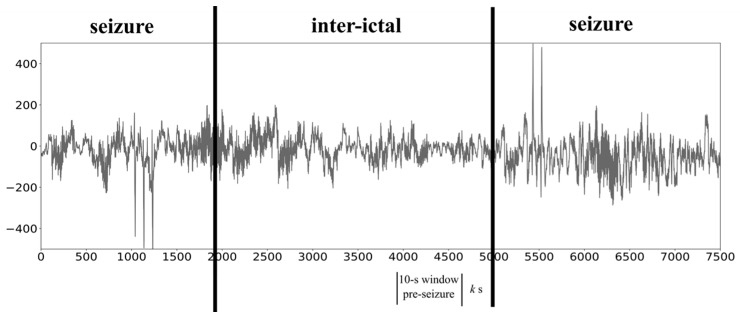
Figure 1
Figure 1
Definitions of seizure samples, inter-ictal samples and pre-seizure samples. This exemplified EEG signal has two seizure onset windows and the inter-ictal window in between.
Figure 2
Figure 2
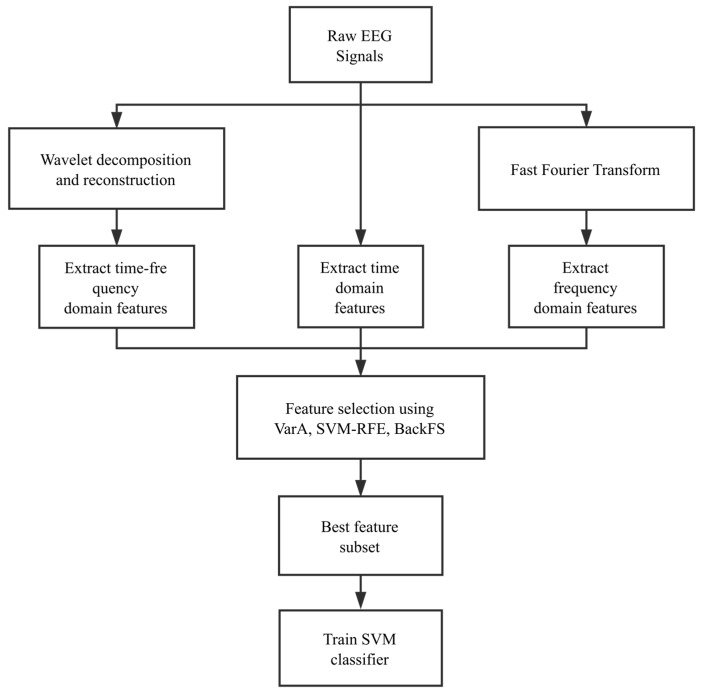
Outline of the experimental procedure. The modules may be roughly grouped as three steps, i.e., feature engineering, feature selection and classification optimization.
Figure 3
Figure 3
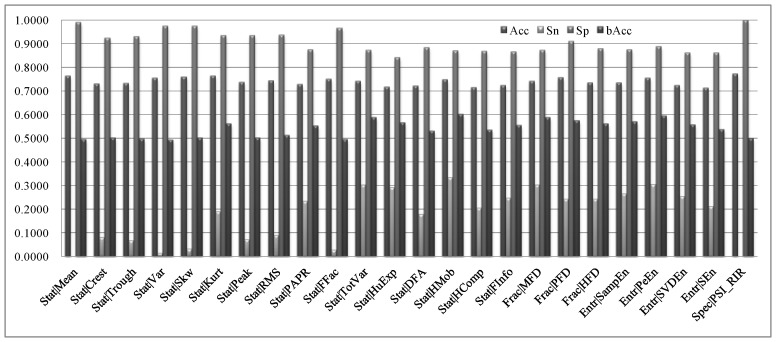
Binary classification performances of each of the 24 feature types. Names of the feature types were defined in the Table 2, and the prefix “Stat|”, “Frac|”, “Entr|” and “Spec” represent the feature families Statistical, Fractal, Entropy and Spectral, respectively.
Figure 4
Figure 4
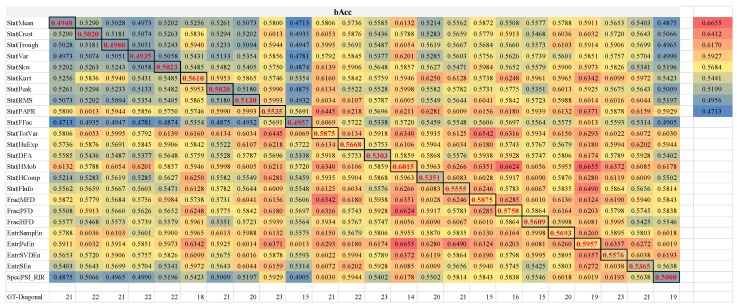
Performance measurement bAcc of the pairwise feature types. The heatmap was colored from blue (minimal bAcc = 0.4713) to red (maximal bAcc = 0.6655). The diagonal grids with red font and black box are pairs of the same feature types, e.g., the top left box gives the bAcc = 0.4948 of a pair of feature types (Stat|Mean, Stat|Mean). The columns and rows are in the same orders of all the 24 feature types. The row “GT-Diagnal” gives the numbers of pairwise orchestrations of feature types that achieved better bAcc than the diagonal grids.
Figure 5
Figure 5
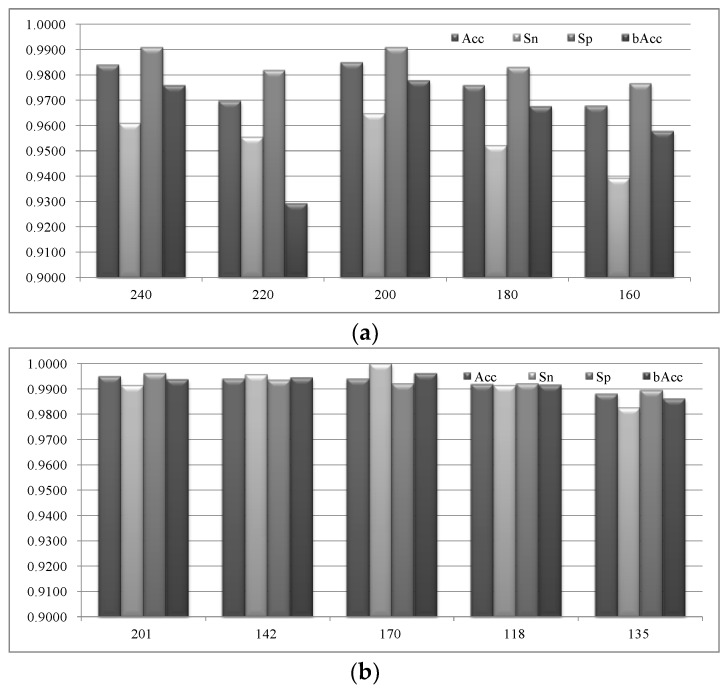
The classification performances of the linear-kernel SVM classifier with different feature numbers. (a) The horizontal axis is the number of features (parameter pNumF), while the vertical axis is the classification performance value of the four measurements Acc/Sn/Sp/bAcc. (b) The feature subset was further filtered by the module BackFS to remove inter-feature redundancies.
Figure 6
Figure 6
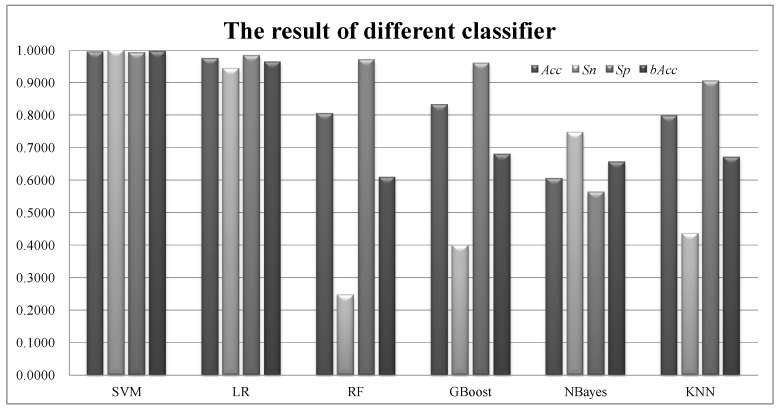
Binary classification performances of different classifiers on detection epileptic seizures using the 22-channel EEG signals. All the classifiers were provided in Python with the default parameters.
Figure 7
Figure 7
Predicting epileptic seizures before their onsets. The binary classification performances were evaluated using Acc, Sn, Sp and bAcc.

References

    1. Mormann F., Andrzejak R.G. Seizure prediction: Making mileage on the long and winding road. Pt 6Brain. 2016;139:1625–1627. doi: 10.1093/brain/aww091. - DOI - PubMed
    1. Zandi A.S., Javidan M., Dumont G.A., Tafreshi R. Automated real-time epileptic seizure detection in scalp EEG recordings using an algorithm based on wavelet packet transform. IEEE Trans. Bio-Med. Eng. 2010;57:1639–1651. doi: 10.1109/TBME.2010.2046417. - DOI - PubMed
    1. Halatchev V.N. Epidemiology of epilepsy—Recent achievements and future. Folia Med. (Plovdiv) 2000;42:17–22. - PubMed
    1. Senanayake N., Roman G.C. Epidemiology of epilepsy in developing countries. Bull. World Health Organ. 1993;71:247–258. - PMC - PubMed
    1. Sakauchi M., Oguni H., Kato I., Osawa M., Hirose S., Kaneko S., Takahashi Y., Takayama R., Fujiwara T. Retrospective multiinstitutional study of the prevalence of early death in Dravet syndrome. Epilepsia. 2011;52:1144–1149. doi: 10.1111/j.1528-1167.2011.03053.x. - DOI - PubMed

LinkOut - more resources