. 2018 Apr 29;23(5):1042.
doi: 10.3390/molecules23051042.

Antidiabetic Effect of Cyclocarya paliurus Leaves Depends on the Contents of Antihyperglycemic Flavonoids and Antihyperlipidemic Triterpenoids

Affiliations

Antidiabetic Effect of Cyclocarya paliurus Leaves Depends on the Contents of Antihyperglycemic Flavonoids and Antihyperlipidemic Triterpenoids

Yang Liu et al. Molecules. .

Abstract

Cyclocarya paliurus has been used commonly to treat diabetes in China. However, the effective components and the effect of plant origin remain unclear. In this study, C. paliurus leaves with different chemical compositions were selected from five geographical locations, and their effects on streptozotocin (STZ)-induced diabetic mice were evaluated with both ethanol and aqueous extracts. Glucose levels, lipid levels, and biomarkers of liver and kidney function were measured. The principal components of both C. paliurus ethanol and aqueous extracts from different geographical locations differed quantitatively and qualitatively. Results showed that C. paliurus extracts with better antihyperglycemic effects were characterized by higher contents of total flavonoids, especially quercetin-3-O-glucuronide and kaempferol-3-O-glucuronide. Furthermore, significantly negative correlations were found between triterpenoids contents and lipid levels. These results revealed the potential antihyperglycemic capacity of C. paliurus flavonoids and the antihyperlipidemic effect of C. paliurus triterpenoids. Thus, we suggest that the composition of C. paliurus compounds might help to design therapeutic alternatives for the treatment of diabetes mellitus. However, geographic origins and the extraction solvents can also affect the effectiveness of the treatment as these factors influence the chemical compositions and thereby the biological activities.

Keywords: Cyclocarya paliurus; diabetes; extraction solvents; flavonoids; geographical locations; triterpenoids.


Conflict of interest statement

The authors declare that there are no conflicts of interest.

Figures
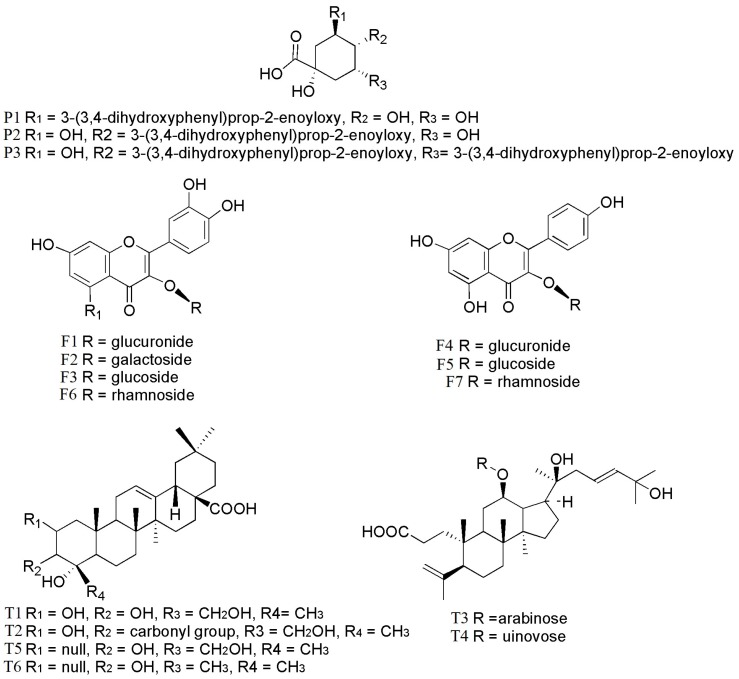
Figure 1
Figure 1
Chemical structures of identified compounds in extracts of C. paliurus: P1: 3-O-caffeoylquinic acid; P2: 4-O-caffeoylquinic acid; P3: 4,5-di-O-caffeoylquinic acid; F1: quercetin-3-O-glucuronide; F2: quercetin-3-O-galactoside; F3: isoquercitrin; F4: kaempferol-3-O-glucuronide; F5: kaempferol-3-O-glucoside; F6: quercetin-3-O-rhamnoside; F7: kaempferol-3-O-rhamnoside; T1: arjunolic acid; T2: cyclocaric acid B; T3: pterocaryoside B; T4: pterocaryoside A; T5: hederagenin; T6: oleanolic acid.
Figure 2
Figure 2
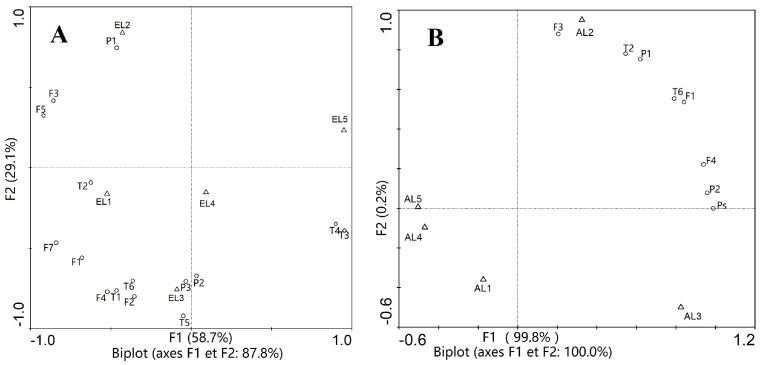
Biplots of Principal Component Analysis (PCA) of ethanol (A) and aqueous (B) extracts of C. paliurus from different locations. L1: Jinzhongshan; L2: Muchuan; L3: Wufeng; L4: Anji; L5: Suining. P1: 3-O-caffeoylquinic acid; P2: 4-O-caffeoylquinic acid; P3: 4,5-di-O-caffeoylquinic acid; F1: quercetin-3-O-glucuronide; F2: quercetin-3-O-galactoside; F3: isoquercitrin; F4: kaempferol-3-O-glucuronide; F5: kaempferol-3-O-glucoside; F7: kaempferol-3-O-rhamnoside; T1: arjunolic acid; T2: cyclocaric acid B; T3: pterocaryoside B; T4: pterocaryoside A; T5: hederagenin; T6: oleanolic acid; Ps: polysaccharides.
Figure 3
Figure 3
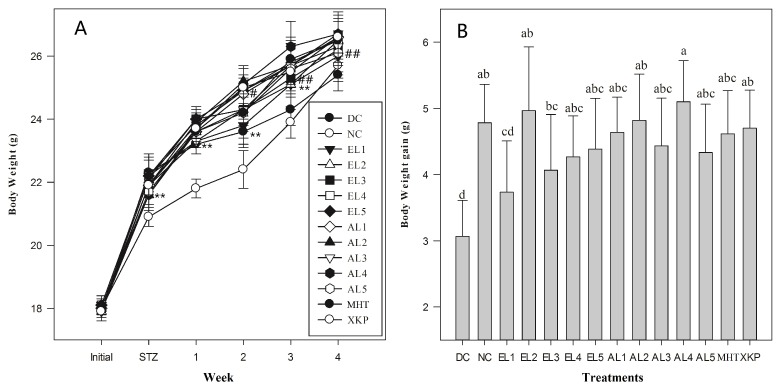
(A) Changes in body weight of different groups (n = 6). (B) Body weight gain. DC: diabetic control group; NC: normal control group; EL1-EL5: STZ-induced diabetic mice treated with ethanol extracts from different locations; AL1-AL5: STZ-induced diabetic mice treated with aqueous extracts from different locations; MHT, XKP: positive controls, STZ-induced diabetic mice treated with Metformin Hydrochloride Tablets (MHT) and Xiaoke Pill (XKP), respectively. Values with different letters significantly differ at p < 0.05 by Duncan’s test. # p < 0.05 and ## p < 0.01 significance against the normal control group (NC). **p < 0.01 significance against the model control group (DC).
Figure 4
Figure 4
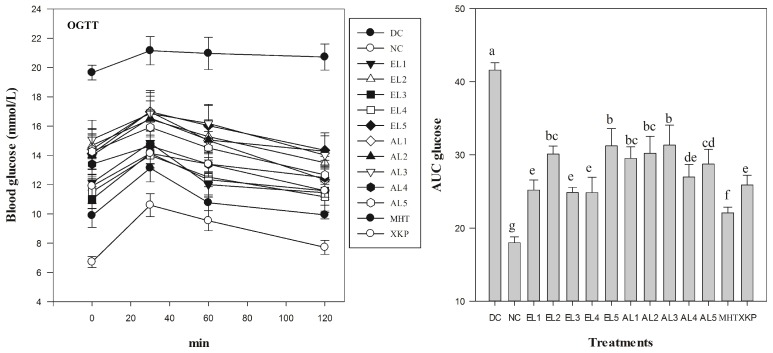
Levels of blood glucose in STZ-induced diabetic mice as revealed by oral glucose tolerance tests (OGTT) (n = 6). AUC glucose: area under the curve for glucose levels. DC: diabetic control group; NC: normal control group; EL1-EL5: STZ-induced diabetic mice treated with ethanol extracts from different locations; AL1-AL5: STZ-induced diabetic mice treated with aqueous extracts from different locations; MHT, XKP: positive controls, STZ-induced diabetic mice treated with Metformin Hydrochloride Tablets (MHT) and Xiaoke Pill (XKP), respectively. Values with different letters significantly differ at p < 0.05 by Duncan’s test.
Figure 5
Figure 5
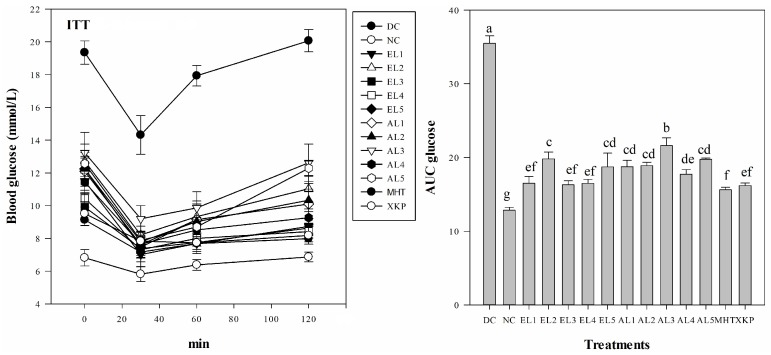
Levels of blood glucose in STZ-induced diabetic mice as revealed by insulin tolerance test (ITT) (n = 6). AUC glucose: area under the curve for glucose levels. DC: diabetic control group; NC: normal control group; EL1-EL5: STZ-induced diabetic mice treated with ethanol extracts from different locations; AL1-AL5: STZ-induced diabetic mice treated with aqueous extracts from different locations; MHT, XKP: positive controls, STZ-induced diabetic mice treated with Metformin Hydrochloride Tablets (MHT) and Xiaoke Pill (XKP), respectively. Values with different letters significantly differ at p < 0.05 by Duncan’s test.
Figure 6
Figure 6
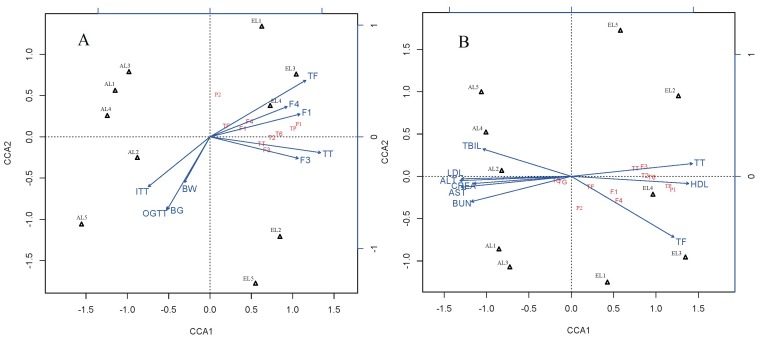
Biplots of Canonical Correspondence Analysis (CCA) of C. paliurus extracts. CCA were done based on matrix linking contents of the major components, geographical locations and their antihyperglycemic (A), antihyperlipidemic (B) activities in STZ-induced diabetic mice. BW, Body weight gain; BG, Final blood glucose level in fasting blood glucose test; OGTT, Oral glucose tolerance test; ITT, Insulin tolerance test; TG, Triglyceride; TC, Total cholesterol; LDL-c, Low density lipoprotein cholesterol; HDL-c, High-density lipoprotein cholesterol; BUN, Blood urea nitrogen; CREA, Creatinine; TBIL, Total bilirubin; AST, Aspartate aminotransferase; ALT, Alanine aminotransferase.

References

    1. Jia W., Gao W., Tang L. Antidiabetic herbal drugs officially approved in China. Phytother. Res. 2003;17:1127–1134. doi: 10.1002/ptr.1398. - DOI - PubMed
    1. Ahmad Aufa Z., Hassan F.A., Ismail A., Mohd Yusof B.N., Hamid M. Chemical compositions and antioxidative and antidiabetic properties of underutilized vegetable palm hearts from Plectocomiopsis geminiflora and Eugeissona insignis. J. Agric. Food Chem. 2014;62:2077–2084. doi: 10.1021/jf403481p. - DOI - PubMed
    1. Jung M., Park M., Lee H.C., Kang Y.H., Kang E.S., Kim S.K. Antidiabetic agents from medicinal plants. Curr. Med. Chem. 2006;13:1203–1218. doi: 10.2174/092986706776360860. - DOI - PubMed
    1. Dehghan-Kooshkghazi M., Mathers J.C. Starch digestion, large-bowel fermentation and intestinal mucosal cell proliferation in rats treated with the α-glucosidase inhibitor acarbose. Br. J. Nutr. 2004;91:357–365. doi: 10.1079/BJN20031063. - DOI - PubMed
    1. Umeno A., Horie M., Murotomi K., Nakajima Y., Yoshida Y. Antioxidative and antidiabetic effects of natural polyphenols and isoflavones. Molecules. 2016;21:708. doi: 10.3390/molecules21060708. - DOI - PMC - PubMed

MeSH terms

LinkOut - more resources